
East Central Europe (820 – 963 CE): …
Years: 820 - 963
East Central Europe (820 – 963 CE): Carolingian Frontiers, Great Moravia, and the Magyar Ingress
Geographic and Environmental Context
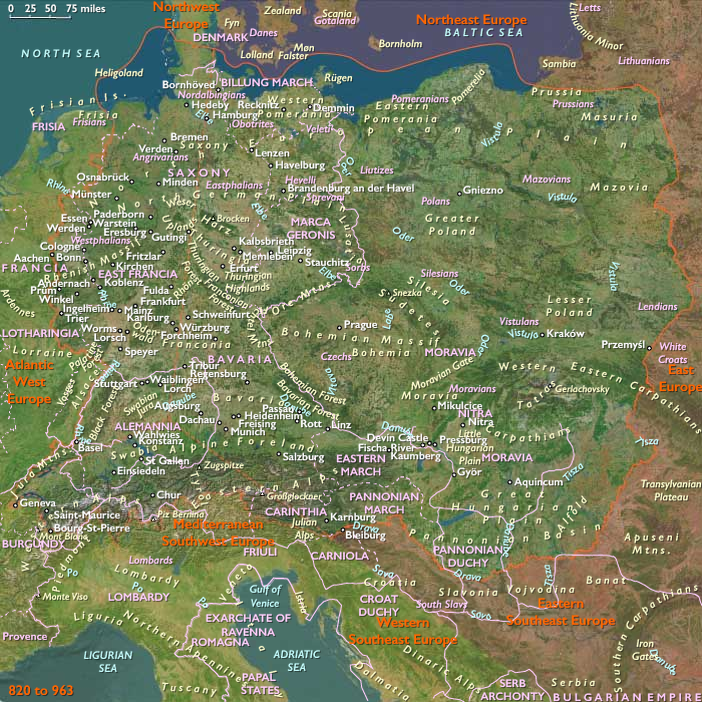
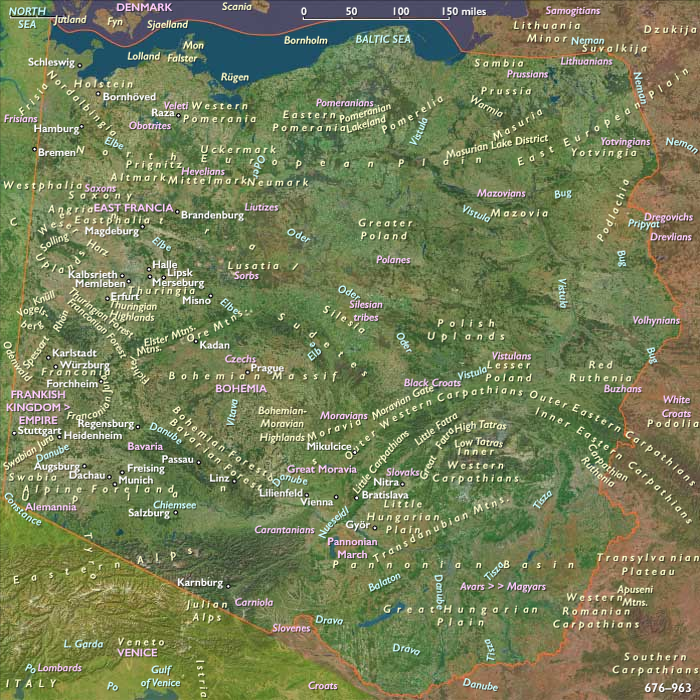
East Central Europe includes Poland, Czechia (Bohemia and Moravia), Slovakia, Hungary (the Carpathian Basin), northeastern Austria, and the greater part of Germany (including Berlin, Munich, Hamburg).
-
The region stretches from the Baltic lowlands of Poland and Germany to the Danube basin of Austria, Slovakia, and Hungary, bounded by the Carpathians and the Bohemian Massif.
-
Key arteries: the Elbe, Oder, and Vistula rivers northward, and the Danube–Morava corridor southward, connecting central Germany to the Pannonian Plain.
Climate and Environmental Shifts
-
A cool–temperate regime with seasonal rainfall.
-
By the mid-10th century the onset of the Medieval Warm Period (c. 950) slightly lengthened growing seasons, aiding cereal expansion on the loess soils of Poland, Moravia, and Bavaria, and improving pastures in the Carpathian Basin.
-
Flood pulses on the Elbe, Oder, and Danube structured transport and settlement.
Societies and Political Developments
-
Carolingian Legacy and Ottonians (Germany, Austria):
-
After the division of the Carolingian Empire, East Francia evolved into the Kingdom of Germany, with Saxony, Franconia, Bavaria, and Swabia as key stem duchies.
-
Henry the Fowler (919–936) and Otto I (r. 936–973) consolidated power, extending marches eastward against Slavic tribes. Otto’s reforms laid the basis for the Holy Roman Empire.
-
-
Great Moravia (833–c. 906):
-
Spanning Moravia, western Slovakia, and parts of Bohemia and Hungary, Great Moravia under Svatopluk I (870–894) was the strongest Slavic polity.
-
Missionaries Cyril and Methodius (863) introduced Slavonic liturgy and the Glagolitic script, rooting Christianity in local languages.
-
Collapse followed Magyar raids and Frankish pressure after 894.
-
-
Magyars (Hungary/Carpathian Basin):
-
Entered c. 895–907 under Árpád, occupying the Pannonian Plain.
-
At the Battle of Pressburg (907), Magyars defeated East Frankish and Bavarian armies, securing dominance over Hungary.
-
Throughout the 10th century, Magyar cavalry raided Bavaria, Saxony, Italy, and even France before being checked later at Lechfeld (955).
-
-
Bohemia (Czech lands):
-
The Přemyslid dynasty emerged in Prague, balancing between Frankish/German suzerainty and Moravian precedents.
-
Duke Wenceslas (r. c. 921–935) promoted Christianity and tribute ties with Saxony; murdered by his brother Boleslaus I, who expanded Bohemian power.
-
-
Poland:
-
Slavic tribes (Polans, Vistulans, Pomeranians) built fortified strongholds (grody).
-
By c. 960, Mieszko I of the Piasts began unifying the Polans and surrounding tribes, setting foundations for Poland’s baptism in 966 (just after this age).
-
Economy and Trade
-
Agriculture: rye, barley, oats, millet, and wheat grown in river valleys and loess uplands; cattle and swine in forest zones; viticulture in Moravia and Bavaria.
-
Crafts & resources: salt from Kraków and alpine mines, amber from the Baltic, iron smelting in Thuringia and Silesia.
-
Trade routes:
-
Elbe and Oder connected Saxony and Poland to the Baltic;
-
Vistula linked Poland to Prussia and Rus’;
-
Danube funneled Bavarian, Moravian, and Magyar exchanges into the Adriatic and Balkans.
-
-
Monetary flows: Islamic silver dirhams reached Poland and Germany via Rus’ and Volga Bulgar routes; Ottonian denarii spread from Saxony and Bavaria into Bohemia and Moravia.
Subsistence and Technology
-
Heavy plow (carruca) spread gradually into loess zones, expanding arable land.
-
Horse and ox traction supported deeper plowing and transport.
-
Fortified grody and hillforts dominated tribal centers, built of timber–earth ramparts.
-
River craft: planked boats and dugouts moved salt, grain, and amber; sledges carried goods across frozen rivers in winter.
-
Military technology: Magyar steppe cavalry (stirrups, composite bows) outmatched early Frankish infantry, reshaping frontier defense.
Movement and Interaction Corridors
-
Elbe–Saale frontier: the line of Ottonian marches facing Polabian Slavs.
-
Morava–Danube route: conduit for Christianity and Frankish influence into Moravia and Hungary.
-
Carpathian passes: vectors for Magyar migrations and later raids into Bavaria and Italy.
-
Oder–Vistula–Baltic corridors: facilitated fur, amber, and slave trades northward.
Belief and Symbolism
-
Christianization:
-
Great Moravia pioneered Slavic liturgy; after its fall, Bohemia and Poland increasingly looked to Latin-rite Christianity from Saxony and Bavaria.
-
Ottonian Germany deepened monastic and episcopal structures, founding bishoprics in Magdeburg and Brandenburg.
-
-
Pagan traditions: Slavic polytheism (Perun, Veles, Svantovit) endured among Poles and Pomeranians; Magyars maintained Tengrist and shamanic cults.
-
Burial customs reveal hybrid practices: cremation persisted in pagan zones, while Christian inhumation advanced in Moravia, Bohemia, and Saxony.
Adaptation and Resilience
-
Military adaptation: Ottonians forged armored cavalry retinues to counter Magyars, culminating in victory at Lechfeld (955), securing East Francia and Bavaria.
-
Agricultural resilience: mixed cropping (rye + millet) and stock herding buffered climate variability; river valleys stabilized surpluses.
-
Political flexibility: polities used tribute, alliances, and intermarriage (e.g., Přemyslids with Ottonians; Piasts with German nobles) to survive between stronger powers.
Long-Term Significance
By 963 CE, East Central Europe was a crucible of state formation and frontier contest:
-
Otto I’s consolidation stabilized the German kingdom and checked the Magyars.
-
Great Moravia had dissolved, but its Christian–Slavic legacy lived on.
-
Magyars controlled the Carpathian Basin, staging raids while adapting to a settled frontier.
-
Bohemia and the Piast realm in Poland were crystallizing into durable dynasties.
This period forged the Christian–pagan, steppe–agrarian frontier dynamics that would define the region until its full integration into Christendom in the following age.
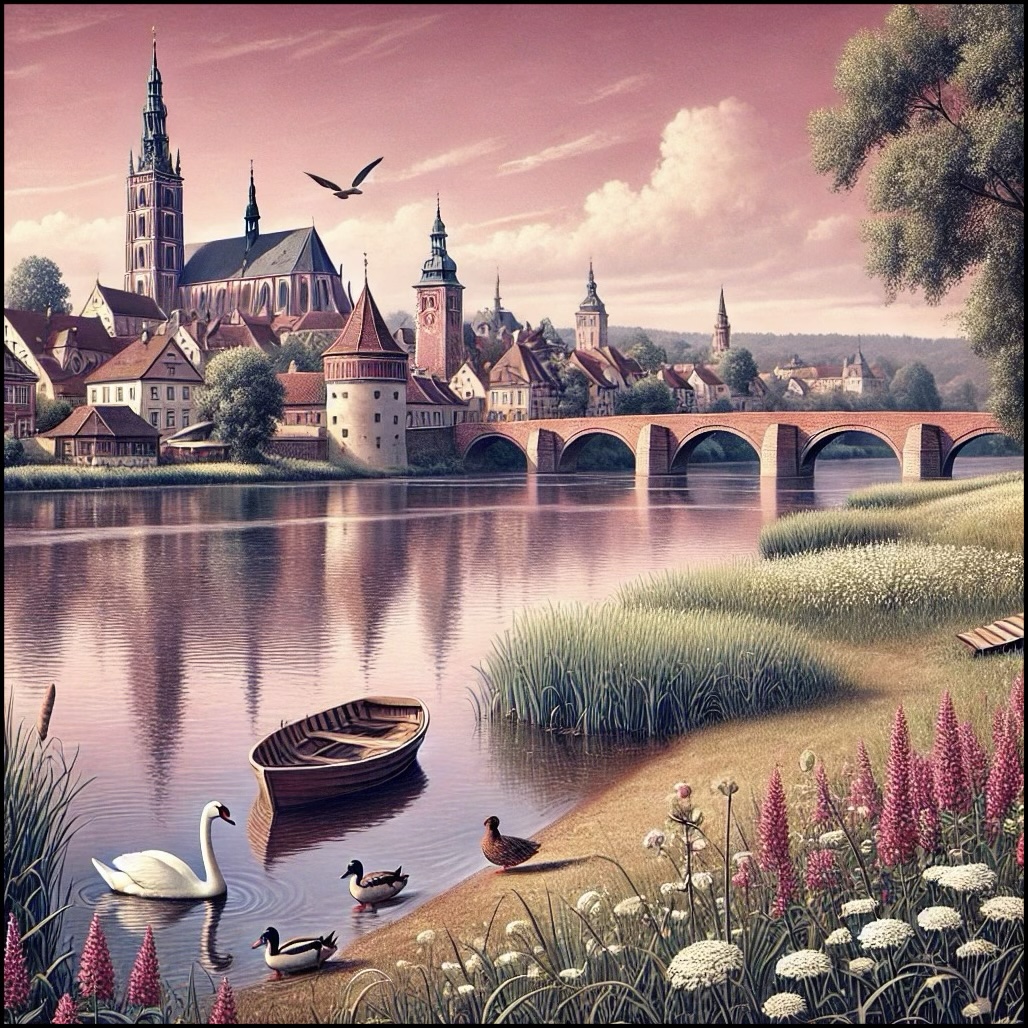
East Central Europe (with civilization) ©2024-25 Electric Prism, Inc. All rights reserved.
People
- Boleslaus I the Cruel
- Henry the Fowler
- Mieszko I
- Otto I
- Saints Cyril and Methodius
- Svatopluk I
- Wenceslaus I
- Árpád
Groups
- Franks
- Germans
- Hungarian people
- Polabian Slavs (West Slavs)
- Slavs, West
- Christianity, Chalcedonian
- Polans, Western (West Slavic tribe)
- Thuringia, Duchy of
- Francia (Carolingians)
- Bavaria, Carolingian Duchy of
- Nitra, Principality of
- Saxony, Duchy of
- Roman Empire, Eastern: Non-dynastic
- Roman Empire, Eastern: Phrygian or Armorian dynasty
- Hungarians, Realm of the (Etelköz)
- Moravia, Great, Kingdom of
- Francia Orientalis (East Francia), Kingdom of
- Roman Empire, Eastern: Macedonian dynasty
- Bohemia, Duchy of
- Hungary, Principality of
- Franconia, Duchy of
- Bavaria, Luitpolding Duchy of
- Swabia, Duchy of
- Bavaria, Ottonian Duchy of
- Rawadid dynasty
- Holy Roman Empire
- German, or Ottonian (Roman) Empire
- Germany, Kingdom of (within the Holy Roman Empire)
- Poland, Principality of
Topics
- Roman Age Optimum
- Renaissance, Carolingian
- Frankish-Avarian War of 791-96
- Hungarian invasions of Europe
- Hungarian conquest of the Carpathian Basin
- Pressburg, Battle of
- Medieval Warm Period (MWP) or Medieval Climate Optimum
- Lechfeld, Battle of
Commodoties
- Weapons
- Hides and feathers
- Gem materials
- Domestic animals
- Grains and produce
- Textiles
- Ceramics
- Strategic metals
- Salt
- Money
Subjects
- Commerce
- Symbols
- Watercraft
- Environment
- Decorative arts
- Conflict
- Mayhem
- Faith
- Government
- Custom and Law
- Metallurgy
Regions
Subregions
Related Events
Showing 10 events out of 65 total
Years: 820 - 963
East Central Europe (with civilization) ©2024-25 Electric Prism, Inc. All rights reserved.
People
- Boleslaus I the Cruel
- Henry the Fowler
- Mieszko I
- Otto I
- Saints Cyril and Methodius
- Svatopluk I
- Wenceslaus I
- Árpád
Groups
- Franks
- Germans
- Hungarian people
- Polabian Slavs (West Slavs)
- Slavs, West
- Christianity, Chalcedonian
- Polans, Western (West Slavic tribe)
- Thuringia, Duchy of
- Francia (Carolingians)
- Bavaria, Carolingian Duchy of
- Nitra, Principality of
- Saxony, Duchy of
- Roman Empire, Eastern: Non-dynastic
- Roman Empire, Eastern: Phrygian or Armorian dynasty
- Hungarians, Realm of the (Etelköz)
- Moravia, Great, Kingdom of
- Francia Orientalis (East Francia), Kingdom of
- Roman Empire, Eastern: Macedonian dynasty
- Bohemia, Duchy of
- Hungary, Principality of
- Franconia, Duchy of
- Bavaria, Luitpolding Duchy of
- Swabia, Duchy of
- Bavaria, Ottonian Duchy of
- Rawadid dynasty
- Holy Roman Empire
- German, or Ottonian (Roman) Empire
- Germany, Kingdom of (within the Holy Roman Empire)
- Poland, Principality of
Topics
- Roman Age Optimum
- Renaissance, Carolingian
- Frankish-Avarian War of 791-96
- Hungarian invasions of Europe
- Hungarian conquest of the Carpathian Basin
- Pressburg, Battle of
- Medieval Warm Period (MWP) or Medieval Climate Optimum
- Lechfeld, Battle of
Commodoties
- Weapons
- Hides and feathers
- Gem materials
- Domestic animals
- Grains and produce
- Textiles
- Ceramics
- Strategic metals
- Salt
- Money
Subjects
- Commerce
- Symbols
- Watercraft
- Environment
- Decorative arts
- Conflict
- Mayhem
- Faith
- Government
- Custom and Law
- Metallurgy
Regions
Subregions