
East Central Europe (664–675 CE): Continued Regional …
Years: 664 - 675
East Central Europe (664–675 CE): Continued Regional Fragmentation, Emergence of Proto-States, and Avar Reconsolidation
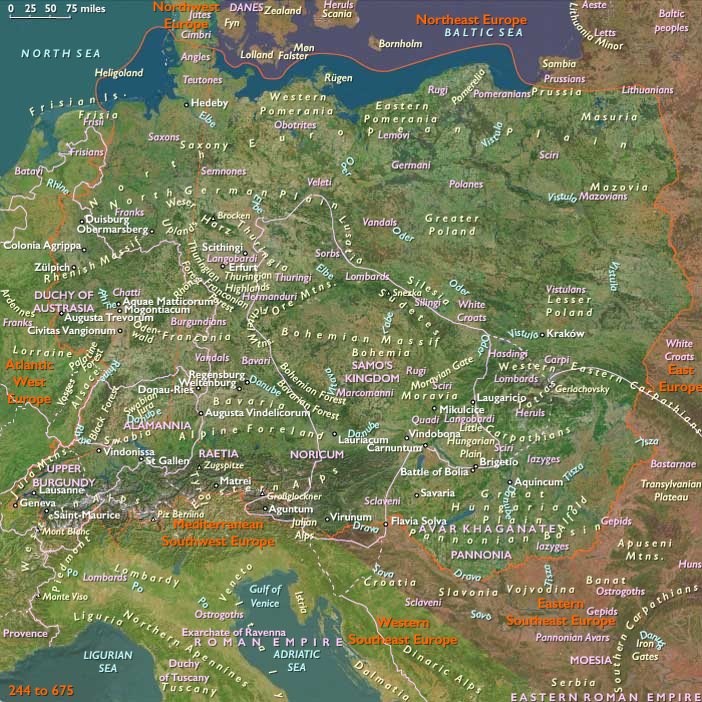
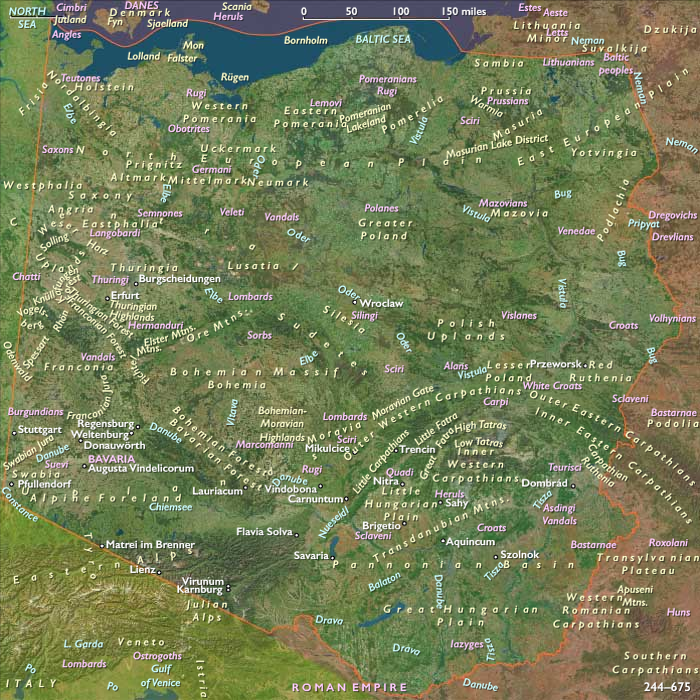
Between 664 and 675 CE, East Central Europe—encompassing Poland, Czechia, Slovakia, Hungary, and those portions of Germany and Austria lying east of 10°E and north of a line stretching from roughly 48.2°N at 10°E southeastward to the Austro-Slovenian border near 46.7°N, 15.4°E—continued to witness profound political and cultural transformations resulting from the collapse of earlier federations. Following the dissolution of Samo’s Kingdom and the fragmentation of Old Great Bulgaria, smaller, decentralized tribal polities began solidifying into early proto-states in Bohemia and Moravia. Concurrently, the Avars sought to recover some lost influence by carefully re-consolidating their authority within a more limited area of the Carpathian Basin. In Thuringia, sustained autonomy under Radulf’s successors highlighted persistent Merovingian royal weakness, demonstrating the continued transition toward powerful regional aristocracies.
Political and Military Developments
Emergence of Early Proto-States in Bohemia and Moravia
-
Following the earlier collapse of Samo’s unified Slavic federation, distinct regional tribal leaders in Bohemia and Moravia increasingly solidified their power, laying the foundations for the future principalities of the Czechs and the Moravians.
-
These early proto-states developed stronger localized political and military institutions, effectively maintaining autonomy against weakened external powers.
Ongoing Fragmentation and Migration of the Bulgars
-
After Old Great Bulgaria’s collapse, multiple Turkic-speaking Bulgar groups continued migrating, especially into southeastern Europe. The most significant group, led by Asparuh, moved south across the Danube into the Balkans during this period, where they would eventually establish a long-lasting Bulgarian state in subsequent decades, becoming heavily Slavicized over time.
Thuringian Autonomy Under Radulf’s Successors
-
Thuringia continued enjoying practical independence from weakened Frankish kings, who failed repeatedly to reassert central authority. After Radulf’s death (mid-7th century), Thuringian dukes retained substantial autonomy, highlighting Merovingian royal impotence during the continuing era of rois fainéants.
Avar Reconsolidation Efforts
-
The Avar Khaganate, diminished by earlier upheavals, engaged in cautious reconsolidation, reasserting political control and re-stabilizing authority within a reduced Carpathian Basin territory.
Economic and Technological Developments
Sustained Regional Trade and Economic Integration
-
Economic integration persisted despite political fragmentation, with continued robust trading relationships among Bavarian, Thuringian, Avar, proto-state Slavic, Frankish, and Byzantine territories. Goods included agricultural produce, ironware, luxury textiles, and crafted products.
Fortification and Defensive Innovations
-
Growing regional stability and consolidation of localized political entities fostered continued fortification development, including fortified settlements, earthworks, and hillforts designed to secure emerging proto-states from external threats.
Cultural and Artistic Developments
Development of Distinct Regional Slavic Identities
-
Bohemia and Moravia increasingly developed separate cultural identities reflected archaeologically through distinct ceramics, jewelry, settlement designs, and burial practices, laying clear foundations for medieval regional identities.
Bulgar Cultural Transformation and Slavicization
-
The southward migration of Bulgar groups into the Balkans initiated their gradual cultural transformation, eventually resulting in their linguistic and cultural assimilation into predominantly Slavic populations.
Persistent Avar Cultural Legacy
-
Avar influence persisted strongly across the region, notably in artistic traditions, metalwork, weaponry, and decorative artifacts, continuing to shape cultural interactions with neighboring Slavic and Bavarian peoples.
Settlement and Urban Development
Growth of Proto-State Settlements in Bohemia and Moravia
-
Fortified settlements grew notably in Bohemia and Moravia, reflecting enhanced political stability, economic productivity, and nascent proto-state structures.
Stability of Bavarian and Thuringian Urban Centers
-
Bavarian settlements, notably Regensburg, and Thuringian communities continued benefiting from economic prosperity and reduced military threats, supporting sustained population growth and urban development.
Social and Religious Developments
Emergence of Stable Regional Leadership Hierarchies
-
Bohemian and Moravian societies developed increasingly stable hierarchical leadership, solidifying proto-state formations led by influential warrior elites capable of diplomatic and military coordination.
Thuringian Aristocratic Consolidation
-
Thuringia maintained stable aristocratic governance structures under Radulf’s successors, reinforcing local power structures at the expense of Merovingian royal authority.
Continuation of Avar Social Structures
-
Within their reduced territory, Avar societal and military hierarchy persisted strongly, enabling continued internal cohesion and external diplomatic engagement.
Long-Term Consequences and Historical Significance
The era 664–675 CE represented ongoing regional transformation in East Central Europe, characterized by the rise of early proto-state political structures in Bohemia and Moravia, the continued migrations and cultural transformation of Bulgar groups, and sustained Thuringian autonomy under weakened Merovingian royal authority. Concurrent Avar reconsolidation efforts provided stability within their remaining territories, ensuring continued cultural influence. Collectively, these developments set foundational patterns shaping future medieval political entities, cultural identities, and historical trajectories within East Central Europe.
People
Groups
- Polytheism (“paganism”)
- Franks
- Germans
- Bulgars
- Wends, or Sorbs (West Slavs)
- Christianity, Chalcedonian
- Avars, Eurasian
- Bavaria, Agilolfing Duchy of
- Avar Khaganate (Eurasian Avars)
- Roman Empire, Eastern: Heraclian dynasty
- Thuringia, Duchy of
- Thuringia, (Frankish) Duchy of
- Bulgaria, “the Old Great “, (Onogur) Khaganate of
- Bulgar Principalities
- Volga Bulgaria, or Volga-Kama Bulgaria
Topics
Commodoties
Subjects
Regions
Subregions
Years: 664 - 675
People
Groups
- Polytheism (“paganism”)
- Franks
- Germans
- Bulgars
- Wends, or Sorbs (West Slavs)
- Christianity, Chalcedonian
- Avars, Eurasian
- Bavaria, Agilolfing Duchy of
- Avar Khaganate (Eurasian Avars)
- Roman Empire, Eastern: Heraclian dynasty
- Thuringia, Duchy of
- Thuringia, (Frankish) Duchy of
- Bulgaria, “the Old Great “, (Onogur) Khaganate of
- Bulgar Principalities
- Volga Bulgaria, or Volga-Kama Bulgaria
Topics
Commodoties
Subjects
Regions
Subregions