
East Central Europe (652–663 CE): Fragmentation after …
Years: 652 - 663
East Central Europe (652–663 CE): Fragmentation after Samo, Dissolution of Old Great Bulgaria, and Continuing Thuringian Autonomy
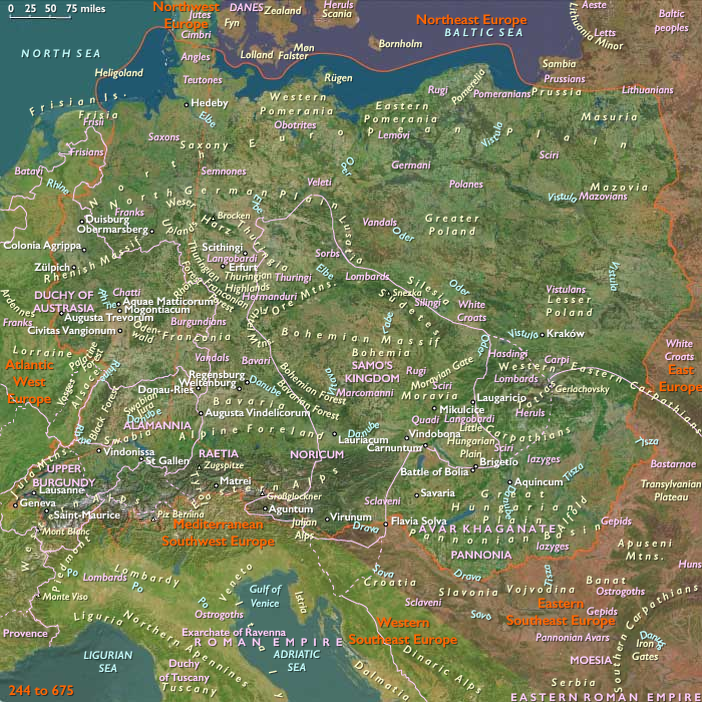
Between 652 and 663 CE, East Central Europe—encompassing Poland, Czechia, Slovakia, Hungary, and those portions of Germany and Austria lying east of 10°E and north of a line stretching from roughly 48.2°N at 10°E southeastward to the Austro-Slovenian border near 46.7°N, 15.4°E—entered a period of fragmentation and realignment. Following King Samo’s death (ca. 658 CE), his unified Slavic federation began to fracture into smaller regional principalities, particularly in Bohemia and Moravia, reshaping the political landscape. Concurrently, Old Great Bulgaria faced internal instability after the death of Khan Kubrat (ca. 650s CE), leading to the dispersal of Bulgar groups. Some Bulgars migrated southward into the Balkans, where they would eventually establish the later Bulgarian state, becoming heavily Slavicized in subsequent centuries. Meanwhile, the Frankish Duchy of Thuringia, under Duke Radulf, continued to assert its practical autonomy from weakened Merovingian rule, further emphasizing the fragmentation of Frankish authority.
Political and Military Developments
Fragmentation of Samo’s Slavic Federation
-
Following Samo’s death (ca. 658 CE), the unified West Slavic federation dissolved into multiple independent or semi-independent tribal entities, particularly in Bohemia, Moravia, and surrounding regions. This political fragmentation allowed localized leadership structures to re-emerge, setting the stage for future distinct medieval Slavic principalities.
Dissolution and Migration of Old Great Bulgaria
-
After Khan Kubrat’s death (mid-650s CE), internal rivalries among his sons fractured Old Great Bulgaria. This led to the dispersal of various Turkic-speaking Bulgar groups:
-
Asparuh’s Bulgars migrated southwestward toward the Danube, laying the foundations for the later medieval Bulgarian state in the Balkans, which became predominantly Slavic in language and culture.
-
Other Bulgar groups migrated northward or eastward, contributing to ongoing regional ethnic shifts in Eastern Europe.
-
Continued Autonomy of Thuringia under Radulf
-
Duke Radulf of Thuringia maintained practical independence from Merovingian kings, who proved increasingly unable to reassert centralized control. This sustained autonomy clearly reflected the Merovingian monarchy’s diminishing power during this era of the rois fainéants.
Avar Re-consolidation Efforts
-
The Avar Khaganate, previously weakened by Bulgar and Slavic uprisings, took advantage of regional fragmentation to modestly reconsolidate and stabilize its reduced territory within the Carpathian Basin.
Economic and Technological Developments
Adaptation and Continuity in Regional Trade
-
Despite political instability, economic exchange and regional trade persisted, linking fragmented Slavic principalities, Thuringia, Bavaria, Avar territories, and Byzantine markets. Trade in agricultural goods, luxury textiles, metal products, and regional crafts continued actively.
Localized Defensive Infrastructure
-
Fragmentation spurred Slavic and Bulgar communities to maintain and further enhance local defensive systems, including fortified settlements and earthwork fortifications, essential to regional security in the absence of centralized authority.
Cultural and Artistic Developments
Emergence of Distinct Slavic Regional Cultures
-
With the dissolution of Samo’s federation, Bohemian and Moravian communities developed distinct localized identities, characterized archaeologically by varied styles in pottery, jewelry, and settlement designs.
Transition of Bulgar Identity
-
Following the collapse of Old Great Bulgaria, the migrating Bulgar groups, particularly those moving into the Balkans, gradually absorbed Slavic influences, initiating a transition toward the predominantly Slavic cultural identity associated with later medieval Bulgaria.
Persistence of Avar Cultural Influence
-
The Avars retained notable influence across the region, particularly through their distinctive styles in metalwork and decorative arts, maintaining continued cultural interactions despite earlier territorial losses.
Settlement and Urban Development
Fragmented Slavic and Bulgar Settlements
-
The dissolution of political unity under Samo and Kubrat’s successors resulted in numerous smaller fortified settlements rather than larger centralized urban centers, reflecting localized governance structures.
Thuringian and Bavarian Urban Stability
-
Thuringia under Radulf and Bavarian territories remained stable and prosperous frontier zones, benefiting from ongoing regional trade and reduced direct military pressures from weakened Merovingian central authority.
Social and Religious Developments
Decentralized Leadership Structures
-
After Samo’s death, decentralized Slavic political leadership emerged prominently across Bohemia, Moravia, and adjacent territories. Leadership became increasingly local and tribal, with limited overarching regional authority.
Thuringian Autonomy and Aristocratic Rule
-
Thuringia under Radulf maintained robust aristocratic governance, further illustrating the diminished practical authority of Merovingian kings, who became symbolic figureheads dependent upon powerful regional dukes.
Long-Term Consequences and Historical Significance
The era 652–663 CE represented a pivotal transitional period marked by political fragmentation and realignment across East Central Europe. The end of Samo’s federation and Old Great Bulgaria reshaped the regional geopolitical landscape, creating smaller, localized entities that would eventually evolve into distinct medieval states. Radulf’s continued autonomy in Thuringia underscored the declining authority of the Merovingian monarchy, providing early evidence of the shift toward powerful local aristocratic rule. These developments set enduring patterns for future ethnic identities, state formations, and cultural trajectories in East Central Europe.
People
Groups
- Polytheism (“paganism”)
- Germans
- Bulgars
- Wends, or Sorbs (West Slavs)
- Christianity, Chalcedonian
- Avars, Eurasian
- Bavarians (West Germanic tribe)
- Bavaria, Agilolfing Duchy of
- Avar Khaganate (Eurasian Avars)
- Roman Empire, Eastern: Heraclian dynasty
- Austrasia, Frankish Kingdom of
- Thuringia, Duchy of
- Samo's Empire
- Bulgaria, “the Old Great “, (Onogur) Khaganate of
- Thuringia, (Frankish) Duchy of
Topics
Commodoties
Subjects
Regions
Subregions

Years: 652 - 663
People
Groups
- Polytheism (“paganism”)
- Germans
- Bulgars
- Wends, or Sorbs (West Slavs)
- Christianity, Chalcedonian
- Avars, Eurasian
- Bavarians (West Germanic tribe)
- Bavaria, Agilolfing Duchy of
- Avar Khaganate (Eurasian Avars)
- Roman Empire, Eastern: Heraclian dynasty
- Austrasia, Frankish Kingdom of
- Thuringia, Duchy of
- Samo's Empire
- Bulgaria, “the Old Great “, (Onogur) Khaganate of
- Thuringia, (Frankish) Duchy of
Topics
Commodoties
Subjects
Regions
Subregions