
East Central Europe (640–651 CE): Samo’s Consolidation, …
Years: 640 - 651
East Central Europe (640–651 CE): Samo’s Consolidation, Kubrat’s Bulgar Stability, and Radulf’s Thuringian Revolt
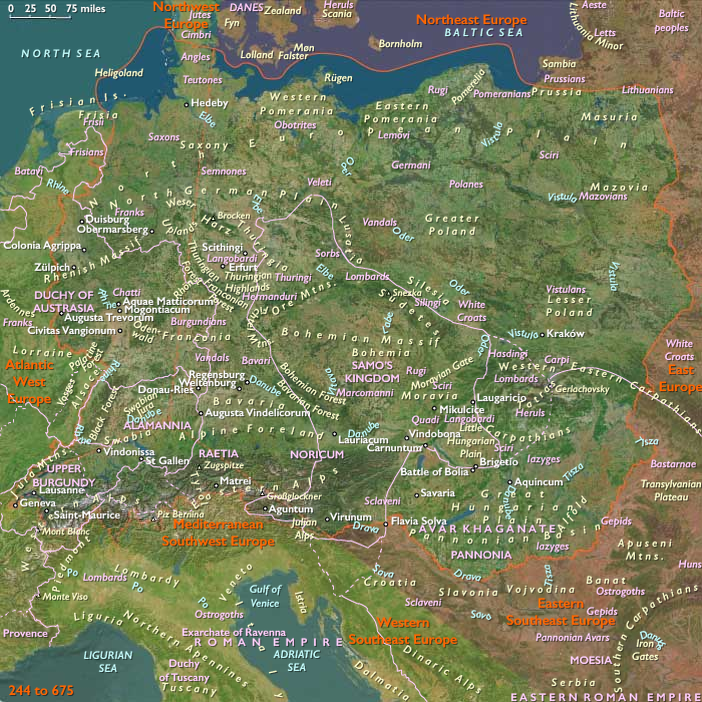
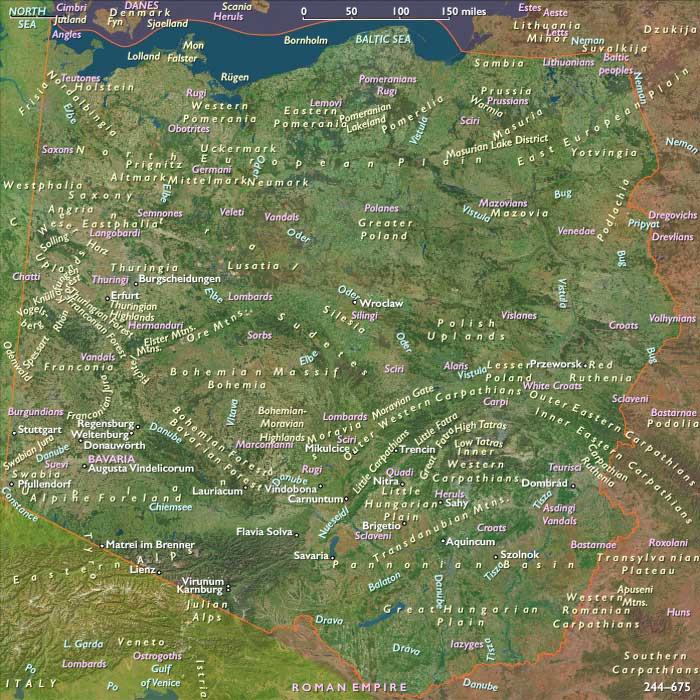
Between 640 and 651 CE, East Central Europe—encompassing Poland, Czechia, Slovakia, Hungary, and those portions of Germany and Austria lying east of 10°E and north of a line stretching from roughly 48.2°N at 10°E southeastward to the Austro-Slovenian border near 46.7°N, 15.4°E—experienced a critical phase marked by internal consolidation and regional realignment. The Slavic federation under King Samo (r. ca. 623–658 CE) maintained stability and cohesion, effectively managing external pressures. Concurrently, Khan Kubrat’s Old Great Bulgaria, a Turkic-speaking Bulgar state, remained stable north and east of the Carpathians, substantially reducing Avar influence. Notably, around 640 CE, Radulf (Rudolf), Duke of Thuringia, rebelled against Frankish authority, decisively defeating Frankish royal forces sent by the Merovingian king Sigebert III. Radulf’s successful revolt established Thuringia as a nearly autonomous political entity, clearly demonstrating the weakened authority of the Merovingian monarchy and highlighting the emerging power of local aristocracies—the hallmark of the era of the rois fainéants (“do-nothing kings”).
Political and Military Developments
Stability and Consolidation under Samo’s Leadership
-
Samo’s Slavic federation maintained internal unity, successfully resisting pressures from neighboring Franks and Avars. Samo’s sustained governance provided enduring political stability and effective regional defense, allowing for stronger cultural and political integration across Bohemia, Moravia, and neighboring Slavic territories.
Stability of Old Great Bulgaria under Kubrat
-
Khan Kubrat maintained a stable Turkic-speaking Bulgar state, significantly reducing Avar influence north and east of the Carpathians. Old Great Bulgaria remained diplomatically influential, particularly through continued contacts with Byzantium.
Radulf’s Revolt and the Autonomy of Thuringia (ca. 640 CE)
-
Around 640 CE, Duke Radulf of Thuringia, appointed by the Merovingian king Dagobert I, openly rebelled against Frankish royal authority. Radulf decisively defeated armies sent by Dagobert’s successor, King Sigebert III, establishing de facto independence and effectively ruling Thuringia autonomously.
-
Radulf’s rebellion significantly demonstrated the declining authority of the Merovingian kings, who became increasingly symbolic rulers reliant on powerful dukes and local aristocratic elites. His successful defiance served as a prominent example of the emerging rois fainéants period, characterized by weak Merovingian monarchs and influential local leaders.
Internal Reorganization of the Avar Khaganate
-
Having suffered territorial losses to Samo’s Slavs and Kubrat’s Bulgars, the Avar Khaganate entered a phase of internal stabilization, focusing on maintaining cohesion and control over their diminished territories.
Economic and Technological Developments
Sustained Regional Trade
-
Trade continued robustly despite political fragmentation, notably among Frankish, Slavic, Bulgar, Bavarian, and Byzantine territories. Key commodities included agricultural products, iron goods, textiles, luxury items, and regional crafts.
Development of Defensive Fortifications
-
Both Samo’s federation and Old Great Bulgaria strengthened their defensive infrastructure, building sophisticated fortifications to maintain security against potential invasions by weakened, yet still dangerous, Avar and Frankish forces.
Cultural and Artistic Developments
Cultural Consolidation of Slavs and Bulgars
-
Samo’s Slavic federation solidified a unified West Slavic identity visible archaeologically through consistent settlement organization, pottery styles, jewelry, and burial customs.
-
Kubrat’s Old Great Bulgaria similarly reinforced a distinctive Turkic Bulgar cultural identity, clearly differentiated from later medieval Slavicized Bulgarians.
Continued Avar Cultural Influence
-
Despite military setbacks, Avar cultural traditions persisted notably in regional metalwork and decorative arts, influencing neighboring Slavic, Bulgar, and Bavarian communities.
Settlement and Urban Development
Expansion of Slavic and Bulgar Fortified Settlements
-
Both Samo’s Slavic federation and Kubrat’s Old Great Bulgaria actively expanded fortified urban settlements and rural communities, supporting greater regional stability and economic prosperity.
Thuringian and Bavarian Stability
-
Bavarian urban centers (notably Regensburg) and Thuringian settlements remained strategically important frontier zones despite the political turmoil associated with Radulf’s rebellion.
Social and Religious Developments
Hierarchical Leadership among Slavs, Bulgars, and Thuringians
-
Societies in Samo’s kingdom, Kubrat’s Old Great Bulgaria, and Radulf’s Thuringia developed strong leadership structures featuring powerful warrior-aristocratic elites capable of centralized governance and military leadership.
Decline in Merovingian Royal Authority
-
Radulf’s successful Thuringian rebellion starkly illustrated the waning power of Merovingian kings, who increasingly became symbolic rulers overshadowed by influential dukes and local aristocrats.
Long-Term Consequences and Historical Significance
The era 640–651 CE, significantly marked by Samo’s continued stability, Kubrat’s Old Great Bulgaria, and Radulf’s successful rebellion in Thuringia, reshaped East Central Europe’s geopolitical landscape. Radulf’s rebellion highlighted the significant weakening of Merovingian royal authority—the beginning of the era of the rois fainéants. These developments permanently influenced political structures, regional alliances, cultural identities, and settlement patterns, establishing enduring historical trajectories across the region.
People
Groups
- Polytheism (“paganism”)
- Germans
- Bulgars
- Wends, or Sorbs (West Slavs)
- Christianity, Chalcedonian
- Avars, Eurasian
- Bavarians (West Germanic tribe)
- Roman Empire, Eastern: Justinian dynasty
- Bavaria, Agilolfing Duchy of
- Avar Khaganate (Eurasian Avars)
- Austrasia, Frankish Kingdom of
- Thuringia, Duchy of
- Samo's Empire
- Bulgaria, “the Old Great “, (Onogur) Khaganate of
- Thuringia, (Frankish) Duchy of
Topics
Commodoties
Subjects
Regions
Subregions
Related Events
Showing 10 events out of 56578 total
Years: 640 - 651
People
Groups
- Polytheism (“paganism”)
- Germans
- Bulgars
- Wends, or Sorbs (West Slavs)
- Christianity, Chalcedonian
- Avars, Eurasian
- Bavarians (West Germanic tribe)
- Roman Empire, Eastern: Justinian dynasty
- Bavaria, Agilolfing Duchy of
- Avar Khaganate (Eurasian Avars)
- Austrasia, Frankish Kingdom of
- Thuringia, Duchy of
- Samo's Empire
- Bulgaria, “the Old Great “, (Onogur) Khaganate of
- Thuringia, (Frankish) Duchy of
Topics
Commodoties
Subjects
Regions
Subregions