
East Central Europe (628–639 CE): Samo’s Kingdom, …
Years: 628 - 639
East Central Europe (628–639 CE): Samo’s Kingdom, Kubrat’s Bulgar Rebellion, and Frankish–Slavic–Bulgar Conflicts
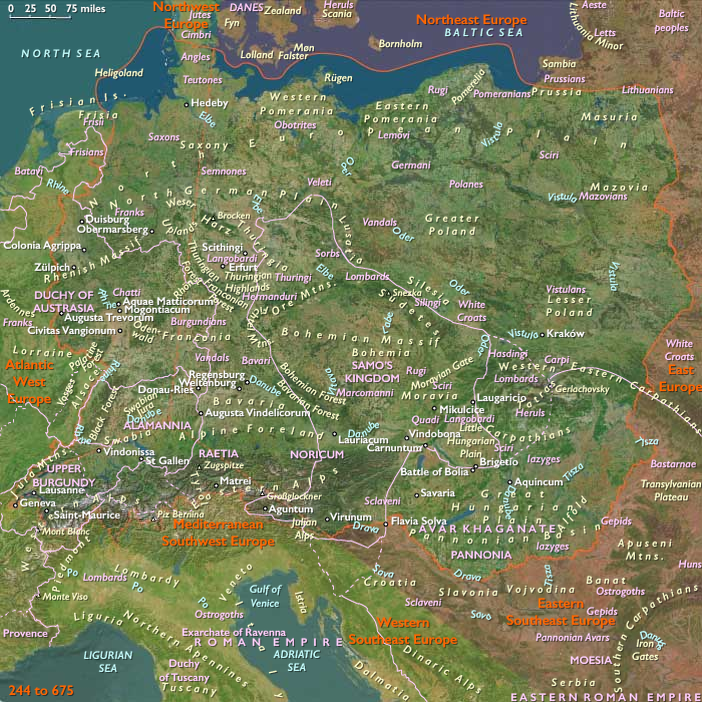
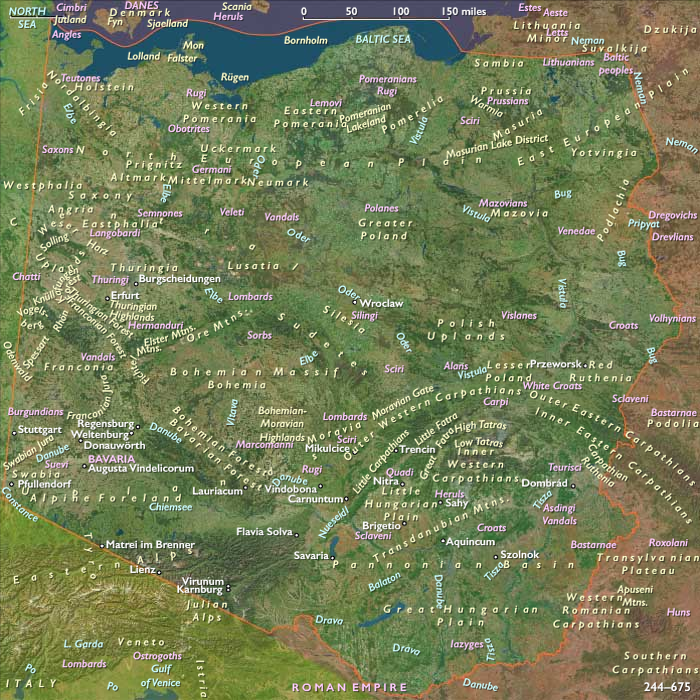
Between 628 and 639 CE, East Central Europe—encompassing Poland, Czechia, Slovakia, Hungary, and those portions of Germany and Austria lying east of 10°E and north of a line stretching from roughly 48.2°N at 10°E southeastward to the Austro-Slovenian border near 46.7°N, 15.4°E—experienced significant geopolitical transformations marked by the establishment of powerful new states and complex regional conflicts. The Slavic federation under King Samo (r. ca. 623–658 CE)decisively resisted Avar and Frankish pressures, securing independence through the notable Battle of Wogastisburg (ca. 631/632 CE). Simultaneously, Khan Kubrat (Kurt), a prominent leader of the Bulgar tribal confederation, successfully led an uprising against Avar domination in the Pannonian Plain and north of the Black Sea, founding a polity that Byzantine chroniclers named Old Great Bulgaria. It is important to note these early medieval Bulgars were a Turkic-speaking people, distinctly different ethnically and linguistically from the later medieval and modern Bulgarians, whose culture and language became predominantly Slavic. Around this same period, chronicler Fredegar records an episode where approximately nine thousand Turkic-speaking Bulgar refugees, fleeing turmoil and Avar reprisals, sought asylum in Bavaria, only to be massacred by Frankish king Dagobert I.
Political and Military Developments
Formation of Samo’s Slavic Kingdom and the Battle of Wogastisburg
-
Samo’s Kingdom, comprising unified West Slavic tribes across Moravia, Bohemia, and surrounding territories, effectively resisted external pressures from Avars and Franks. The critical Slavic victory at Wogastisburg (ca. 631/632 CE), fought against Frankish forces and their Alamanni and Lombard allies, significantly curtailed Frankish ambitions eastward, reinforcing the stability and independence of Slavic territories.
Khan Kubrat’s Bulgar Revolt and Old Great Bulgaria
-
Around 632 CE, the Turkic-speaking Bulgar leader Kubrat (of the Dulo clan) led a powerful rebellion against Avar rule, significantly weakening Avar authority north and east of the Carpathian Basin. Kubrat established a sizable independent state—Old Great Bulgaria—recognized by Byzantine chronicles.
-
These early medieval Bulgars, closely related culturally and linguistically to other Turkic tribes such as the Onogurs, were ethnically and linguistically distinct from the later medieval Bulgarians who became heavily Slavicized.
Fredegar’s Bulgar Episode and Frankish Repression
-
Chronicler Fredegar recounts how, amid the chaos following Kubrat’s rebellion, a group of approximately nine thousand Turkic-speaking Bulgar refugees sought protection in Bavaria. King Dagobert I, suspicious of their intentions, ordered their massacre—highlighting the harshness of Frankish frontier policies and ongoing regional tensions.
Frankish Duchy of Thuringia (ca. 631 CE)
-
Around the same time, the Franks formally organized Thuringia into a duchy (631 CE), aiming to solidify their eastern frontier. Thuringia quickly became embroiled in conflict during Samo’s campaigns against Frankish territories.
Economic and Technological Developments
Continuation of Trade Networks
-
Despite political instability and warfare, trade persisted actively between Frankish, Slavic, Bavarian, and Bulgar regions, exchanging agricultural products, luxury items, metalwork, and textiles.
Enhanced Defensive Fortifications
-
Facing continuous threats, Samo’s Slavic territories and Kubrat’s Bulgar domains developed fortified settlements, strategic defensive systems, and enhanced fortifications.
Cultural and Artistic Developments
Early Medieval Bulgar Cultural Identity
-
Kubrat’s establishment of Old Great Bulgaria fostered a distinctively Turkic Bulgar cultural identity, significantly different from subsequent medieval Bulgarians who were predominantly Slavic-speaking. This Turkic cultural influence is visible archaeologically in weaponry, metalwork, burial customs, and artistic expressions.
Consolidation of West Slavic Cultural Identity
-
Concurrently, Samo’s Slavic federation reinforced a cohesive cultural identity among West Slavic groups, evident in settlement organization, pottery styles, jewelry, and burial rituals.
Continued Avar Cultural Influence
-
Despite military setbacks, the Avar Khaganate maintained significant regional cultural influence, particularly in metallurgy and decorative arts.
Settlement and Urban Development
Expansion of Fortified Bulgar and Slavic Settlements
-
Both Kubrat’s Bulgars and Samo’s Slavs significantly expanded fortified settlements and strongholds, bolstering political stability, agricultural productivity, and social cohesion.
Stability of Bavarian and Thuringian Settlements
-
Bavarian towns (especially Regensburg) and Thuringian frontier settlements remained strategically important, despite occasional conflicts and disruptions.
Social and Religious Developments
Hierarchical Societies: Samo’s Slavs and Kubrat’s Bulgars
-
Both Slavic and Turkic Bulgar societies during this period developed clear political hierarchies, characterized by strong warrior elites and centralized governance structures essential for effective military organization and regional diplomacy.
Frankish Control and Regional Tensions
-
The Franks under Dagobert I implemented harsh frontier policies (exemplified by the Bulgar refugee massacre) to maintain control over ethnically diverse and strategically vulnerable border territories.
Long-Term Consequences and Historical Significance
The era 628–639 CE, significantly shaped by Samo’s Slavic victory, Kubrat’s establishment of Old Great Bulgaria, and Frankish–Slavic–Bulgar conflicts, constituted a crucial turning point in East Central European history. The period marked the first major regional weakening of the Avars and highlighted complex interactions among Turkic-speaking Bulgars, West Slavic peoples, Franks, and Avars. Importantly, early medieval Bulgars—distinctly Turkic-speaking and culturally separate from later Slavicized Bulgarians—began playing a decisive role in regional geopolitics. Collectively, these developments profoundly influenced medieval state formation, political alliances, ethnic identities, and historical trajectories in East Central Europe.
People
Groups
- Polytheism (“paganism”)
- Lombards (West Germanic tribe)
- Germans
- Alamannia
- Thuringii (Germanic tribe)
- Bulgars
- Wends, or Sorbs (West Slavs)
- Christianity, Chalcedonian
- Avars, Eurasian
- Bavarians (West Germanic tribe)
- Roman Empire, Eastern: Justinian dynasty
- Bavaria, Agilolfing Duchy of
- Avar Khaganate (Eurasian Avars)
- Austrasia, Frankish Kingdom of
- Thuringia, Duchy of
- Samo's Empire
- Thuringia, (Frankish) Duchy of
- Bulgaria, “the Old Great “, (Onogur) Khaganate of
Topics
Commodoties
Subjects
Regions
Subregions
Related Events
Showing 10 events out of 17 total
Years: 628 - 639
People
Groups
- Polytheism (“paganism”)
- Lombards (West Germanic tribe)
- Germans
- Alamannia
- Thuringii (Germanic tribe)
- Bulgars
- Wends, or Sorbs (West Slavs)
- Christianity, Chalcedonian
- Avars, Eurasian
- Bavarians (West Germanic tribe)
- Roman Empire, Eastern: Justinian dynasty
- Bavaria, Agilolfing Duchy of
- Avar Khaganate (Eurasian Avars)
- Austrasia, Frankish Kingdom of
- Thuringia, Duchy of
- Samo's Empire
- Thuringia, (Frankish) Duchy of
- Bulgaria, “the Old Great “, (Onogur) Khaganate of
Topics
Commodoties
Subjects
Regions
Subregions