
Central Europe (6,093 – 4,366 BCE): Middle …
Years: 6093BCE - 4366BCE
Central Europe (6,093 – 4,366 BCE): Middle Holocene — The Dawn of the Continental Neolithic
Geographic & Environmental Context
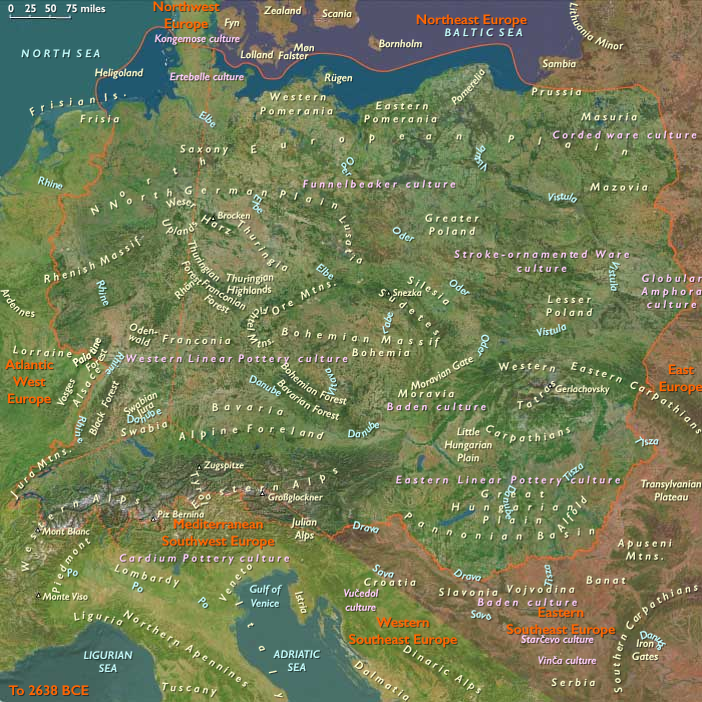
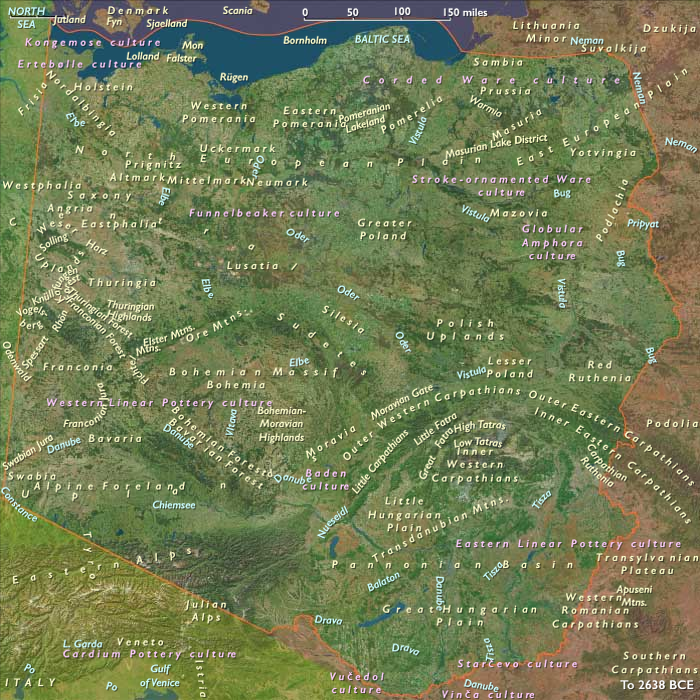
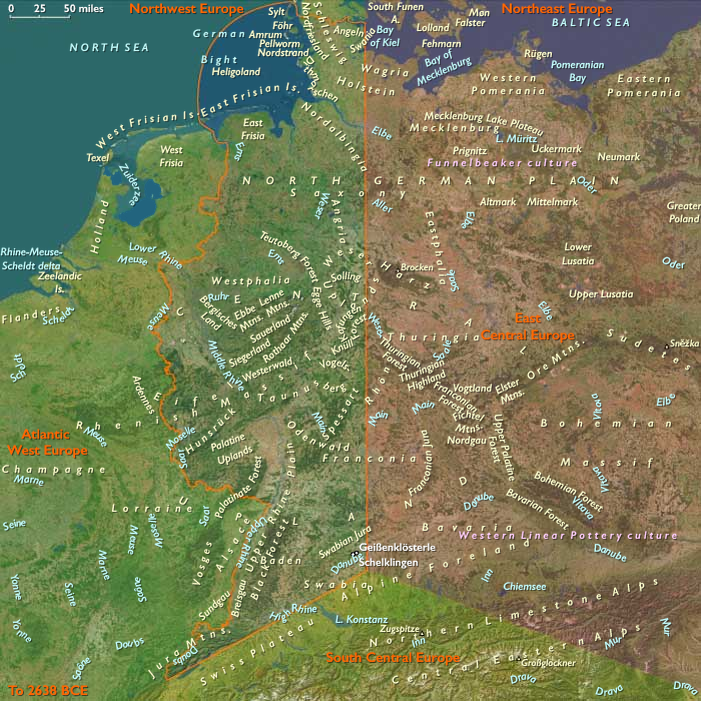
During the Middle Holocene, Central Europe—stretching from the Rhine and Danube valleys to the Carpathian Basin and the upper Alpine forelands—was transformed by the arrival of the first full agricultural societies.
Across its subregions—West, South, and East Central Europe—the Linearbandkeramik (LBK) horizon unified diverse landscapes under a shared Neolithic economy.
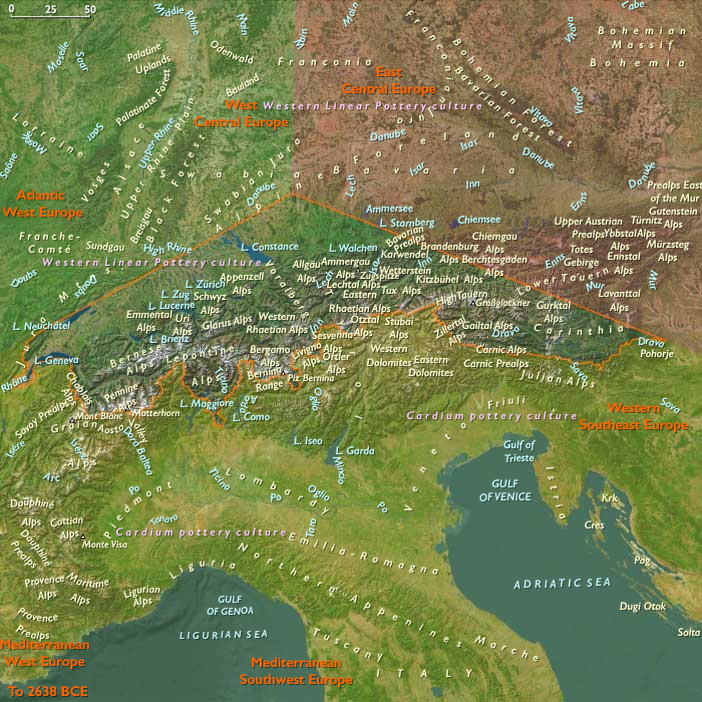
The fertile loess belts of the Rhine, Elbe, and Danube supported longhouse villages and open fields, while mountain passes such as the Brenner, Gotthard, and St. Bernard tied interior basins to the Mediterranean and Balkan worlds.
The region’s mosaic of rivers, terraces, and upland clearings became Europe’s agricultural heartland, anchoring the transition from Mesolithic foraging to organized farming.
Climate & Environmental Shifts
The Hypsithermal climatic optimum (c. 7000–4000 BCE) brought warm, stable conditions ideal for cultivation.
Rainfall was abundant but well-distributed, and fertile loess and alluvial soils across Central Europe produced exceptional yields.
Forests of oak, elm, and hazel expanded, then gradually gave way to agricultural clearings as Neolithic settlers cut and burned woodlands for fields.
This mild, consistent climate sustained both farming communities and residual forager groups, fostering coexistence and exchange along environmental frontiers.
Subsistence & Settlement
Central Europe’s first farmers established a complete agrarian system between 5600 and 4900 BCE.
-
The LBK culture, originating in the Middle Danube and spreading across the Elbe, Vistula, and Rhine basins, founded rectangular longhouse villages of timber, wattle, and daub.
-
Their economy revolved around emmer and einkorn wheat, barley, peas, and lentils, alongside cattle, pigs, sheep, and goats.
-
Foraging and fishing persisted in adjacent forests and rivers, ensuring dietary diversity.
-
In the Alpine forelands, groups such as the Egolzwil and Cortaillod cultures exploited lake margins and wetlands, constructing early pile-dwellings and maintaining mixed farming–fishing economies.
These early farmers created a settled landscape of clearings, fields, and water-edge villages, establishing the foundations of rural Europe.
Technology & Material Culture
The technological package of the Central European Neolithic combined practicality and craft refinement:
-
Pottery bore the LBK’s characteristic banded incised decoration, while regional variants emerged in the Alpine and Danubian fringes.
-
Polished stone adzes and axes were the hallmark tools for forest clearance and carpentry.
-
Grinding stones, querns, and sickles supported cereal processing; loom weights and spindle whorls signaled weaving with flax and wool fibers.
-
Early copper ornaments appeared near the close of the period, presaging Chalcolithic metallurgy.
-
In the Alpine lakes, watercraft, fish weirs, and wooden platforms testify to advanced woodworking and hydrological adaptation.
Together these innovations defined a mature Neolithic toolkit capable of transforming entire landscapes.
Movement & Interaction Corridors
Central Europe stood at the crossroads of continental exchange:
-
The Danube corridor served as the principal route for the spread of farming from the Balkans into the heart of Europe.
-
The Elbe–Vistula–Rhine network carried pottery styles, livestock, and cult objects westward.
-
Alpine passes—notably the Brenner, Gotthard, and St. Bernard—linked the plateau to Mediterranean and Adriatic trade spheres, channeling jadeite axes, obsidian, and shell ornaments.
-
The Carpathian Basin functioned as a cultural staging ground, mediating between Balkan and Central European communities.
These corridors made Central Europe the communication hub of early European civilization, binding farmers, traders, and foragers in an emerging web of interaction.
Cultural & Symbolic Expressions
Ritual and belief flourished alongside agriculture:
-
Longhouse cemeteries and settlement burials reveal ancestor veneration tied to family lineages.
-
Figurines, painted pottery, and house shrines symbolize fertility, continuity, and domestic prosperity.
-
Communal ovens and pits in village centers may have hosted ritual feasting.
-
In the Alpine lake villages, votive deposits of tools and ornaments into water bodies marked spiritual relationships with landscape and ancestors.
Across the region, symbolic life blended the sacred and the practical, embedding religion in daily subsistence and settlement.
Environmental Adaptation & Resilience
Neolithic communities managed their environment through balanced exploitation and renewal.
-
Forest clearance was cyclical, allowing natural regeneration and soil fertility maintenance.
-
Crop rotation and livestock integration ensured nutrient recycling.
-
Mixed farming and fishing economies buffered against harvest failure.
-
Longhouse design and tell accumulation elevated dwellings above floodplains.
This environmental intelligence enabled LBK and successor societies to thrive for centuries without depleting their resource base.
Long-Term Significance
By 4,366 BCE, Central Europe had evolved into a stable agricultural civilization.
The LBK and successor cultures united the Danubian, Alpine, and Rhineland worlds in shared economic and symbolic systems.
Trade routes, ritual traditions, and settlement models radiated outward from these river valleys, carrying the Neolithic into Northern Europe, the Atlantic façade, and the British Isles.
The legacy of this epoch was the European village itself—the longhouse amid cleared fields, sustained by communal labor and ancestral memory—a model that would endure for millennia.
In these centuries, the forests of Central Europe were transformed into Europe’s first continuous cultural landscape, where the rhythms of field, hearth, and river began the long story of settled life.
Groups
Topics
- Mesolithic Europe
- Neolithic Europe
- 8.2 kiloyear event during the Neolithic Subpluvial
- Older Peron Transgression during the Neolithic Subpluvial
Commodoties
Subjects
Regions
Subregions
Years: 6093BCE - 4366BCE
Groups
Topics
- Mesolithic Europe
- Neolithic Europe
- 8.2 kiloyear event during the Neolithic Subpluvial
- Older Peron Transgression during the Neolithic Subpluvial
Commodoties
Subjects
Regions
Subregions