
East Central Europe (616–627 CE): Peak of …
Years: 616 - 627
East Central Europe (616–627 CE): Peak of Avar Power, Slavic Expansion, and Early Political Structures in Bohemia and Moravia
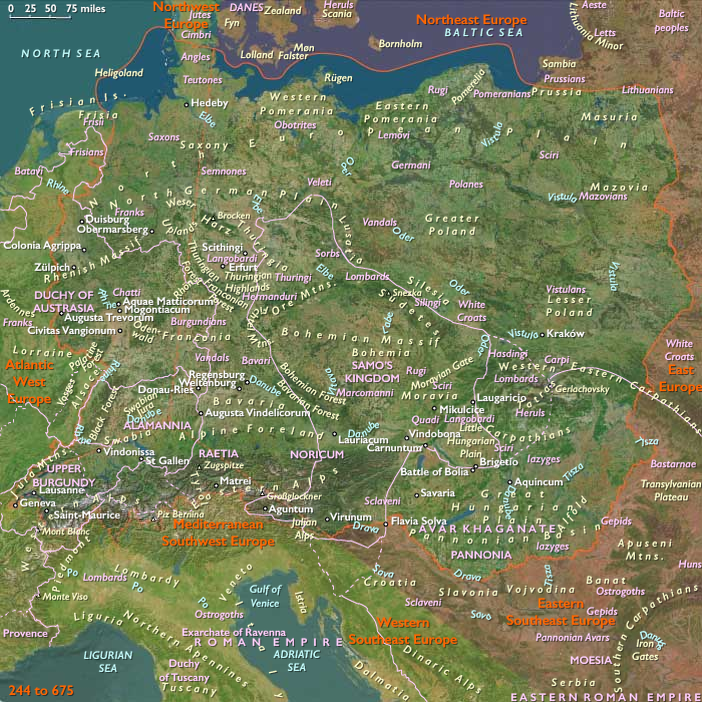
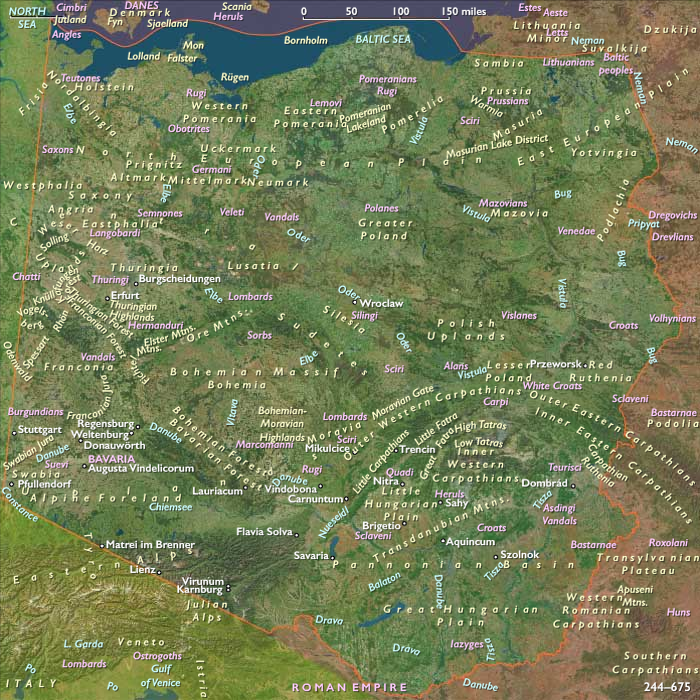
Between 616 and 627 CE, East Central Europe—encompassing Poland, Czechia, Slovakia, Hungary, and those portions of Germany and Austria lying east of 10°E and north of a line stretching from roughly 48.2°N at 10°E southeastward to the Austro-Slovenian border near 46.7°N, 15.4°E—witnessed the peak territorial expansion and political influence of the Avar Khaganate, accompanied by intensified interactions and conflicts with neighboring peoples. Concurrently, the West Slavic territories of Bohemia and Moravia increasingly solidified early political structures, reflecting clear hierarchical leadership and territorial cohesion. The era was marked by continued Slavic migration and settlement throughout the region, shaping distinct cultural and demographic landscapes, while the Bavarians (Baiuvarii) maintained their influential intermediary role between the Frankish, Slavic, and Avar worlds.
Political and Military Developments
Peak Avar Dominance and Territorial Influence
-
The Avar Khaganate reached the height of its territorial power, exerting strong military control and diplomatic influence from the Carpathian Basin deep into neighboring regions. Avar military pressure intensified along the Byzantine frontier, and northward into Slavic-held territories, solidifying the khaganate's dominance.
Strengthening of Early Bohemian and Moravian Polities
-
In Bohemia, West Slavic tribal groups consolidated further under increasingly centralized leadership, establishing stable political entities capable of regional defense and internal governance.
-
Similarly, Moravia strengthened political cohesion, forming distinct regional leadership hierarchies that effectively responded to external pressures from Avars and diplomatically engaged with the neighboring Bavarians.
Bavarian Diplomatic Balancing Act
-
The Bavarians continued to serve as crucial diplomatic and economic intermediaries, carefully managing complex relationships with Avars, emerging Slavic polities, and the Frankish kingdom, facilitating stable trade and political alliances throughout the region.
Economic and Technological Developments
Flourishing Regional Trade Networks
-
Trade through Bavaria, Bohemia, and Moravia prospered, enhancing economic connections among Frankish lands, the Byzantine Empire, and Avar-dominated territories. Prominent traded goods included metals, luxury items, textiles, agricultural products, and craftwork.
Development of Advanced Defensive Structures
-
Faced with persistent Avar incursions, Bohemian and Moravian settlements significantly enhanced fortifications, hillforts, and defensive constructions, indicating advanced regional engineering and increased political organization.
Cultural and Artistic Developments
Distinctive Bohemian and Moravian Cultural Identity
-
Bohemian and Moravian Slavic communities developed highly distinctive cultural identities, evident in regional pottery styles, jewelry, settlement organization, and burial practices, clearly separating their traditions from neighboring groups.
Avar Cultural Zenith
-
The Avar Khaganate continued disseminating its rich Central Asian artistic traditions across the region, leaving profound influences in metallurgy, decorative jewelry, ceramics, and weapons, reflecting the cultural exchanges between nomadic and sedentary populations.
Settlement and Urban Development
Growth and Strengthening of Bohemian and Moravian Centers
-
Bohemia and Moravia experienced significant expansion of fortified urban settlements and rural villages, reflecting increasingly organized regional governance structures and social stability.
Centralized Avar Urban and Administrative Centers
-
Important regional settlements such as Augusta Vindelicorum (Augsburg), Vindobona, and Aquincumcontinued to prosper under centralized Avar authority, sustaining their roles as pivotal administrative, commercial, and strategic centers.
Social and Religious Developments
Emergence of Stable Social Structures in Bohemia and Moravia
-
Clear hierarchical structures emerged in Bohemia and Moravia, centered around tribal leadership, warrior elites, and community governance, laying critical foundations for medieval duchies and principalities.
Continued Avar Hierarchical Organization
-
Avar society maintained its stable, hierarchical structure, centered around the Khagan’s authority and military elite, reinforcing regional dominance and cohesion across a diverse population base.
Long-Term Consequences and Historical Significance
The era 616–627 CE was critical in East Central Europe's historical evolution, marked by the apex of Avar territorial influence, the clear establishment of early state structures in Bohemia and Moravia, and continued Slavic territorial expansion. Bavaria’s diplomatic prominence further stabilized and enriched regional dynamics. The era laid essential foundations for subsequent political, social, and cultural developments, permanently shaping the medieval historical landscape and future identities in East Central Europe.
People
Groups
- Polytheism (“paganism”)
- Germans
- Thuringii (Germanic tribe)
- Wends, or Sorbs (West Slavs)
- Christianity, Chalcedonian
- Avars, Eurasian
- Bavarians (West Germanic tribe)
- Roman Empire, Eastern: Justinian dynasty
- Bavaria, Agilolfing Duchy of
- Reims and Metz (eventually Austrasia), Frankish Kingdom of
- Avar Khaganate (Eurasian Avars)
Topics
Commodoties
Subjects
Regions
Subregions
Related Events
Showing 10 events out of 56989 total
Years: 616 - 627
People
Groups
- Polytheism (“paganism”)
- Germans
- Thuringii (Germanic tribe)
- Wends, or Sorbs (West Slavs)
- Christianity, Chalcedonian
- Avars, Eurasian
- Bavarians (West Germanic tribe)
- Roman Empire, Eastern: Justinian dynasty
- Bavaria, Agilolfing Duchy of
- Reims and Metz (eventually Austrasia), Frankish Kingdom of
- Avar Khaganate (Eurasian Avars)
Topics
Commodoties
Subjects
Regions
Subregions