
East Central Europe (580–591 CE): Expansion of …
Years: 580 - 591
East Central Europe (580–591 CE): Expansion of the Avar Khaganate, Emergence of Bohemia and Moravia, and Continued Slavic Consolidation
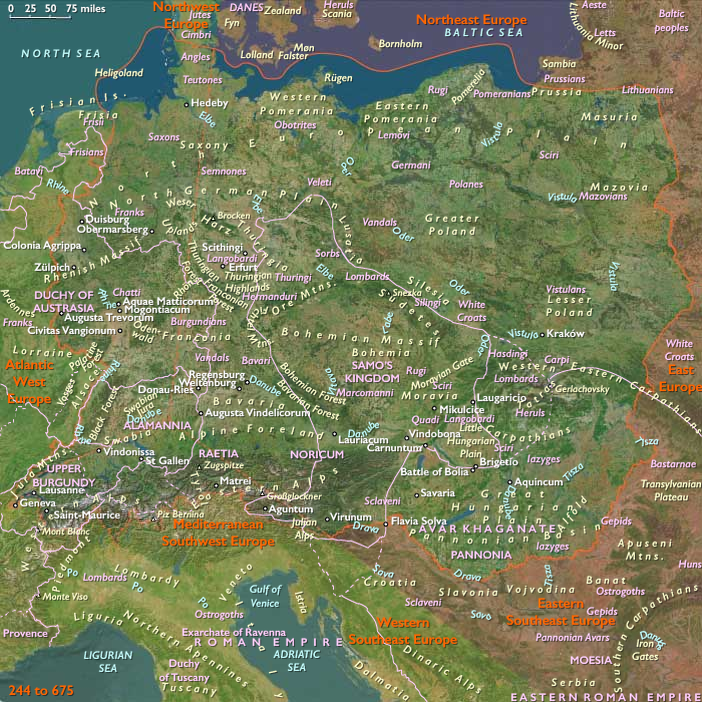
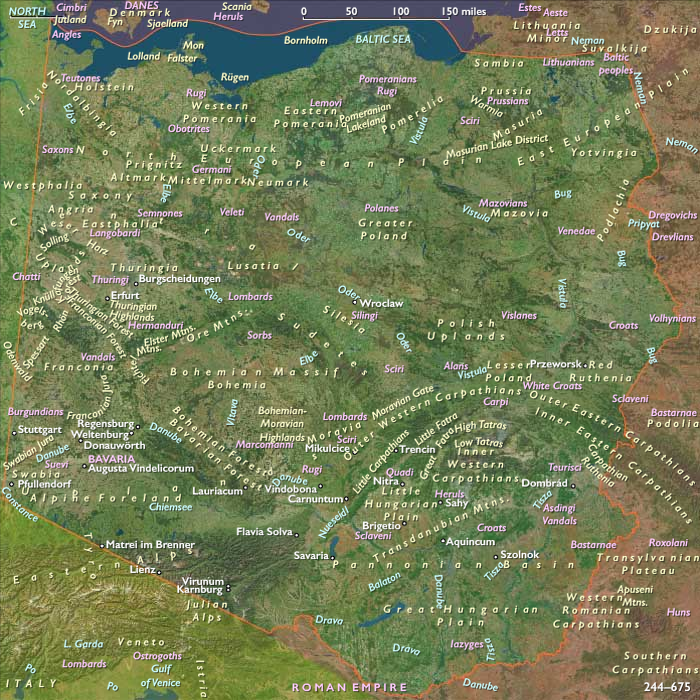
Between 580 and 591 CE, East Central Europe—encompassing Poland, Czechia, Slovakia, Hungary, and those portions of Germany and Austria lying east of 10°E and north of a line stretching from roughly 48.2°N at 10°E southeastward to the Austro-Slovenian border near 46.7°N, 15.4°E—experienced significant political consolidation and cultural differentiation. The Avar Khaganate reached the zenith of its early expansion, exerting profound influence over the Carpathian Basin and its surrounding territories. Concurrently, the historical regions of Bohemia and Moravia began clearly emerging as distinct geopolitical and cultural entities, predominantly inhabited by Slavic tribes. This era also saw continued consolidation and differentiation of Slavic communities across the region, firmly establishing distinct cultural identities and laying the groundwork for future medieval states.
Political and Military Developments
Avar Expansion and Regional Dominance
-
Under aggressive leadership, the Avar Khaganate expanded significantly, achieving dominance over most territories previously held by Germanic tribes. They firmly controlled the Carpathian Basin, extending their influence northward and westward, pressuring both Bavarian and emerging Slavic territories.
Emergence of Bohemia and Moravia
-
In the territories of modern Czechia and Slovakia, two distinct Slavic political and cultural centers began taking form:
-
Bohemia emerged clearly as a regional entity, inhabited primarily by early West Slavic tribes—ancestors of the later Czech people—who established stable settlements, fortified strongholds, and structured communities within its basin region.
-
To its east, Moravia also began to emerge as a distinct territorial entity, similarly settled by West Slavic communities. Moravia soon became strategically important, serving as a frontier territory interacting closely with both Avars to the south and Bavarians to the west.
-
Bavarian–Moravian–Avar Interactions
-
The Bavarians (Baiuvarii) increasingly interacted diplomatically, commercially, and occasionally militarily with emerging Moravian Slavic groups and the Avars, navigating complex relationships between Frankish dominance in the west and Avar pressures in the east.
Economic and Technological Developments
Expansion of Regional Trade Networks
-
Bohemia and Moravia became crucial nodes in expanding regional trade networks, linking the Avar-controlled south and east, Bavarian-controlled west, and emerging Slavic territories to the north. Trade routes notably increased in significance, transporting goods like metals, furs, amber, and agricultural products.
Continued Avar Infrastructure Development
-
The Avars maintained and enhanced existing infrastructure, including roads, fortifications, and strategically positioned settlements that improved trade, military mobility, and regional administration.
Cultural and Artistic Developments
Bohemian and Moravian Cultural Differentiation
-
Distinctive West Slavic cultural identities clearly formed in Bohemia and Moravia, marked by unique settlement patterns, ceramics, burial customs, and emerging local traditions, clearly distinguishable archaeologically.
Avar Cultural Influence
-
The Avars continued introducing steppe-influenced cultural expressions into East Central Europe, visibly impacting regional art and craftsmanship, particularly in metallurgy and jewelry-making.
Settlement and Urban Development
Consolidation of Bohemian and Moravian Settlements
-
Bohemia and Moravia saw significant growth of fortified settlements and stable agricultural villages, reflecting increasing social organization and political cohesion among early West Slavic populations.
Avar-Dominated Urban Centers
-
Important regional settlements such as Augusta Vindelicorum (Augsburg), Vindobona, and Aquincum remained crucial administrative, military, and economic hubs under firm Avar control.
Social and Religious Developments
West Slavic Social Organization
-
In Bohemia and Moravia, early Slavic societies developed clearer hierarchical structures, including tribal leaders, warrior elites, and communal decision-making practices. These communities laid the foundations for future regional polities and medieval duchies.
Avar Hierarchical Structures
-
The Avars maintained highly structured hierarchical societies, centered around their Khagan and military elites, further consolidating their hold over extensive territories and diverse populations.
Long-Term Consequences and Historical Significance
The era 580–591 CE represented a crucial formative period in East Central European history. The emergence of distinct Slavic entities—Bohemia and Moravia—significantly reshaped regional dynamics, creating stable demographic and political foundations for future medieval states. Simultaneously, the expansive power of the Avar Khaganate continued shaping the geopolitical landscape, influencing cultural interactions, settlement patterns, and regional economic development. The interactions among Bavarians, Moravians, Bohemians, and Avars set enduring historical patterns that profoundly impacted the future of East Central Europe.
People
Groups
- Polytheism (“paganism”)
- Germans
- Thuringii (Germanic tribe)
- Wends, or Sorbs (West Slavs)
- Christianity, Chalcedonian
- Avars, Eurasian
- Bavarians (West Germanic tribe)
- Roman Empire, Eastern: Justinian dynasty
- Bavaria, Agilolfing Duchy of
- Reims and Metz (eventually Austrasia), Frankish Kingdom of
- Avar Khaganate (Eurasian Avars)
Topics
Commodoties
Subjects
Regions
Subregions
Related Events
Showing 10 events out of 57370 total
Years: 580 - 591
People
Groups
- Polytheism (“paganism”)
- Germans
- Thuringii (Germanic tribe)
- Wends, or Sorbs (West Slavs)
- Christianity, Chalcedonian
- Avars, Eurasian
- Bavarians (West Germanic tribe)
- Roman Empire, Eastern: Justinian dynasty
- Bavaria, Agilolfing Duchy of
- Reims and Metz (eventually Austrasia), Frankish Kingdom of
- Avar Khaganate (Eurasian Avars)
Topics
Commodoties
Subjects
Regions
Subregions