
East Central Europe (568–579 CE): Avar Khaganate …
Years: 568 - 579
East Central Europe (568–579 CE): Avar Khaganate Established, Slavic Consolidation, and Roles of Thuringia and Bavaria
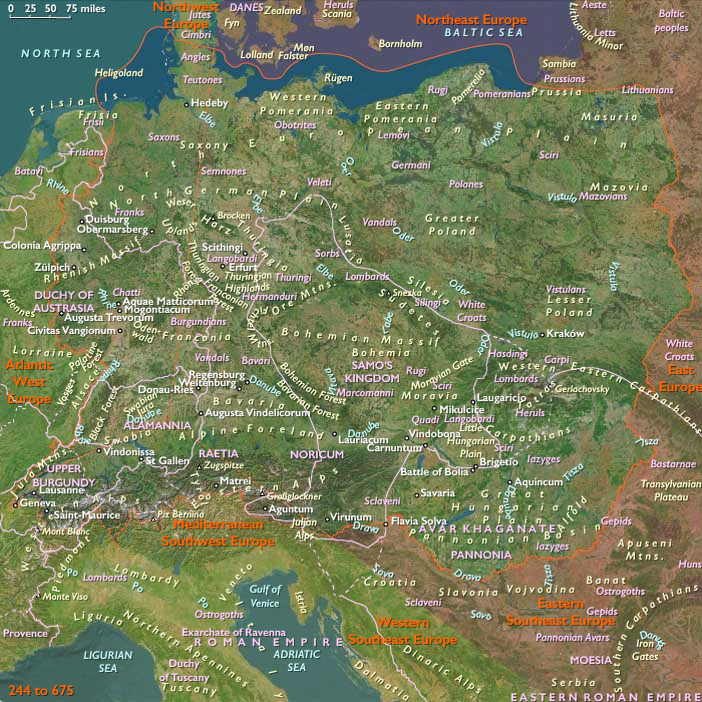
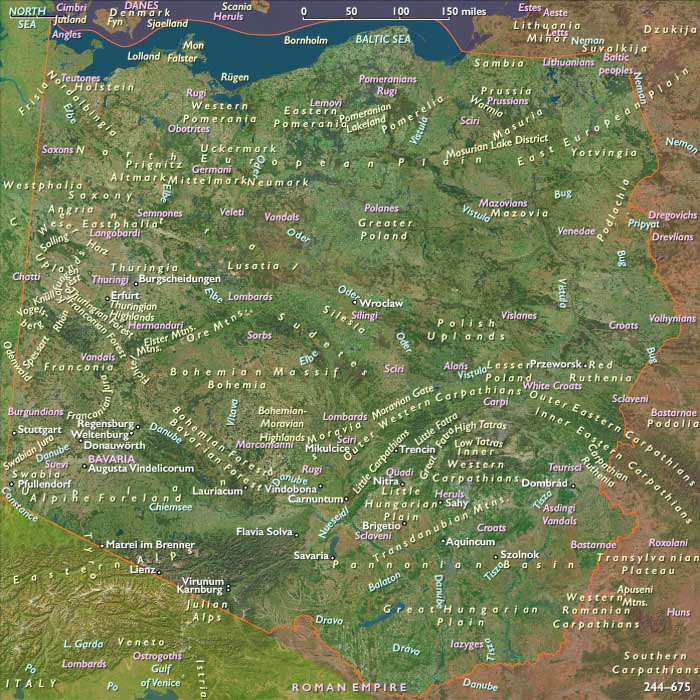
Between 568 and 579 CE, East Central Europe—encompassing Poland, Czechia, Slovakia, Hungary, and those portions of Germany and Austria lying east of 10°E and north of a line stretching from roughly 48.2°N at 10°E southeastward to the Austro-Slovenian border near 46.7°N, 15.4°E—underwent significant geopolitical transformations. The migration of the Lombards into Italy (568 CE) left the Pannonian Avars firmly established as regional rulers, forming their powerful Avar Khaganate in the Carpathian Basin. Simultaneously, Slavic populations expanded dramatically, solidifying control over territories vacated by Germanic tribes. On the region's western periphery, the semi-autonomous Germanic duchies of Thuringia and Bavaria continued to play crucial roles, significantly influencing economic interactions, diplomatic alignments, and cultural exchanges between Frankish and Avar realms.
Political and Military Developments
Avar Khaganate and Byzantine Frontier Diplomacy
-
After Lombard withdrawal (568 CE), the Avar Khaganate rapidly established control, dominating former Gepid and Lombard territories across modern Hungary, Slovakia, Czechia, and eastern Austria.
-
Byzantium intensified diplomatic engagements with the Avars, employing tribute and negotiation to secure its Danube frontier against incursions and maintain regional stability.
Thuringia and Bavaria: Western Influences
-
Thuringia, previously conquered by the Franks in 531 CE, operated as a Frankish-dominated region that retained substantial cultural independence. It became a frontier zone interacting with newly consolidated Slavic groups, facilitating trade and cultural exchanges.
-
Bavaria, centered around Regensburg, emerged distinctly as a semi-autonomous duchy under Frankish political influence. Bavaria played a strategic intermediary role between the Frankish west, Avar east, and Slavic north, managing careful diplomacy and commercial relationships with multiple powers, thus becoming a critical political and economic player.
Extensive Slavic Territorial Consolidation
-
Slavic groups (Sclaveni, Antes, Polanes, Vislanes, Sorbs, Veleti, Obotrites, Pomeranians, and White Croats) rapidly consolidated control over regions vacated by Germanic tribes, establishing permanent settlements that transformed the demographic landscape.
Economic and Technological Developments
Avar Economic Stability and Bavarian Trade Networks
-
Under Avar governance, regional economies flourished, maintaining robust agricultural productivity, livestock husbandry, and extensive trade connections.
-
Bavarian territories facilitated critical trade routes between western Europe (Frankish territories), Lombard-controlled Italy, and the Avar-controlled east, enhancing the region's overall economic connectivity and prosperity.
Infrastructure Maintenance
-
Both Avars and Bavarians maintained vital trade routes, roads, bridges, and fortifications, ensuring regional stability and economic resilience.
Cultural and Artistic Developments
Cultural Exchanges: Avar, Bavarian, and Slavic Influences
-
The Avars introduced distinctive Central Asian steppe traditions into regional art, including metalwork, jewelry, and ceramics.
-
Bavaria and Thuringia maintained and blended Germanic artistic traditions with influences from neighboring Slavic and Frankish cultures, creating unique regional hybrid forms.
Slavic Cultural Identity
-
Slavic communities across East Central Europe solidified distinct cultural identities, evident through settlement patterns, ceramics, and communal customs, contributing significantly to regional cultural diversity.
Settlement and Urban Development
Continuity in Avar-Controlled Settlements
-
Strategic urban centers such as Augusta Vindelicorum (Augsburg), Vindobona, and Aquincum remained economically and administratively central under Avar rule.
Bavarian and Thuringian Settlement Stability
-
Bavarian settlements, notably Regensburg, flourished economically and culturally, benefiting from active trade and diplomacy with Avar and Slavic territories.
-
Thuringian communities, despite Frankish oversight, retained cultural independence and economic stability, becoming key contact points between Frankish, Slavic, and Avar spheres.
Rapid Expansion of Slavic Settlements
-
Slavic villages rapidly proliferated, permanently reshaping demographic landscapes and laying foundations for future medieval states.
Social and Religious Developments
Hierarchical Societies of Avars and Bavarians
-
The Avar Khaganate introduced hierarchical structures rooted in Central Asian traditions, creating clearly defined military and administrative classes.
-
Bavarian and Thuringian societies, though influenced by Frankish governance, maintained distinct Germanic social structures centered around ducal leadership, noble hierarchies, and tribal traditions.
Slavic Social Cohesion
-
Slavic tribes continued forming robust communal social structures and leadership hierarchies, enabling successful territorial consolidation.
Long-Term Consequences and Historical Significance
The era 568–579 CE was pivotal for East Central Europe. The establishment of the Avar Khaganate decisively reshaped geopolitical dynamics, while the significant roles played by Thuringia and Bavaria facilitated critical economic, diplomatic, and cultural exchanges. Simultaneously, Slavic territorial consolidation established lasting demographic and cultural foundations. These developments set enduring historical trajectories, shaping the medieval landscape and cultural identity of the region profoundly.
People
Groups
- Polytheism (“paganism”)
- Lombards (West Germanic tribe)
- Gepids (East Germanic tribe)
- Goths (East Germanic tribe)
- Germans
- Thuringii (Germanic tribe)
- Ostrogoths, Realms of the
- Wends, or Sorbs (West Slavs)
- Roman Empire, Western (Ravenna)
- Christianity, Chalcedonian
- Gepids, Kingdom of the
- Avars, Eurasian
- Bavarians (West Germanic tribe)
- Francia (Merovingians)
- White Croats (East Slavic tribe)
- Veleti (West Slavic tribe)
- Vistulans (West Slavic tribe)
- Polans, Western (West Slavic tribe)
- Pomeranians (West Slavic tribe)
- Obotrites (Slavic tribal confederation)
- Roman Empire, Eastern: Justinian dynasty
- Bavaria, Agilolfing Duchy of
- Avar Khaganate (Eurasian Avars)
Topics
Commodoties
Subjects
Regions
Subregions
Related Events
Showing 10 events out of 21 total
Years: 568 - 579
People
Groups
- Polytheism (“paganism”)
- Lombards (West Germanic tribe)
- Gepids (East Germanic tribe)
- Goths (East Germanic tribe)
- Germans
- Thuringii (Germanic tribe)
- Ostrogoths, Realms of the
- Wends, or Sorbs (West Slavs)
- Roman Empire, Western (Ravenna)
- Christianity, Chalcedonian
- Gepids, Kingdom of the
- Avars, Eurasian
- Bavarians (West Germanic tribe)
- Francia (Merovingians)
- White Croats (East Slavic tribe)
- Veleti (West Slavic tribe)
- Vistulans (West Slavic tribe)
- Polans, Western (West Slavic tribe)
- Pomeranians (West Slavic tribe)
- Obotrites (Slavic tribal confederation)
- Roman Empire, Eastern: Justinian dynasty
- Bavaria, Agilolfing Duchy of
- Avar Khaganate (Eurasian Avars)
Topics
Commodoties
Subjects
Regions
Subregions