
East Central Europe (556–567 CE): Lombard–Gepid War, …
Years: 556 - 567
East Central Europe (556–567 CE): Lombard–Gepid War, Decisive Arrival of the Avars, and Extensive Slavic Expansion
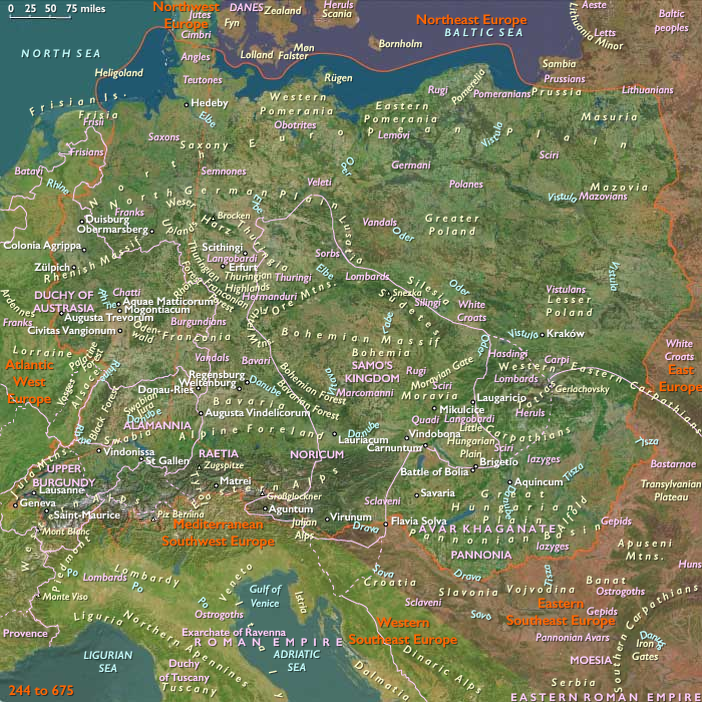
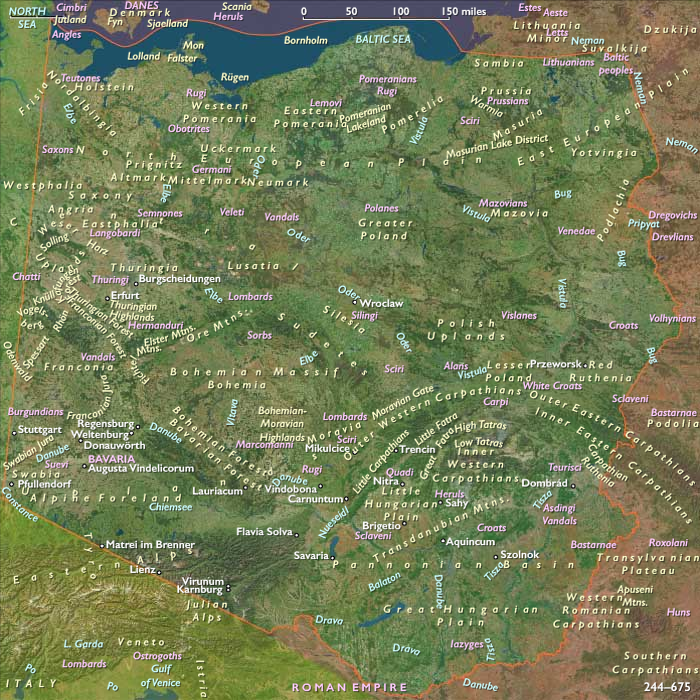
Between 556 and 567 CE, East Central Europe—encompassing Poland, Czechia, Slovakia, Hungary, and those portions of Germany and Austria lying east of 10°E and north of a line stretching from roughly 48.2°N at 10°E southeastward to the Austro-Slovenian border near 46.7°N, 15.4°E— experienced profound geopolitical transformation. The Lombard–Gepid rivalry culminated in a final, decisive conflict in 567 CE—distinct from the earlier battle of Asfeld—when the Lombards under King Alboin (r. ca. 560–572 CE) allied strategically with the recently arrived Pannonian Avars. This coalition decisively defeated the Gepid king, Cunimund, permanently ending Gepid rule. Following this victory, the Lombards undertook a mass migration into Italy (568 CE), leaving the Avars as dominant rulers of the Carpathian Basin and surrounding territories. Throughout this turbulent period, the Byzantine Empire continued its active diplomatic and strategic involvement, facilitating alliances that reshaped regional power structures. Concurrently, Slavic populations rapidly expanded into territories vacated by the Lombards and Gepids, solidifying their control across much of East Central Europe.
Political and Military Developments
-
The Lombard–Gepid War (567 CE) conclusively ended Gepid political autonomy. King Alboin’s Lombards, aided by the Avars, decisively defeated and eliminated Gepid rule.
-
Immediately following their victory, the Lombards migrated in 568 CE toward Italy, driven by internal ambitions and Byzantine encouragement, leaving behind a substantial territorial vacuum.
-
The Pannonian Avars, now dominant regional rulers, quickly established their powerful Avar Khaganate, centered in modern Hungary and exerting considerable influence across the Danube region.
Economic and Technological Developments
-
Economic continuity and stability were sustained through these turbulent transitions. Under Avar rule, agriculture, livestock management, and trade networks remained productive, benefiting from maintained infrastructure, roads, and fortifications.
Cultural and Artistic Developments
-
A transition in material culture occurred as Lombard artistic traditions departed toward Italy. In their place, the Avars introduced distinctive Central Asian steppe motifs into local craftsmanship, significantly influencing regional cultural expressions.
-
Slavic communities, including West Slavs (Polanes, Vislanes, Sorbs, Obotrites, Pomeranians) and proto-South Slavs (White Croats), displayed increasingly distinct cultural markers in pottery styles, settlement patterns, and communal traditions.
Settlement and Urban Development
-
Key settlements such as Augusta Vindelicorum (Augsburg), Vindobona, and Aquincum transitioned from Lombard to Avar control, remaining important administrative and commercial centers under the new regime.
-
Rapid Slavic settlement expansion across the region filled territories vacated by Germanic tribes, significantly reshaping the demographic landscape.
Social and Religious Developments
-
Social structures transitioned from Lombard warrior aristocracies, which moved largely intact into Italy, toward steppe-influenced Avar social hierarchies.
-
Slavic communities solidified internally, forming cohesive tribal identities with clear leadership structures and social organization.
Long-Term Consequences
This era represented a pivotal historical turning point. The definitive collapse of Gepid power, Lombard migration to Italy, and Avar consolidation dramatically altered the geopolitical landscape. Concurrently, extensive Slavic settlement laid permanent foundations for the distinct identities and later medieval states in East Central Europe, profoundly influencing the region's future historical trajectory.
People
Groups
- Polytheism (“paganism”)
- Lombards (West Germanic tribe)
- Gepids (East Germanic tribe)
- Goths (East Germanic tribe)
- Germans
- Ostrogoths, Realms of the
- Wends, or Sorbs (West Slavs)
- Roman Empire, Western (Ravenna)
- Christianity, Chalcedonian
- Gepids, Kingdom of the
- Avars, Eurasian
- Francia (Merovingians)
- Veleti (West Slavic tribe)
- White Croats (East Slavic tribe)
- Polans, Western (West Slavic tribe)
- Pomeranians (West Slavic tribe)
- Obotrites (Slavic tribal confederation)
- Vistulans (West Slavic tribe)
- Roman Empire, Eastern: Justinian dynasty
- Avar Khaganate (Eurasian Avars)
Topics
Commodoties
Subjects
Regions
Subregions
Related Events
Showing 10 events out of 57561 total
Years: 556 - 567
People
Groups
- Polytheism (“paganism”)
- Lombards (West Germanic tribe)
- Gepids (East Germanic tribe)
- Goths (East Germanic tribe)
- Germans
- Ostrogoths, Realms of the
- Wends, or Sorbs (West Slavs)
- Roman Empire, Western (Ravenna)
- Christianity, Chalcedonian
- Gepids, Kingdom of the
- Avars, Eurasian
- Francia (Merovingians)
- Veleti (West Slavic tribe)
- White Croats (East Slavic tribe)
- Polans, Western (West Slavic tribe)
- Pomeranians (West Slavic tribe)
- Obotrites (Slavic tribal confederation)
- Vistulans (West Slavic tribe)
- Roman Empire, Eastern: Justinian dynasty
- Avar Khaganate (Eurasian Avars)
Topics
Commodoties
Subjects
Regions
Subregions