
East Central Europe (676–819 CE): Collapse of …
Years: 676 - 819
East Central Europe (676–819 CE): Collapse of the Avar Khaganate, Rise of Slavic Principalities, and Carolingian Expansion
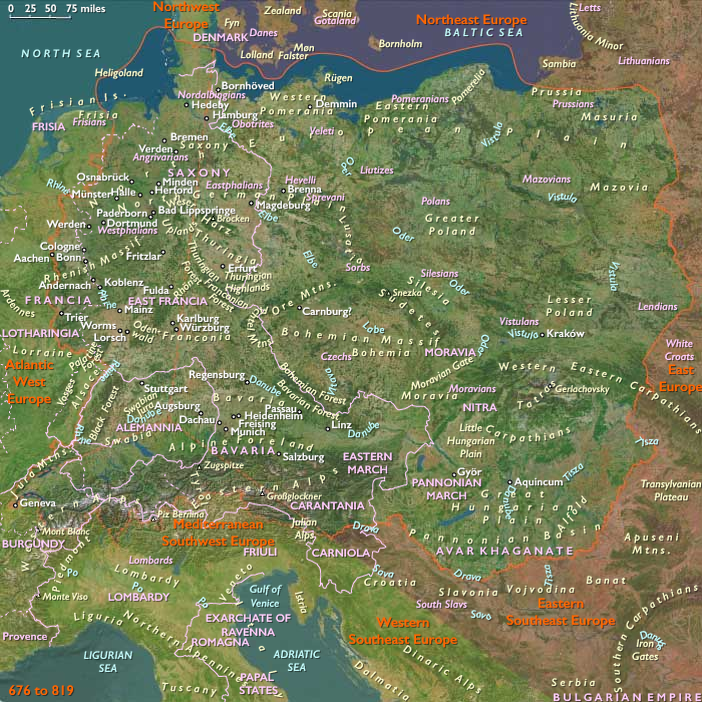
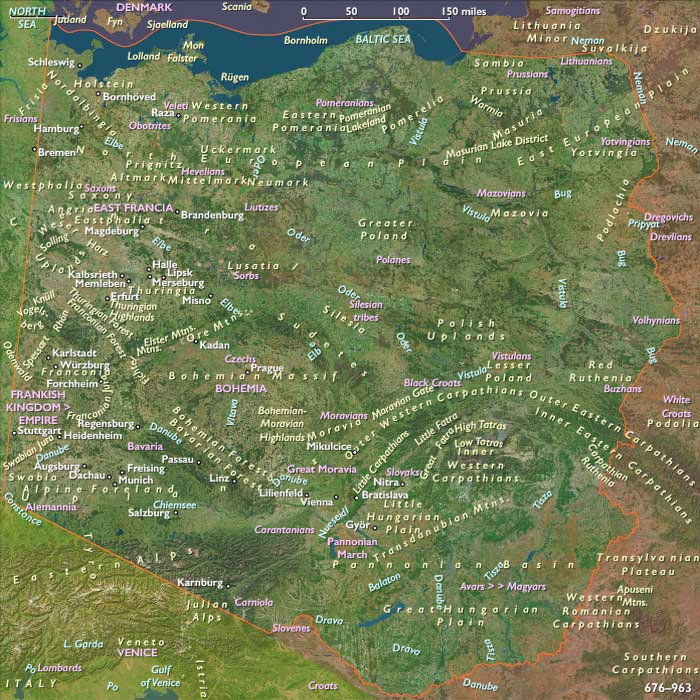
Between 676 and 819 CE, East Central Europe—including present-day Poland, Czechia, Slovakia, Hungary, and regions of Germany and Austria east of 10°E and north of an imaginary line from roughly 48.2°N at 10°E southeastward to the Austro-Slovenian border near 46.7°N, 15.4°E—experienced transformative political, cultural, and social changes. This period was defined by the decline and eventual collapse of the powerful Avar Khaganate, the rapid emergence and strengthening of Slavic principalities, and significant eastward expansion by the Carolingian Empire, culminating in Charlemagne’s conquest of the Avars. The result was a dramatically altered regional landscape that laid the foundation for the later medieval kingdoms of Central Europe.
Political and Military Developments
Decline and Fall of the Avar Khaganate
-
From the late 7th century, the once-dominant Avar Khaganate entered prolonged decline due to internal conflicts, external pressures from Slavic groups, and incursions from neighboring powers.
-
In 796 CE, Charlemagne, king of the Franks, decisively defeated the Avars along the Danube. The Franks captured extensive treasures, including vast amounts of gold and silver, which substantially financed the subsequent Carolingian Renaissance.
Rise and Expansion of Slavic Principalities
-
During this era, numerous Slavic principalities emerged, notably in Moravia and Bohemia, laying the foundations for later states such as Great Moravia and the Duchy of Bohemia.
-
In modern-day Poland, tribal federations began coalescing into structured territorial entities, marking the first steps toward future Polish statehood.
Carolingian Empire and Eastern Frontier
-
Carolingian campaigns brought Frankish control into regions of modern Austria, western Hungary, Bavaria, and Thuringia, significantly reshaping political boundaries.
-
Charlemagne established border territories known as Marches (notably the March of Pannonia), intensifying Frankish influence over regional political, economic, and military structures.
Economic and Technological Developments
Economic Revival and Trade Networks
-
The collapse of the Avars revitalized regional economic activity by redirecting trade networks westward, facilitating exchanges between Slavic territories and Carolingian lands.
-
Enhanced economic stability promoted agricultural productivity, metalworking, and increased commerce, benefiting greatly from Carolingian coinage and trade integration.
Carolingian Agricultural and Technological Influence
-
Advanced agricultural techniques, improved ironworking technologies, and superior fortification methods introduced by the Carolingian Empire significantly shaped economic practices and technological development across the region.
Cultural and Artistic Developments
Contributions to the Carolingian Renaissance
-
Captured Avar treasure substantially funded cultural, artistic, and educational initiatives central to the Carolingian Renaissance, including monasteries, churches, and scholarly centers.
Slavic Cultural Consolidation
-
Slavic principalities developed distinct cultural identities, visible archaeologically through unique pottery styles, jewelry, metalwork, fortified settlements, and evolving religious practices.
Settlement and Urban Development
Formation of Early Medieval Towns
-
Early medieval urban centers and fortified hilltop settlements proliferated across Moravia, Bohemia, and adjacent regions, becoming essential hubs of political, economic, and cultural activity.
-
Previously Roman and Avar fortifications were reconstructed and expanded under Frankish and Slavic influence, signaling sustained urbanization in medieval East Central Europe.
Social and Religious Developments
Christianization and Religious Integration
-
Carolingian expansion accelerated the spread of Christianity throughout East Central Europe. Missionary activities grew significantly, laying critical foundations for future religious organization and cultural integration.
-
Local populations adopted Christianity, blending new beliefs with existing indigenous practices, resulting in complex syncretic traditions.
Social Hierarchies and Feudal Precursors
-
Social structures evolved toward hierarchical governance, influenced by emerging warrior elites, territorial rulers, and early forms of feudal relationships and vassalage. This laid the foundation for medieval governance patterns.
Integration and Assimilation of Avar Survivors
-
Following their defeat, surviving Avars gradually assimilated into neighboring populations, primarily Slavic and later Magyar communities, preserving elements of their culture through metalwork, equestrian traditions, and technological influences.
Long-Term Consequences and Historical Significance
The period 676–819 CE was pivotal in shaping the historical trajectory of East Central Europe. The destruction of the Avar Khaganate and the appropriation of its treasures significantly contributed to the cultural and intellectual vigor of the Carolingian Renaissance, influencing broader European civilization. The formation and strengthening of early Slavic states created enduring ethnic, cultural, and political identities, laying groundwork for later medieval kingdoms. Finally, Carolingian expansion introduced new administrative frameworks, technologies, and religious structures, profoundly influencing the medieval development of the region for centuries to come.
People
Groups
- Franks
- Germans
- Slavs, West
- Christianity, Chalcedonian
- Roman Empire, Eastern: Justinian dynasty
- Bavaria, Agilolfing Duchy of
- Avar Khaganate (Eurasian Avars)
- Lombards (Italy), Kingdom of the
- Roman Empire, Eastern: Non-dynastic
- Roman Empire, Eastern: Heraclian dynasty
- Thuringia, (Frankish) Duchy of
- Roman Empire, Eastern: Heraclian dynasty
- Roman Empire, Eastern: Non-dynastic
- Roman Empire, Eastern: Isaurian dynasty
- Francia (Carolingians)
- Bavaria, Carolingian Duchy of
- Frankish, or Carolingian (Roman) Empire
- Roman Empire, Eastern: Nikephorian dynasty
- Roman Empire, Eastern: Non-dynastic
Topics
Commodoties
Subjects
Regions
Subregions
Years: 676 - 819
People
Groups
- Franks
- Germans
- Slavs, West
- Christianity, Chalcedonian
- Roman Empire, Eastern: Justinian dynasty
- Bavaria, Agilolfing Duchy of
- Avar Khaganate (Eurasian Avars)
- Lombards (Italy), Kingdom of the
- Roman Empire, Eastern: Non-dynastic
- Roman Empire, Eastern: Heraclian dynasty
- Thuringia, (Frankish) Duchy of
- Roman Empire, Eastern: Heraclian dynasty
- Roman Empire, Eastern: Non-dynastic
- Roman Empire, Eastern: Isaurian dynasty
- Francia (Carolingians)
- Bavaria, Carolingian Duchy of
- Frankish, or Carolingian (Roman) Empire
- Roman Empire, Eastern: Nikephorian dynasty
- Roman Empire, Eastern: Non-dynastic
Topics
Commodoties
Subjects
Regions
Subregions