
East Central Europe (496–507 CE): Gepid Dominance, …
Years: 496 - 507
East Central Europe (496–507 CE): Gepid Dominance, Lombard Expansion, and Rugian Decline
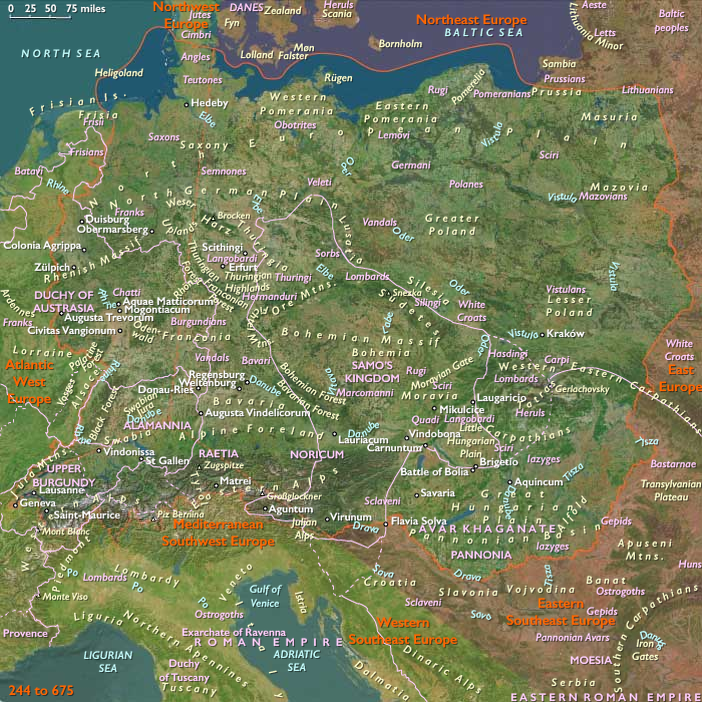
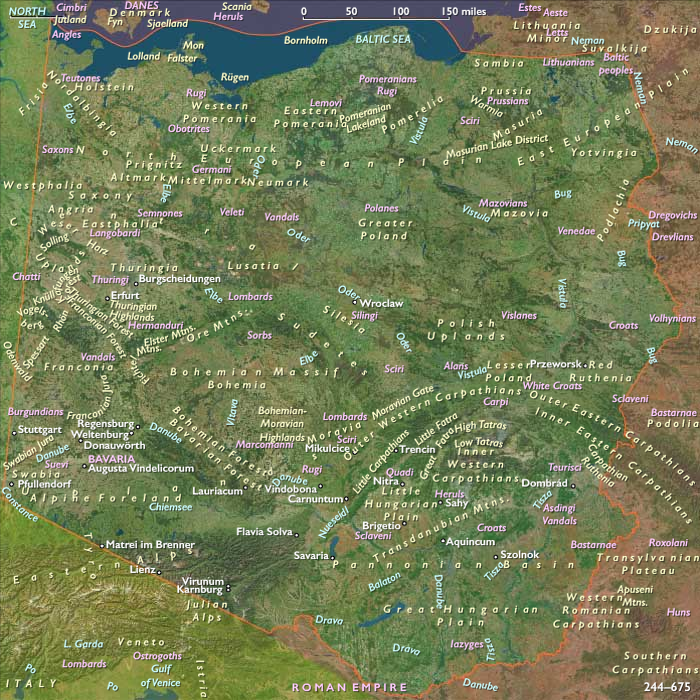
Between 496 and 507 CE, East Central Europe—including Poland, Czechia, Slovakia, Hungary, and those portions of Germany and Austria lying east of 10°E and north of a line stretching from roughly 48.2°N at 10°E southeastward to the Austro-Slovenian border near 46.7°N, 15.4°E—experienced further geopolitical transformation driven by strengthened Gepid control and the growing influence of the migrating Lombards (Langobardi). This era also saw the collapse of Rugian autonomy following their conflict with Odoacer and subsequent regional instability. Moreover, in 496 CE, the Roman provincial administration in Pannonia Valeria ceased entirely, marking the definitive end of direct Roman governance in the region. Throughout these significant transformations, the proto-Slavic communities maintained notable cultural resilience and social cohesion.
Political and Military Developments
End of Roman Pannonia Valeria (496 CE)
-
In 496 CE, Roman administrative control in Pannonia Valeria effectively ended, marking the final dissolution of Roman provincial governance in East Central Europe. The province's territories became fully absorbed into the domains of tribal powers, notably the Gepids, reflecting the broader transition from Roman to Germanic authority in the region.
Consolidation of Gepid Authority
-
Gepid dominance solidified further, particularly across the Hungarian Plain and the eastern Carpathian Basin, as their rulers secured firm territorial control. Their political strength enabled a stable regional environment, reinforcing Gepid centrality within East Central Europe.
Lombard Migration and Rising Influence
-
The Lombards (Langobardi), migrating southward from territories north of the Danube, steadily increased their presence and influence within East Central Europe. Their movements and growing power introduced a significant new element into regional politics, positioning them as potential rivals to Gepid authority.
Rugian Conflict with Odoacer and Decline
-
The previously stable Rugii suffered a significant decline in autonomy and stability following their conflict with Odoacer, ruler of Italy (476–493 CE), and later, with his successors. The Rugian kingdom on the upper Tisza disintegrated rapidly around the turn of the century (circa 500 CE), marking the end of their sustained political independence.
Economic and Technological Developments
Stabilized Local Economies under Gepid Control
-
Gepid consolidation provided relative economic stability, allowing localized trade networks to expand modestly, especially along strategic trade routes linking regional centers such as Augusta Vindelicorum (Augsburg) and former Roman frontier towns.
Continued Maintenance of Infrastructure
-
Essential infrastructure, notably roads and fortifications, was maintained sufficiently to ensure secure trade routes and communication, though major infrastructure projects remained limited.
Cultural and Artistic Developments
Flourishing Gepid Artistic Traditions
-
Gepid material culture reached new levels of sophistication, reflected in jewelry, pottery, weaponry, and metalwork. Their artifacts demonstrated distinctively Gepid styles blended with Lombard and residual Roman elements.
Proto-Slavic Cultural Continuity
-
Proto-Slavic communities continued preserving their distinctive cultural traditions, maintaining traditional craftsmanship, social structures, and religious practices despite external geopolitical turbulence.
Settlement and Urban Development
Continuing Importance of Key Urban Centers
-
Major settlements like Augusta Vindelicorum (Augsburg) maintained their regional significance, acting as hubs for trade, communication, and local administration, benefiting from stable Gepid rule.
-
Former Roman towns, including Carnuntum, Vindobona, and Aquincum, remained as fortified centers and administrative points within Gepid-controlled territories, though now entirely detached from Roman governance.
Decline of Rugian Settlements
-
Rugian settlements along the upper Tisza entered a phase of decline and disintegration following their defeat and destabilization after conflicts involving Odoacer, significantly diminishing their previously influential role.
Social and Religious Developments
Gepid and Lombard Social Organization
-
Gepid and emerging Lombard societies solidified around powerful warrior elites, emphasizing strong leadership structures and traditional Germanic rituals to reinforce their legitimacy and social cohesion.
Rugian Social Collapse
-
Rugian social and political structures faced rapid dissolution as a consequence of their military defeats and the loss of autonomy, ending their role as a stabilizing regional power.
Proto-Slavic Social Resilience
-
Proto-Slavic populations preserved their internal social structures and communal cohesion, adapting pragmatically to changing regional realities while preserving their cultural and religious traditions.
Long-Term Consequences and Historical Significance
The era 496–507 CE was pivotal for East Central Europe, marking the definitive consolidation of Gepid dominance, the emergence of the Lombards as a significant new power, and the dramatic decline of Rugian autonomy. The termination of Roman provincial administration in Pannonia Valeria in 496 CE signaled the conclusive withdrawal of Roman authority from the region. These developments significantly reshaped the regional balance of power, establishing geopolitical patterns that would profoundly influence subsequent regional history. Concurrently, the ongoing cultural resilience of proto-Slavic communities provided crucial continuity, setting the stage for enduring regional diversity and the future historical trajectory of East Central Europe into the early medieval period.
Groups
- Polytheism (“paganism”)
- Slavs, Proto-
- Lombards (West Germanic tribe)
- Rugii (East Germanic tribe )
- Germans
- Gepids (East Germanic tribe)
- Goths (East Germanic tribe)
- Pannonia Valeria (Roman province)
- Ostrogoths, Realms of the
- Christianity, Chalcedonian
- Gepids, Kingdom of the
- Roman Empire, Eastern: Leonid dynasty
Topics
Commodoties
Subjects
Regions
Subregions
Years: 496 - 507
Groups
- Polytheism (“paganism”)
- Slavs, Proto-
- Lombards (West Germanic tribe)
- Rugii (East Germanic tribe )
- Germans
- Gepids (East Germanic tribe)
- Goths (East Germanic tribe)
- Pannonia Valeria (Roman province)
- Ostrogoths, Realms of the
- Christianity, Chalcedonian
- Gepids, Kingdom of the
- Roman Empire, Eastern: Leonid dynasty
Topics
Commodoties
Subjects
Regions
Subregions