
East Central Europe (484–495 CE): Theodoric’s Migration …
Years: 484 - 495
East Central Europe (484–495 CE): Theodoric’s Migration to Italy and Gepid Ascendancy
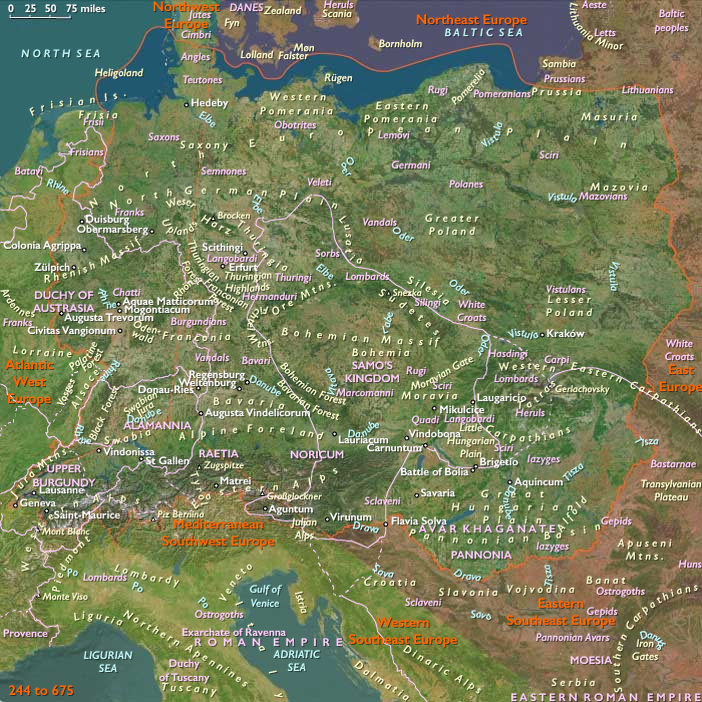
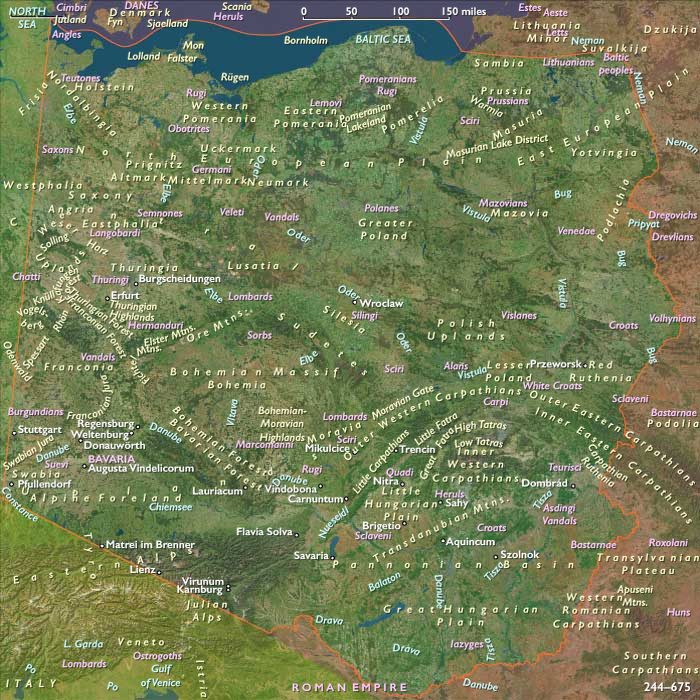
Between 484 and 495 CE, East Central Europe—including Poland, Czechia, Slovakia, Hungary, and those portions of Germany and Austria lying east of 10°E and north of a line stretching from roughly 48.2°N at 10°E southeastward to the Austro-Slovenian border near 46.7°N, 15.4°E—underwent significant geopolitical shifts following the departure of Theodoric the Great and his Ostrogothic followers for Italy in 488 CE. This migration reshaped regional power dynamics, leading to increased dominance by the Gepids, who rapidly expanded into territories vacated by the Ostrogoths. Amid these transitions, the Rugii maintained their diplomatic neutrality and autonomy along the upper Tisza, while the region's proto-Slavic communities continued their enduring cultural stability and careful adaptation to shifting power balances.
Political and Military Developments
Theodoric the Great’s Departure (488 CE)
-
In 488 CE, Theodoric the Great, encouraged by the Eastern Roman Empire, led his Ostrogothic followers from East Central Europe to Italy, drastically altering regional power structures and leaving a substantial political and territorial vacuum behind.
Gepid Expansion and Dominance
-
Following the Ostrogothic exodus, the Gepids, already influential in modern Hungary and the Carpathian Basin, swiftly moved to consolidate control over the newly vacated territories, greatly expanding their sphere of influence and firmly establishing regional dominance.
Continued Autonomy of the Rugii
-
The Rugii adeptly navigated these shifting alliances and regional changes, preserving their autonomy and regional stability through continued diplomatic engagement with the Gepids and other neighboring powers.
Economic and Technological Developments
Economic Reorientation and Stability
-
The Gepid ascendency provided stability in previously Ostrogoth-controlled territories, allowing a modest economic revival through renewed trade networks, particularly along routes linking major settlements like Augusta Vindelicorum (Augsburg) and the former Roman frontier towns.
Infrastructure and Settlement Maintenance
-
Existing infrastructure, including roads, bridges, and settlements, saw modest maintenance efforts, reflecting the Gepids' intent to sustain trade and military mobility throughout the region.
Cultural and Artistic Developments
Gepid Cultural Flourishing
-
With Gepid consolidation came renewed expressions of cultural identity, as evident in refined metalwork, decorative jewelry, pottery, and weaponry. These cultural artifacts displayed distinctively Gepid motifs blended with remnants of Roman, Ostrogothic, and Hunnic artistic influences.
Proto-Slavic Cultural Continuity
-
Proto-Slavic communities maintained traditional cultural and social practices, carefully integrating limited external influences without compromising their core communal and cultural identities.
Settlement and Urban Development
Strengthened Regional Settlements
-
Strategic settlements such as Augusta Vindelicorum (Augsburg) continued to flourish as essential regional centers, benefiting from increased stability and restored trade under Gepid authority.
-
Former Roman towns, notably Carnuntum, Vindobona, and Aquincum, persisted as fortified centers and administrative hubs within Gepid-dominated regions, albeit on a smaller scale.
Stability and Prosperity of Rugian Settlements
-
Rugian communities along the upper Tisza remained economically and politically stable, anchoring local prosperity and providing continuity during regional realignments.
Social and Religious Developments
Gepid Tribal Consolidation
-
Gepid society became increasingly organized around strong warrior elites and chieftains, consolidating their regional authority by emphasizing traditional Germanic cultural practices, rituals, and governance structures.
Continued Rugian Diplomatic Success
-
Rugian leaders preserved their autonomy through careful diplomatic interactions, ensuring their continued regional independence despite the changing geopolitical landscape.
Proto-Slavic Social Resilience
-
Proto-Slavic communities continued their stable social structures and religious traditions, facilitating strong internal cohesion amid external shifts in political control.
Long-Term Consequences and Historical Significance
The era 484–495 CE represented a critical period of transition following the departure of Theodoric and the Ostrogoths, significantly reshaping East Central Europe's geopolitical landscape. The rapid Gepid expansion filled the resulting power vacuum, stabilizing parts of the region and laying the groundwork for subsequent tribal and political arrangements. Concurrently, the continued autonomy of the Rugii and the enduring resilience of proto-Slavic communities provided crucial continuity, profoundly influencing East Central Europe's historical trajectory toward early medieval configurations.
People
Groups
- Polytheism (“paganism”)
- Slavs, Proto-
- Rugii (East Germanic tribe )
- Gepids (East Germanic tribe)
- Goths (East Germanic tribe)
- Germans
- Ostrogoths, Realms of the
- Christianity, Chalcedonian
- Gepids, Kingdom of the
- Roman Empire, Eastern: Leonid dynasty
Topics
Commodoties
Subjects
Regions
Subregions
Years: 484 - 495
People
Groups
- Polytheism (“paganism”)
- Slavs, Proto-
- Rugii (East Germanic tribe )
- Gepids (East Germanic tribe)
- Goths (East Germanic tribe)
- Germans
- Ostrogoths, Realms of the
- Christianity, Chalcedonian
- Gepids, Kingdom of the
- Roman Empire, Eastern: Leonid dynasty
Topics
Commodoties
Subjects
Regions
Subregions