
Central Europe (4,365 – 2,638 BCE): Late …
Years: 4365BCE - 2638BCE
Central Europe (4,365 – 2,638 BCE): Late Neolithic / Chalcolithic — Copper Trails, Megaliths, and Expanding Frontiers
Geographic & Environmental Context
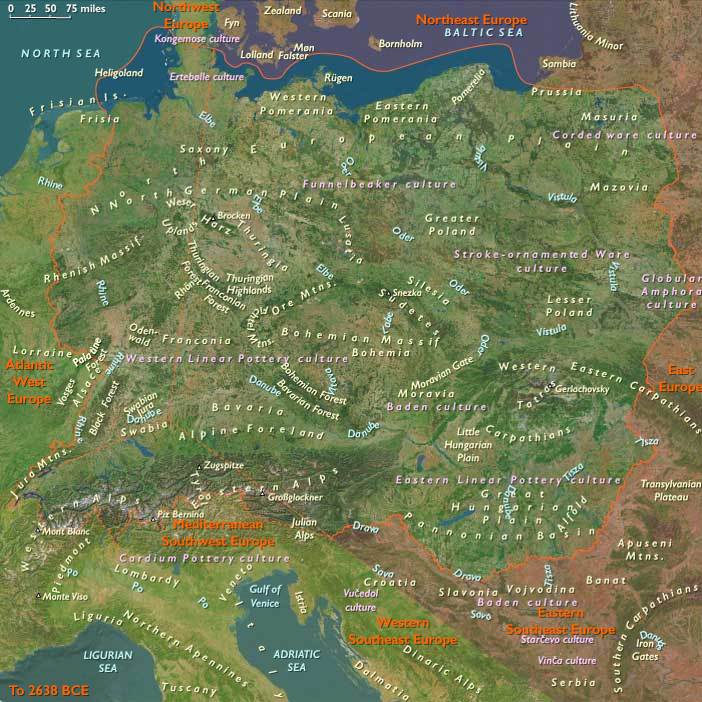
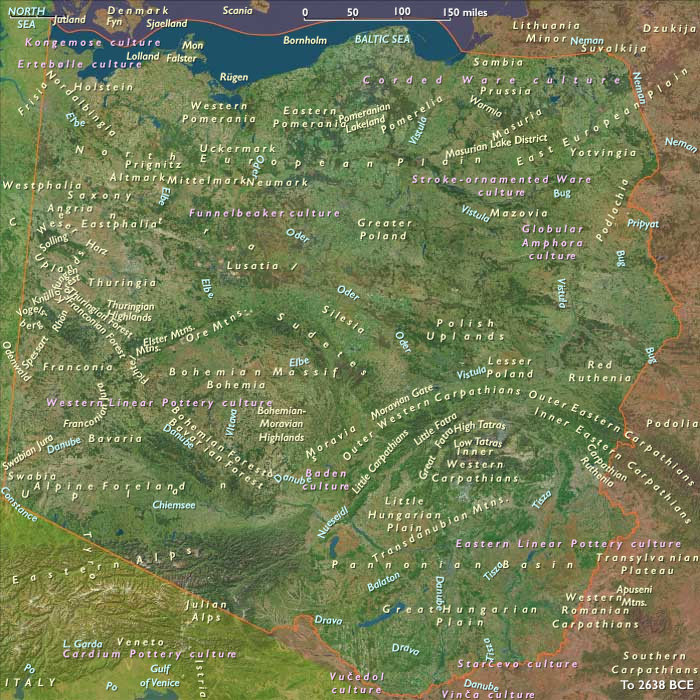
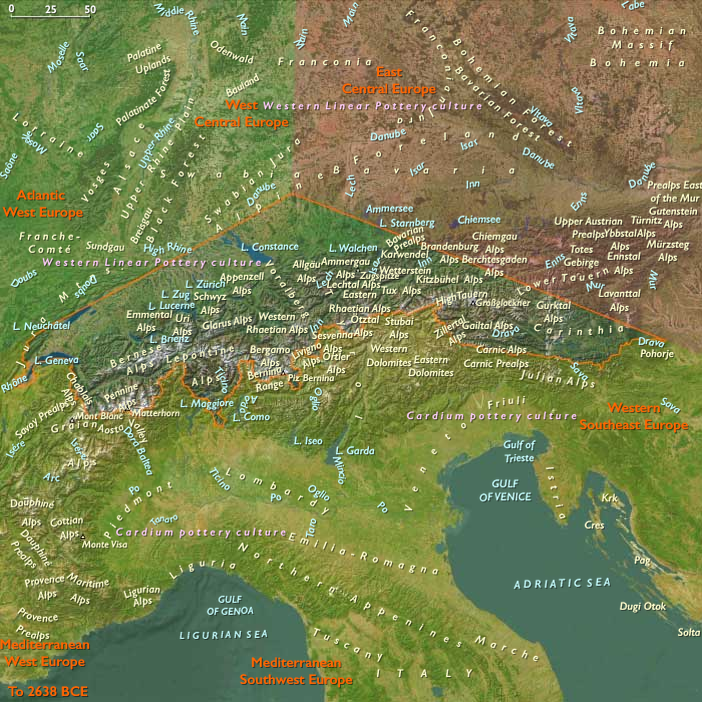
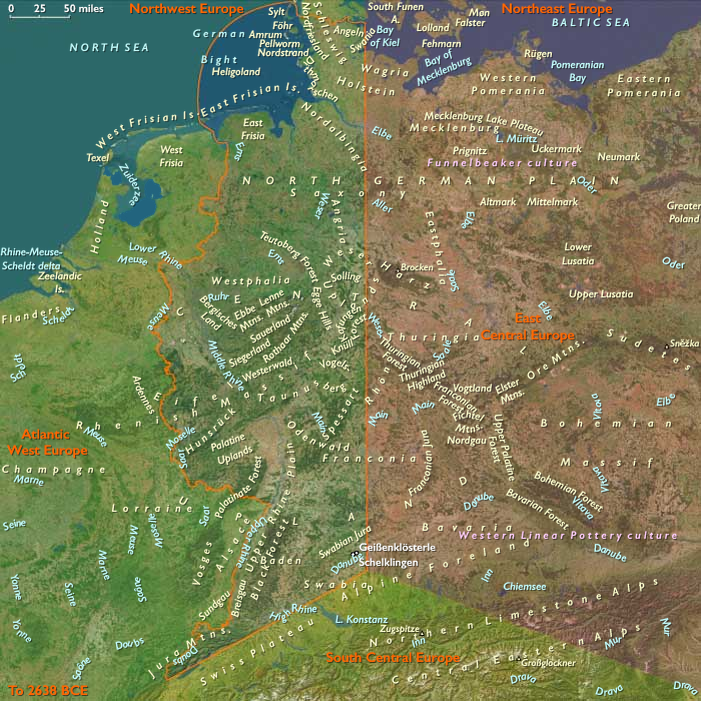
By the middle of the fifth millennium BCE, Central Europe had matured into a continuous landscape of river valleys, forested plateaus, and alpine corridors connecting the Carpathians, Rhine, and Alps. The region embraced the fertile loess belts of the Danube and Elbe basins, the lake districts of the alpine forelands, and the upland clearances of the Tyrol and Bohemia.
These varied ecologies fostered both dense agricultural core zones and mobile herding frontiers, linking the steppe to the Mediterranean and the Atlantic via copper and amber routes. Rivers such as the Danube, Rhine, and Vistula became the great arteries of exchange and diffusion.
Climate & Environmental Shifts
The Holocene climatic optimum still lingered, though late pulses of cooling and moisture fluctuation reshaped settlement and farming patterns.
Wetland expansion in alpine basins alternated with periodic drying that exposed new ground for cultivation.
Overall stability favored demographic growth, but localized floods and forest regrowth demanded flexible land use and communal labor for field drainage and terracing.
Subsistence & Settlement
Across Central Europe, mixed agriculture combined cereals, legumes, and orchard crops with cattle and sheep herding.
Large villages and proto-towns appeared in the Tisza–Danube plain, while pile-dwellings and lake villages proliferated around the alpine margins.
Communities practiced transhumant dairying, maintaining summer pastures in uplands and winter herds in valleys.
By the later third millennium BCE, Corded Ware and Bell Beaker groups added mobility and new herding practices, integrating wagon and horse technologies.
Settlement diversity—tells, hilltop enclosures, and stilted hamlets—reflected a region simultaneously agrarian and exploratory.
Technology & Material Culture
Innovation defined the age.
Polished stone tools remained in use, but copper metallurgy spread widely from the Balkans and Alpine sources into the Rhine and Carpathian basins.
Lengyel, Tisza, and Funnelbeaker artisans produced richly painted pottery; later Corded Ware battle-axes and Beaker cups signaled social transformation and widening horizons.
Alpine miners extracted flint, salt, and copper, fueling specialized craft production.
Fiber and textile industries advanced, and wheel-made transport began to knit distant communities together.
Movement & Exchange Corridors
Central Europe served as the continental crossroads of the Late Neolithic world.
The Amber Road linked Baltic shores to the Danube, while Alpine passes—Gotthard, Brenner, and Rhine–Inn—channeled copper, stone axes, and prestige goods northward.
River systems connected these routes, allowing salt, grain, and ornament metals to circulate through vast reciprocal networks.
Steppe contacts introduced horses, wagons, and new social forms, while western corridors conveyed megalithic and metallurgical ideas from the Atlantic façade.
Belief & Symbolism
Spiritual expression ranged from communal megaliths to individualized warrior burials.
Early causewayed enclosures and long barrows celebrated ancestral continuity; by the late third millennium BCE, Corded Ware and Beaker graves emphasized personal status through weapons and ornaments.
Domestic figurines, painted ceramics, and solar symbols linked fertility, sky, and lineage, while lakeside votive deposits and antler offerings mirrored water’s centrality to renewal.
Across the region, ritual architecture and burial practice charted a shift from collective to hierarchical cosmology.
Adaptation & Resilience
Agricultural communities managed climate variability through crop diversification and herding mobility.
Wetland and mountain populations exploited micro-ecologies—fish, reeds, and alpine grazing—to balance risk.
Trade itself functioned as resilience: copper, amber, and salt exchanges stabilized subsistence cycles by binding distant regions into mutual support.
Communal cooperation in irrigation, timber clearance, and metallurgy fostered both productivity and social cohesion.
Long-Term Significance
By 2638 BCE, Central Europe had become a densely peopled, metallurgically connected heartland.
Megaliths, lake villages, and fortified tells testified to surplus and coordination; copper and gold ornaments signaled emerging elites.
The fusion of alpine mining, riverine agriculture, and northern trade created a durable framework for the Bronze Age polities to come.
Here, amid rivers, forests, and passes, Europe’s core learned to balance community and hierarchy, mobility and settlement—a continental equilibrium that would shape its civilizations for millennia.
Groups
- Lengyel culture
- Rössen Culture
- Funnelbeaker Culture
- Corded Ware culture
- Bell-Beaker, or beaker, culture
Topics
- Neolithic Europe
- Chalcolithic Epoch, or Copper Ages
- Older Peron Transgression during the Neolithic Subpluvial
- Younger Peron Transgression during the Neolithic Subpluvial
- 5.9 kiloyear event during the Neolithic Subpluvial
- Subboreal Period during the Neolithic Subpluvial
- Piora Oscillation ending the Neolithic Subpluvial
- Subboreal Period
Commodoties
Subjects
Regions
Subregions
Related Events
Showing 10 events out of 186 total
Years: 4365BCE - 2638BCE
Groups
- Lengyel culture
- Rössen Culture
- Funnelbeaker Culture
- Corded Ware culture
- Bell-Beaker, or beaker, culture
Topics
- Neolithic Europe
- Chalcolithic Epoch, or Copper Ages
- Older Peron Transgression during the Neolithic Subpluvial
- Younger Peron Transgression during the Neolithic Subpluvial
- 5.9 kiloyear event during the Neolithic Subpluvial
- Subboreal Period during the Neolithic Subpluvial
- Piora Oscillation ending the Neolithic Subpluvial
- Subboreal Period
Commodoties
Subjects
Regions
Subregions