
East Central Europe (424–435 CE): Rise of …
Years: 424 - 435
East Central Europe (424–435 CE): Rise of Attila and Bleda, Hun Ascendancy, and Regional Realignments
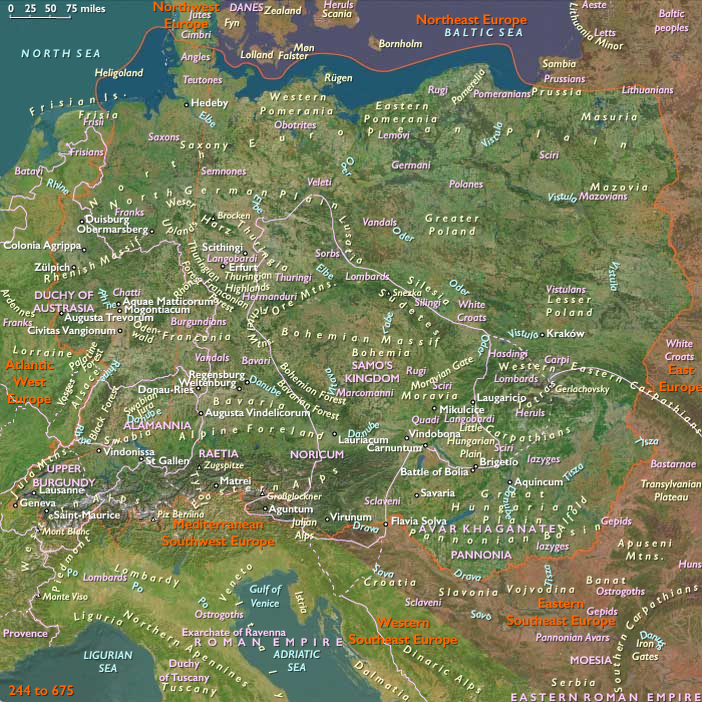
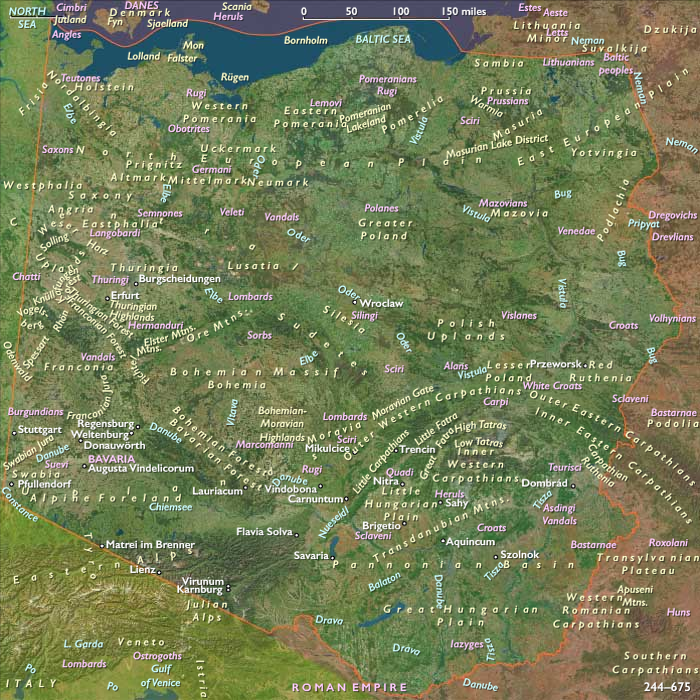
Between 424 and 435 CE, East Central Europe—including Poland, Czechia, Slovakia, Hungary, and those portions of Germany and Austria lying east of 10°E and north of a line stretching from roughly 48.2°N at 10°E southeastward to the Austro-Slovenian border near 46.7°N, 15.4°E—entered a decisive period marked by the emergence and expanding dominance of the Huns under the brothers Bleda and Attila, following the death of their uncle and predecessor, King Rua (Rugila) (d. 434). Their rise intensified Hunnic influence and further fragmented the remaining Roman authority along the Danube frontier. Nevertheless, the Rugii maintained diplomatic stability, skillfully navigating the shifting balance of power, while proto-Slavic communities persisted, maintaining their cultural coherence amid escalating Hunnic dominance.
Political and Military Developments
Leadership Transition: From Rua to Attila and Bleda
-
Following the death of King Rua in 434 CE, his nephews Bleda and Attila assumed joint leadership of the Huns, swiftly consolidating their authority and significantly expanding Hunnic military power across East Central Europe.
-
Under their rule, Hunnic dominance reached unprecedented heights, decisively reshaping regional geopolitics and establishing their realm as a formidable power.
Accelerated Roman Frontier Decline
-
Roman provinces (Pannonia Prima, Secunda, Savia, and Valeria) struggled severely under intensified Hunnic pressures, losing the capacity to maintain frontier integrity. Roman control became largely nominal, with real power increasingly passing to Hunnic rulers and local tribal leaders.
Rugian Diplomatic Resilience
-
Rugian communities maintained their stability and relative autonomy along the upper Tisza through skillful diplomacy, balancing relationships carefully with the ascendant Huns, fragmented Roman authorities, and neighboring Germanic groups.
Economic and Technological Developments
Localized Economic Adaptation
-
Regional economic structures adapted further to prolonged instability, shifting decisively toward local agriculture, pastoralism, and small-scale, community-based trade networks that operated cautiously under the shadow of Hunnic influence.
Frontier Infrastructure in Decline
-
Maintenance and improvements to Roman frontier fortifications and infrastructure declined substantially, limited mostly to essential defensive works responding to immediate Hunnic threats.
Cultural and Artistic Developments
Heightened Cultural Hybridization
-
Material culture increasingly reflected a strong Hun influence, integrated with Roman and Germanic elements. Jewelry, decorative objects, weaponry, and pottery demonstrated sophisticated cultural blending indicative of the era’s complex interactions.
Proto-Slavic Cultural Stability
-
Proto-Slavic populations remained culturally resilient, continuing their traditional ways of life and maintaining stable social structures despite intensified external pressures from dominant Hunnic and Germanic groups.
Settlement and Urban Development
Roman Frontier Towns in Decline
-
Roman frontier settlements (Carnuntum, Vindobona, Aquincum) deteriorated further in demographic size and economic function, primarily existing as military garrisons with limited civilian populations, struggling to respond effectively to escalating threats.
Rugian Settlements as Stable Centers
-
Rugian communities along the upper Tisza continued their relative stability and prosperity, serving as regional anchors amid broader instability and facilitating localized economic and diplomatic interactions.
Social and Religious Developments
Rugian Leadership Adaptation
-
Rugian tribal elites maintained internal cohesion and regional significance through adaptive diplomacy and strategic alliances, ensuring their continued autonomy despite growing Hunnic dominance.
Proto-Slavic Social Cohesion
-
Proto-Slavic communities maintained strong internal social hierarchies and religious practices, emphasizing collective resilience amid the profound regional transformations driven by Hunnic power.
Long-Term Consequences and Historical Significance
The era 424–435 CE was crucially significant for East Central Europe, marking the decisive rise of Attila and Bleda and the peak expansion of Hunnic authority. The continued erosion of Roman frontier control dramatically altered regional dynamics, while local groups such as the Rugii and proto-Slavic peoples adeptly maintained stability through diplomatic flexibility and cultural resilience. These developments set the stage for the dramatic events and further geopolitical transformations that would characterize subsequent decades, profoundly influencing the region's historical trajectory.
People
Groups
- Polytheism (“paganism”)
- Slavs, Proto-
- Rugii (East Germanic tribe )
- Goths (East Germanic tribe)
- Germans
- Christians, Early
- Noricum (Roman province)
- Pannonia Savia (Roman province)
- Pannonia Prima (Roman province)
- Pannonia Secunda (Roman province)
- Pannonia Valeria (Roman province)
- Hunnic Empire
- Roman Empire: Theodosian dynasty (Constantinople)
Topics
Commodoties
Subjects
Regions
Subregions
Related Events
Showing 10 events out of 59010 total
Years: 424 - 435
People
Groups
- Polytheism (“paganism”)
- Slavs, Proto-
- Rugii (East Germanic tribe )
- Goths (East Germanic tribe)
- Germans
- Christians, Early
- Noricum (Roman province)
- Pannonia Savia (Roman province)
- Pannonia Prima (Roman province)
- Pannonia Secunda (Roman province)
- Pannonia Valeria (Roman province)
- Hunnic Empire
- Roman Empire: Theodosian dynasty (Constantinople)
Topics
Commodoties
Subjects
Regions
Subregions