
East Central Europe (412–423 CE): Consolidation of …
Years: 412 - 423
East Central Europe (412–423 CE): Consolidation of Hunnic Power, Frontier Fragmentation, and Tribal Diplomacy
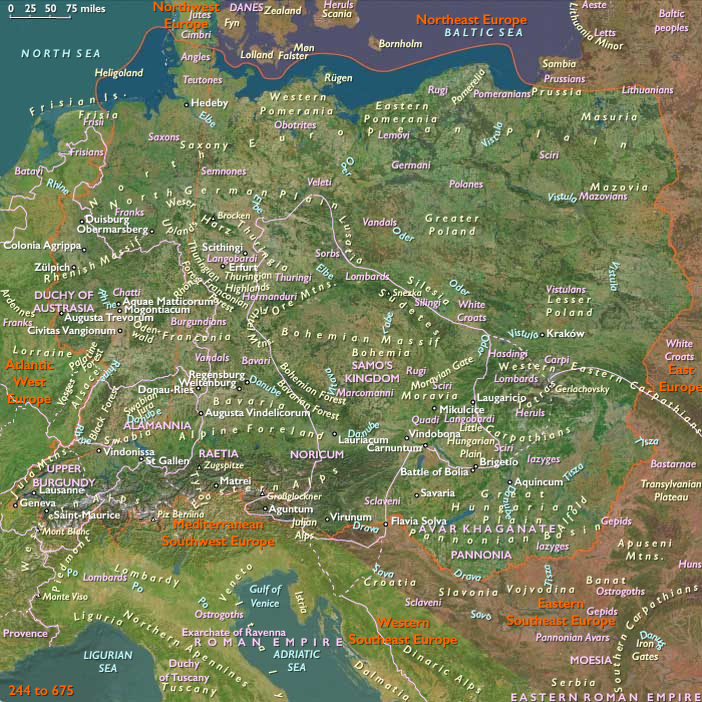
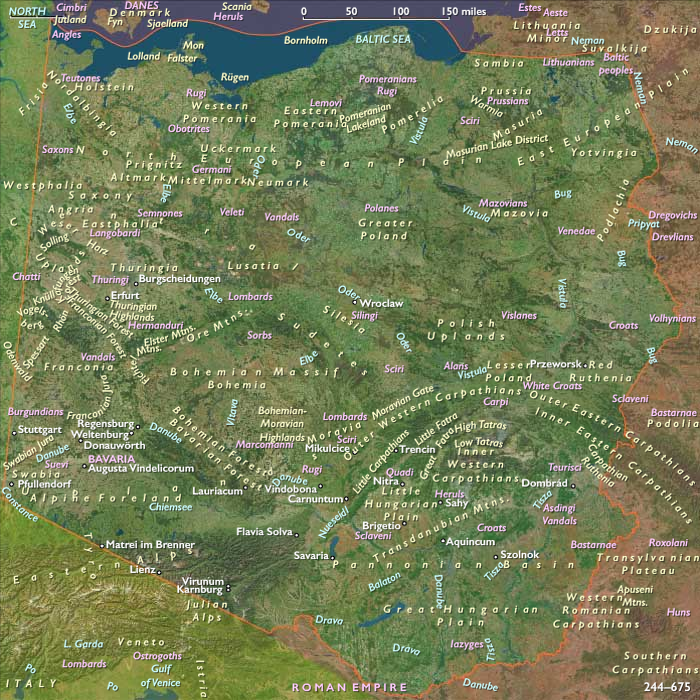
Between 412 and 423 CE, East Central Europe—covering Poland, Czechia, Slovakia, Hungary, and those portions of Germany and Austria lying east of 10°E and north of a line stretching from roughly 48.2°N at 10°E southeastward to the Austro-Slovenian border near 46.7°N, 15.4°E—entered an era defined by the increasing consolidation of Hunnic dominance under King Rua (Rugila). Roman frontier provinces along the Danube, already severely weakened, fragmented further under relentless Hun pressure. Despite growing regional instability, the Rugii adeptly navigated this shifting environment, preserving their autonomy through diplomatic flexibility. At the same time, proto-Slavic communities sustained their resilience and internal cohesion, adapting pragmatically to changing political realities.
Political and Military Developments
Rua’s Hunnic Consolidation
-
King Rua (Rugila) unified previously fragmented Hunnic factions, significantly expanding and solidifying Hunnic control over East Central Europe. Under Rua’s leadership, the Huns extended their influence, decisively reshaping regional power dynamics and exerting dominance over Germanic and local tribal groups.
Deepening Roman Frontier Fragmentation
-
Roman provinces (Pannonia Prima, Secunda, Savia, and Valeria) along the Danube deteriorated further under constant Hunnic pressure, effectively losing coherent administrative control. Roman frontier defenses weakened significantly, and military strength increasingly depended on unstable tribal alliances.
Rugian Diplomatic Adaptation
-
The Rugii maintained their stability along the upper Tisza through skillful diplomacy, balancing carefully between Hunnic dominance and residual Roman authority, thus preserving their autonomy and local prominence.
Economic and Technological Developments
Economic Decentralization and Localization
-
Growing instability accelerated economic decentralization. Regional economic activities shifted toward local agriculture, livestock raising, and small-scale production, adapting to the uncertainty brought by Hunnic power and fragmented Roman control.
Defensive Infrastructure Maintenance
-
Frontier infrastructure deteriorated further, although Roman and local communities maintained essential fortifications, roads, and settlements where strategically necessary, primarily for immediate military defense.
Cultural and Artistic Developments
Intensified Cultural Hybridization
-
Hunnic influence intensified in regional material culture, with art and crafts increasingly integrating Hun, Roman, and local Germanic styles. Jewelry, weaponry, and pottery reflected the emerging regional cultural fusion shaped by Hunnic dominance.
Proto-Slavic Cultural Resilience
-
Proto-Slavic communities continued their cultural stability, maintaining traditional practices and cautious interactions with neighboring Germanic and Hun populations, reinforcing their distinctive identity.
Settlement and Urban Development
Continued Decline of Frontier Towns
-
Roman settlements along the Danube frontier (Carnuntum, Vindobona, Aquincum) experienced continued demographic and economic decline, increasingly transforming into military outposts isolated from central Roman administration.
Stability of Rugian Communities
-
Rugian settlements remained stable, preserving their economic strength and regional significance, benefiting from diplomatic relations with Hunnic rulers and Roman remnants.
Social and Religious Developments
Adaptive Rugian Leadership
-
Rugian tribal leadership remained cohesive, successfully navigating regional complexities through diplomatic negotiations and balancing relationships with Huns and Romans, ensuring continued autonomy.
Proto-Slavic Social Cohesion
-
Proto-Slavic communities sustained resilient social structures, emphasizing internal cohesion, traditional religious practices, and pragmatic adaptation to regional shifts under Hunnic and Germanic influences.
Long-Term Consequences and Historical Significance
The era 412–423 CE was pivotal in East Central Europe's historical trajectory, characterized by the solidification of Hunnic dominance under Rua (Rugila), the fragmentation of Roman frontier control, and the adept diplomacy of local tribal groups, notably the Rugii. The continued resilience of proto-Slavic populations and the emergence of hybrid cultural forms set foundations for enduring regional diversity. These developments directly shaped the profound transformations and migrations that would dominate East Central Europe throughout the 5th century.
People
Groups
- Polytheism (“paganism”)
- Slavs, Proto-
- Rugii (East Germanic tribe )
- Goths (East Germanic tribe)
- Germans
- Christians, Early
- Noricum (Roman province)
- Pannonia Savia (Roman province)
- Pannonia Prima (Roman province)
- Pannonia Secunda (Roman province)
- Pannonia Valeria (Roman province)
- Hunnic Empire
- Roman Empire: Theodosian dynasty (Constantinople)
Topics
Commodoties
Subjects
Regions
Subregions
Years: 412 - 423
People
Groups
- Polytheism (“paganism”)
- Slavs, Proto-
- Rugii (East Germanic tribe )
- Goths (East Germanic tribe)
- Germans
- Christians, Early
- Noricum (Roman province)
- Pannonia Savia (Roman province)
- Pannonia Prima (Roman province)
- Pannonia Secunda (Roman province)
- Pannonia Valeria (Roman province)
- Hunnic Empire
- Roman Empire: Theodosian dynasty (Constantinople)
Topics
Commodoties
Subjects
Regions
Subregions