
East Central Europe (376–387 CE): Gothic Migration, …
Years: 376 - 387
East Central Europe (376–387 CE): Gothic Migration, Adrianople, and Frontier Upheaval
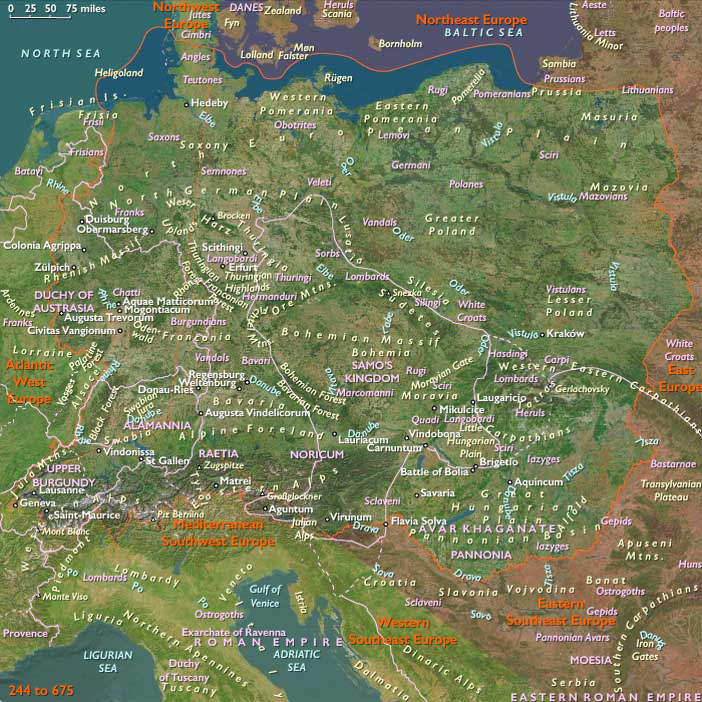
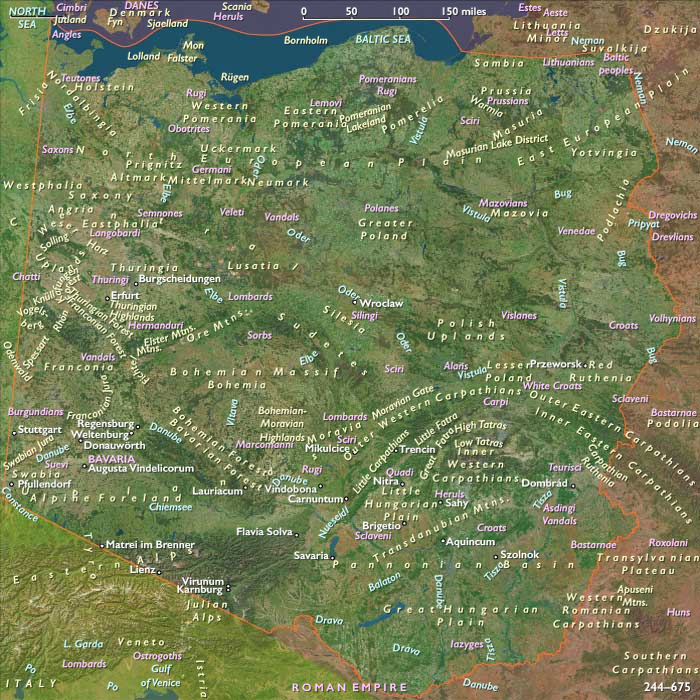
Between 376 and 387 CE, East Central Europe—covering Poland, Czechia, Slovakia, Hungary, and those portions of Germany and Austria lying east of 10°E and north of a line stretching from roughly 48.2°N at 10°E southeastward to the Austro-Slovenian border near 46.7°N, 15.4°E—experienced profound regional upheaval driven by major Gothic migrations and the catastrophic Battle of Adrianople (378 CE). The large-scale crossing of the Danube by Gothic tribes in 376 CE dramatically altered frontier stability, undermining Roman control in provinces like Pannonia Prima, Pannonia Secunda, Pannonia Savia, Pannonia Valeria, and Noricum, and profoundly affecting the political and social landscape. Amid this turmoil, previously stable communities such as the Rugii maintained their established positions near the upper Tisza, while proto-Slavic peoples persisted largely undisturbed, adapting cautiously to the shifting regional conditions.
Political and Military Developments
Gothic Migration and Frontier Collapse
-
In 376 CE, Gothic tribes crossed the Danube in massive numbers, fleeing pressure from Hunnic advances from the east. This mass migration overwhelmed Roman frontier defenses, triggering widespread turmoil and instability across East Central Europe and neighboring Roman provinces.
-
The devastating Roman defeat at the Battle of Adrianople (378 CE) resulted in Emperor Valens’s death, significantly weakening imperial authority and frontier control in the region.
Theodosius I’s Attempts at Stabilization
-
Emperor Theodosius I (379–395 CE) worked vigorously to restore stability along the Danube frontier, negotiating settlements with the Goths and reorganizing frontier defenses. Although partially successful, lasting damage to Roman provincial stability was already extensive.
Rugian Stability Amid Turmoil
-
Despite dramatic regional instability, the Rugii’s presence along the upper Tisza remained relatively secure. Their settlements provided stability amidst surrounding chaos, maintaining diplomatic relationships with weakened Roman authorities.
Economic and Technological Developments
Frontier Economic Disruption
-
The Gothic migrations and ensuing warfare disrupted frontier commerce severely, sharply reducing trade activity and causing economic hardship throughout the region.
Limited Infrastructure Maintenance
-
Roman infrastructure suffered significantly, with limited resources allocated primarily toward urgent military repairs and minimal maintenance of essential defensive networks.
Cultural and Artistic Developments
Artistic Expressions Reflecting Crisis
-
Cultural production emphasized survival, defense, and resilience. Material culture from this period, such as metalwork and ceramics, became simpler and more utilitarian, reflecting practical needs in uncertain times.
Continued Proto-Slavic Cultural Resilience
-
Proto-Slavic communities persisted culturally stable, cautiously adapting to regional instability without substantial cultural disruption.
Settlement and Urban Development
Frontier Towns under Severe Strain
-
Roman frontier towns (Carnuntum, Vindobona, Aquincum) struggled significantly, facing population losses, economic hardships, and damage from repeated incursions and disruptions.
Rugian Settlement Stability
-
Rugian settlements remained stable and relatively prosperous, providing crucial regional continuity amid the broader instability and migratory turmoil.
Social and Religious Developments
Rugian Leadership Continuity
-
Rugian leadership maintained social cohesion and strong local control, successfully navigating the complexities of regional instability.
Proto-Slavic Community Resilience
-
Proto-Slavic societies maintained resilient social structures and religious practices, reinforcing internal stability despite the external chaos brought by Gothic migrations and warfare.
Long-Term Consequences and Historical Significance
The era 376–387 CE dramatically reshaped the geopolitical landscape of East Central Europe. The Gothic migrations and the decisive Battle of Adrianople undermined Roman frontier security, triggering significant political realignments and long-lasting instability. However, communities such as the Rugii and proto-Slavic populations provided critical continuity, preserving social cohesion amid regional chaos. These events set the stage for profound historical transformations, influencing East Central Europe’s political, social, and cultural trajectory into the subsequent decades.
People
Groups
- Polytheism (“paganism”)
- Slavs, Proto-
- Finns
- Iazyges, or Iazygians
- Vandals (East Germanic tribe)
- Marcomanni (Germanic tribe)
- Rugii (East Germanic tribe )
- Germans
- Quadi (Germanic tribe)
- Goths (East Germanic tribe)
- Christians, Early
- Noricum (Roman province)
- Pannonia Savia (Roman province)
- Pannonia Prima (Roman province)
- Pannonia Secunda (Roman province)
- Pannonia Valeria (Roman province)
- Roman Empire: Constantinian dynasty (Constantinople)
- Roman Empire: Valentinian dynasty (Rome)
- Roman Empire: Theodosian dynasty (Constantinople)
Topics
Commodoties
Subjects
Regions
Subregions
Related Events
Showing 10 events out of 59617 total
Years: 376 - 387
People
Groups
- Polytheism (“paganism”)
- Slavs, Proto-
- Finns
- Iazyges, or Iazygians
- Vandals (East Germanic tribe)
- Marcomanni (Germanic tribe)
- Rugii (East Germanic tribe )
- Germans
- Quadi (Germanic tribe)
- Goths (East Germanic tribe)
- Christians, Early
- Noricum (Roman province)
- Pannonia Savia (Roman province)
- Pannonia Prima (Roman province)
- Pannonia Secunda (Roman province)
- Pannonia Valeria (Roman province)
- Roman Empire: Constantinian dynasty (Constantinople)
- Roman Empire: Valentinian dynasty (Rome)
- Roman Empire: Theodosian dynasty (Constantinople)
Topics
Commodoties
Subjects
Regions
Subregions