
East Central Europe (352–363 CE): Frontier Struggles …
Years: 352 - 363
East Central Europe (352–363 CE): Frontier Struggles and the Rise of Julian
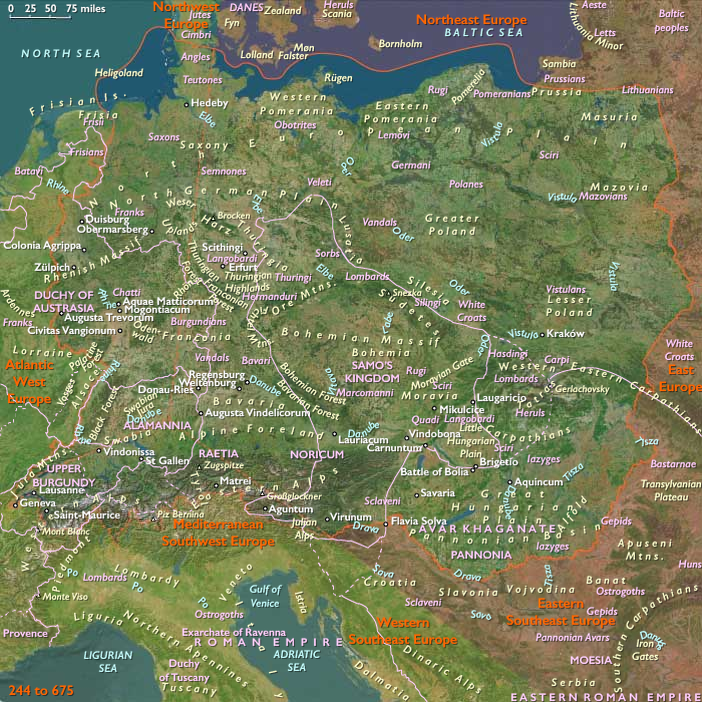
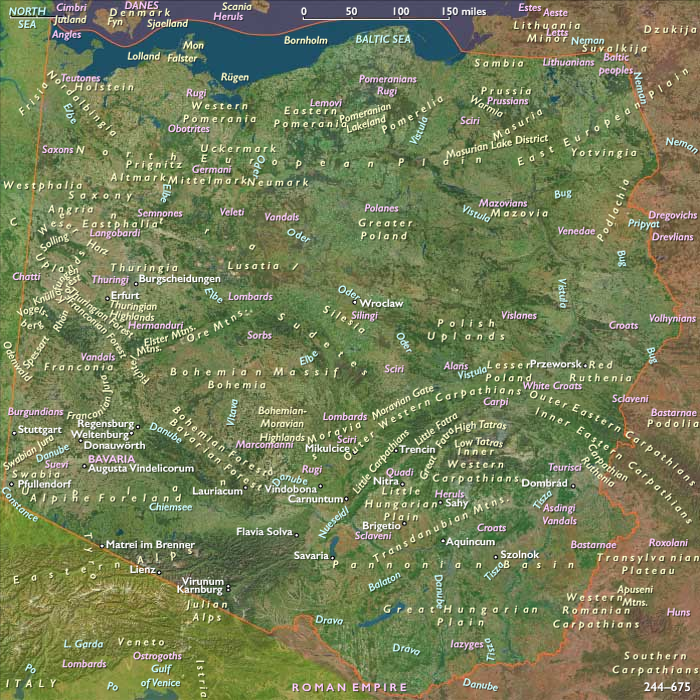
Between 352 and 363 CE, East Central Europe—covering Poland, Czechia, Slovakia, Hungary, and those portions of Germany and Austria lying east of 10°E and north of a line stretching from roughly 48.2°N at 10°E southeastward to the Austro-Slovenian border near 46.7°N, 15.4°E—experienced intensified frontier conflicts amid internal Roman turmoil under Emperors Constantius II (337–361 CE) and Julian the Apostate (361–363 CE). Gothic pressure along the Danube increased significantly, testing Roman military capacity and frontier fortifications. Nonetheless, the Rugii continued to consolidate their stable presence in Roman-controlled Pannonia, and proto-Slavic communities maintained steady cultural resilience, adjusting to the heightened regional tensions.
Political and Military Developments
Heightened Frontier Conflicts
-
Emperor Constantius II grappled with ongoing internal divisions, limiting effective Roman responses to increasing Gothic raids along the Danube.
-
Julian’s brief rule (361–363 CE) brought temporary efforts to strengthen frontier defenses, although significant improvements were short-lived due to his focus on eastern campaigns against Persia.
Increased Gothic Pressure
-
Gothic groups notably increased the frequency and intensity of their incursions, exploiting Roman political instability and military overstretch. Roman frontier provinces (Pannonia Superior, Pannonia Inferior, Noricum) experienced repeated conflicts and raids.
Rugian Stability amid Turmoil
-
Despite the instability, Rugian settlements near the upper Tisza maintained stable diplomatic and economic relations with Roman authorities, helping to anchor local frontier security and cohesion.
Economic and Technological Developments
Economic Stress and Disrupted Trade
-
Regional economic conditions suffered under repeated Gothic raids and internal Roman instability. Cross-border commerce, while continuing, faced increasing disruption, resulting in more cautious trade interactions.
Defensive Fortification Enhancements
-
Roman frontier settlements and fortifications, especially around Carnuntum, Vindobona, and Aquincum, received modest reinforcements and defensive upgrades, reflecting an urgent military priority.
Cultural and Artistic Developments
Defensive and Military Themes
-
Artistic production increasingly emphasized practical and defensive themes. Metalwork, ceramics, and jewelry reflected heightened security concerns, focusing on resilience rather than luxury or elaborate aesthetics.
Proto-Slavic Cultural Stability
-
Proto-Slavic populations continued to sustain their cultural traditions, remaining relatively unaffected culturally by intensified Gothic-Roman conflicts, maintaining social and economic cohesion.
Settlement and Urban Development
Fortified Frontier Towns
-
Frontier towns continued emphasizing military preparedness, focusing resources on defensive infrastructure and garrisons rather than economic or demographic growth.
Continued Rugian Integration
-
Rugian settlements along the Tisza region further stabilized, integrating closely with local Roman provincial communities, maintaining regional stability and providing a buffer against external threats.
Social and Religious Developments
Tribal Leadership Adaptation
-
Rugian tribal structures adapted successfully to regional instability, combining strong internal leadership with effective diplomatic relationships with Roman authorities.
Resilient Proto-Slavic Communities
-
Proto-Slavic communities remained internally cohesive, emphasizing traditional religious and communal practices to reinforce social solidarity amidst external conflicts.
Long-Term Consequences and Historical Significance
The era 352–363 CE represented a critical juncture for East Central Europe, characterized by intensified frontier conflicts and Gothic incursions amid Roman internal instability. The continued resilience of Rugian and proto-Slavic communities provided essential regional stability, shaping the region's cultural, social, and political landscape. These developments significantly influenced subsequent interactions, migrations, and the eventual reshaping of the broader historical trajectory of East Central Europe in late antiquity.
People
Groups
- Polytheism (“paganism”)
- Slavs, Proto-
- Finns
- Iazyges, or Iazygians
- Vandals (East Germanic tribe)
- Marcomanni (Germanic tribe)
- Rugii (East Germanic tribe )
- Goths (East Germanic tribe)
- Quadi (Germanic tribe)
- Germans
- Christians, Early
- Noricum (Roman province)
- Pannonia Savia (Roman province)
- Pannonia Secunda (Roman province)
- Pannonia Prima (Roman province)
- Pannonia Valeria (Roman province)
- Roman Empire: Constantinian dynasty (Constantinople)
Topics
Commodoties
Subjects
Regions
Subregions
Related Events
Showing 10 events out of 59783 total
Years: 352 - 363
People
Groups
- Polytheism (“paganism”)
- Slavs, Proto-
- Finns
- Iazyges, or Iazygians
- Vandals (East Germanic tribe)
- Marcomanni (Germanic tribe)
- Rugii (East Germanic tribe )
- Goths (East Germanic tribe)
- Quadi (Germanic tribe)
- Germans
- Christians, Early
- Noricum (Roman province)
- Pannonia Savia (Roman province)
- Pannonia Secunda (Roman province)
- Pannonia Prima (Roman province)
- Pannonia Valeria (Roman province)
- Roman Empire: Constantinian dynasty (Constantinople)
Topics
Commodoties
Subjects
Regions
Subregions