
East Central Europe (340–351 CE): Rising Frontier …
Years: 340 - 351
East Central Europe (340–351 CE): Rising Frontier Tensions and Regional Realignments
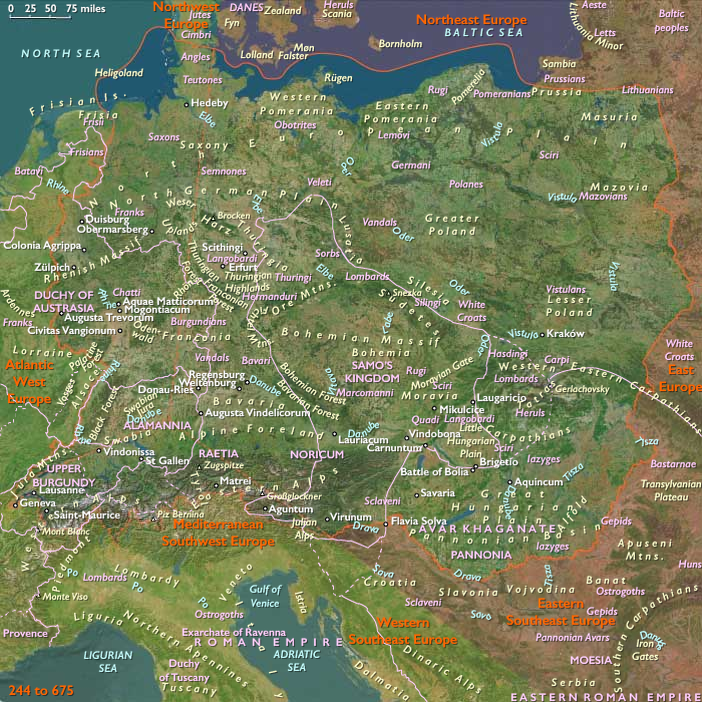
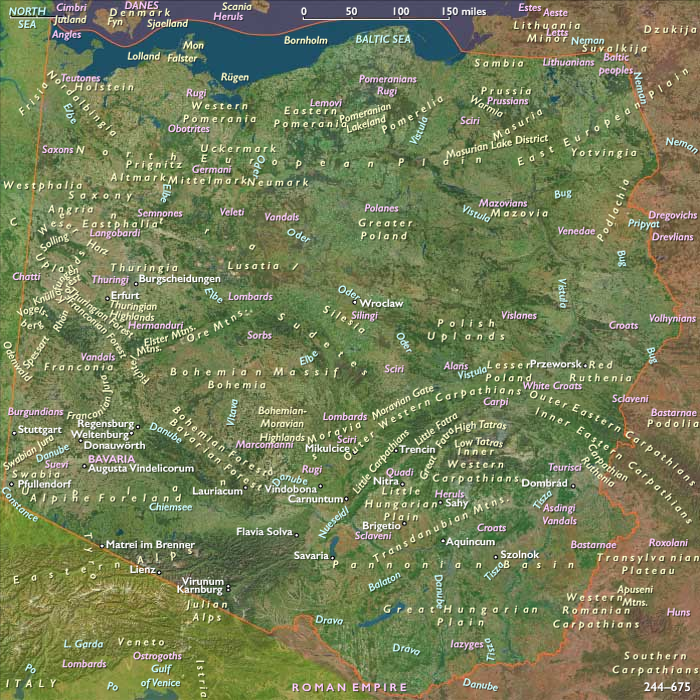
Between 340 and 351 CE, East Central Europe—covering Poland, Czechia, Slovakia, Hungary, and those portions of Germany and Austria lying east of 10°E and north of a line stretching from roughly 48.2°N at 10°E southeastward to the Austro-Slovenian border near 46.7°N, 15.4°E—began facing increased frontier pressures following the death of Constantine the Great (337 CE). Internal Roman political divisions weakened frontier stability, prompting growing assertiveness among tribal groups, notably the Goths, while the recently settled Rugii continued to consolidate their presence in Roman Pannonia. The proto-Slavic communities of Eastern Europe remained stable but increasingly felt external pressures amid shifting regional dynamics.
Political and Military Developments
Post-Constantine Frontier Instability
-
Constantine’s death (337 CE) triggered internal political instability among his successors, weakening Roman control over the Danube provinces (Pannonia Superior, Pannonia Inferior, and Noricum) and creating vulnerabilities along the frontier.
-
Frontier defenses, while still robust, became strained by periodic tribal incursions and internal Roman power struggles.
Growing Gothic Pressure
-
The Goths intensified their pressure and influence in Eastern Europe, increasing incursions along the Danube frontier. While large-scale invasions were limited, frequent smaller raids and diplomatic tensions heightened regional insecurity.
Rugian Stability in Pannonia
-
The Rugii, settled along the upper Tisza, maintained stable relations with Roman authorities despite the increasing instability. Their settlements provided a stabilizing influence on local frontier dynamics.
Economic and Technological Developments
Economic Stress along the Frontier
-
Growing tensions led to disruptions in frontier trade, though economic exchanges continued cautiously between Roman provinces, Rugian settlements, and neighboring tribal communities.
Continued Infrastructure Maintenance
-
Roman frontier infrastructure maintenance continued at a reduced pace due to internal divisions and resource constraints, emphasizing defensive fortifications and critical trade routes.
Cultural and Artistic Developments
Adaptive Cultural Expressions
-
Cultural and artistic production adapted to regional uncertainties, increasingly reflecting defensive themes in metalwork, pottery, and jewelry. Nevertheless, cultural interactions and exchanges between Romans, Rugii, and neighboring tribes persisted.
Continued Proto-Slavic Cultural Resilience
-
Proto-Slavic communities maintained stable cultural identities despite growing Gothic dominance, preserving traditional customs and lifestyles.
Settlement and Urban Development
Frontier Town Fortifications Strengthened
-
Roman frontier settlements (Carnuntum, Vindobona, Aquincum) focused heavily on defensive enhancements due to growing regional instability, with limited economic and demographic expansion.
Rugian Settlement Consolidation
-
Rugian settlements along the upper Tisza further solidified their presence, strengthening local economic ties and integrating into frontier dynamics, providing stability amid regional tensions.
Social and Religious Developments
Rugian Leadership Stability
-
Rugian tribal structures remained stable, successfully balancing diplomatic cooperation with Roman authorities and independent tribal governance.
Proto-Slavic Community Cohesion
-
Proto-Slavic societies sustained stable internal social structures and religious practices, reinforcing community resilience amidst growing external pressures.
Long-Term Consequences and Historical Significance
The era 340–351 CE marked the beginning of renewed frontier tensions in East Central Europe following Constantine’s death. Growing Gothic assertiveness and internal Roman instability signaled challenges ahead, even as Rugian and proto-Slavic communities maintained relative stability. These shifting dynamics foreshadowed intensified regional conflicts and realignments, significantly influencing the subsequent historical development of the region.
People
Groups
- Polytheism (“paganism”)
- Slavs, Proto-
- Finns
- Iazyges, or Iazygians
- Vandals (East Germanic tribe)
- Marcomanni (Germanic tribe)
- Rugii (East Germanic tribe )
- Goths (East Germanic tribe)
- Quadi (Germanic tribe)
- Germans
- Christians, Early
- Noricum (Roman province)
- Pannonia Savia (Roman province)
- Pannonia Secunda (Roman province)
- Pannonia Prima (Roman province)
- Pannonia Valeria (Roman province)
- Roman Empire: Constantinian dynasty (Constantinople)
Topics
Commodoties
Subjects
Regions
Subregions
Years: 340 - 351
People
Groups
- Polytheism (“paganism”)
- Slavs, Proto-
- Finns
- Iazyges, or Iazygians
- Vandals (East Germanic tribe)
- Marcomanni (Germanic tribe)
- Rugii (East Germanic tribe )
- Goths (East Germanic tribe)
- Quadi (Germanic tribe)
- Germans
- Christians, Early
- Noricum (Roman province)
- Pannonia Savia (Roman province)
- Pannonia Secunda (Roman province)
- Pannonia Prima (Roman province)
- Pannonia Valeria (Roman province)
- Roman Empire: Constantinian dynasty (Constantinople)
Topics
Commodoties
Subjects
Regions
Subregions