
Central Europe (2637 – 910 BCE): Bronze …
Years: 2637BCE - 910BCE
Central Europe (2637 – 910 BCE): Bronze and Early Iron — From Tumulus Lords to Celtic Heartlands
Regional Overview
Throughout the Bronze and Early Iron Ages, Central Europe became the pivotal crossroads of the continent.
Between the Danube, the Rhine, and the Alps, diverse communities merged steppe innovations, alpine metallurgy, and Mediterranean trade into a single cultural engine.
From the Urnfield horizon to the first Hallstatt chieftaincies, these centuries forged the foundations of the European Iron Age and the rise of the Celtic world.
Geography and Environment
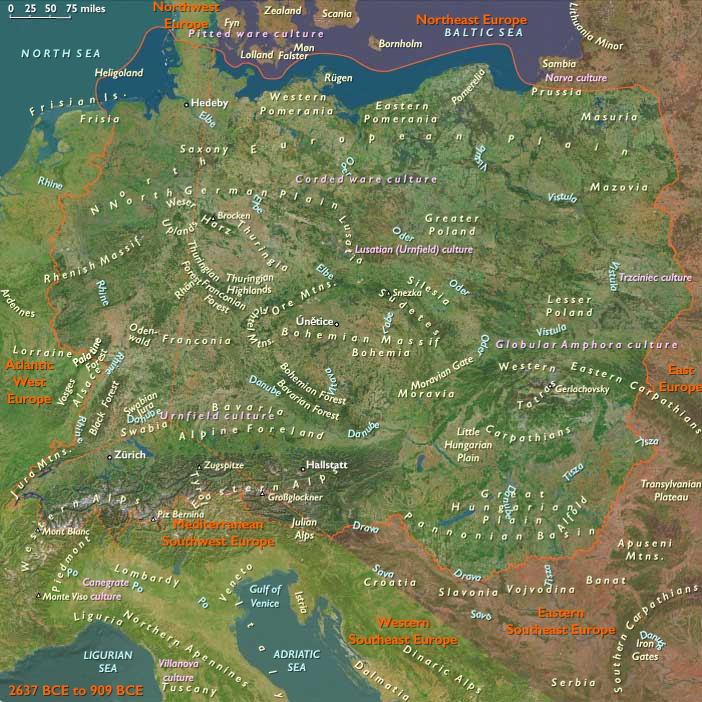
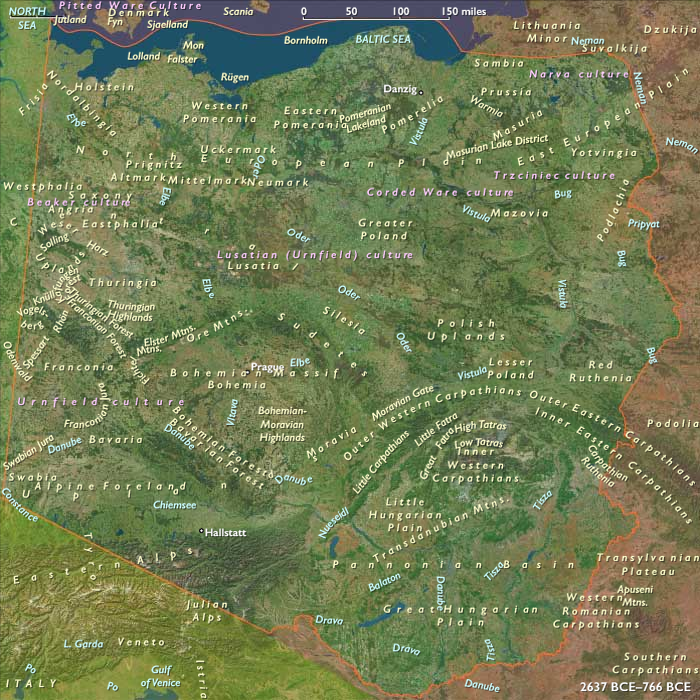
Central Europe spanned the Carpathian Basin, the Danube–Rhine corridor, and the Alpine passes, blending lowland plains, forested uplands, and mountain valleys.
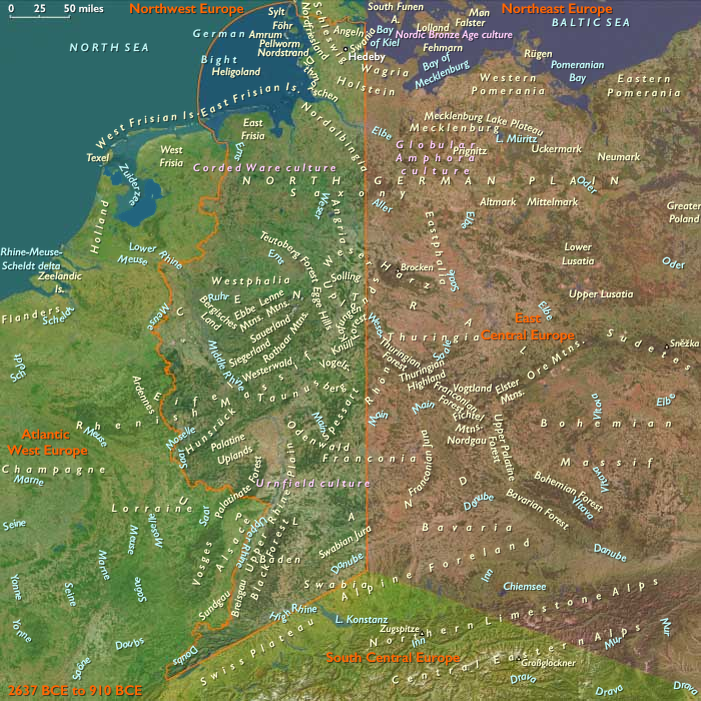
Rivers such as the Danube, Rhine, Elbe, and Vistula connected the Baltic to the Adriatic and Black Seas.
Fertile loess soils and rich copper, tin, and salt deposits made the region both agriculturally and industrially self-sufficient.
The Alps and Carpathians functioned as both barriers and trade conduits—routes of amber, metal, and wine.
Climate and Environmental Shifts
Holocene warmth persisted through most of the second millennium BCE.
Variable rainfall and periodic cooling encouraged agricultural diversification—cereals in valleys, pastures in uplands.
Late in the epoch, wetter phases and forest regrowth pushed communities toward deforestation, terracing, and intensified stock-keeping.
Societies and Political Developments
Eastern Sector
In the Carpathian and Danubian worlds, Tumulus and later Urnfield cultures expanded hillfort systems and cremation rites.
Lusatian and Thracian–Dacian forelands combined farming with bronze industries.
By the early first millennium BCE, warrior elites and wagon burials signaled stratification and links to steppe neighbors such as the Cimmerians.
Southern Sector
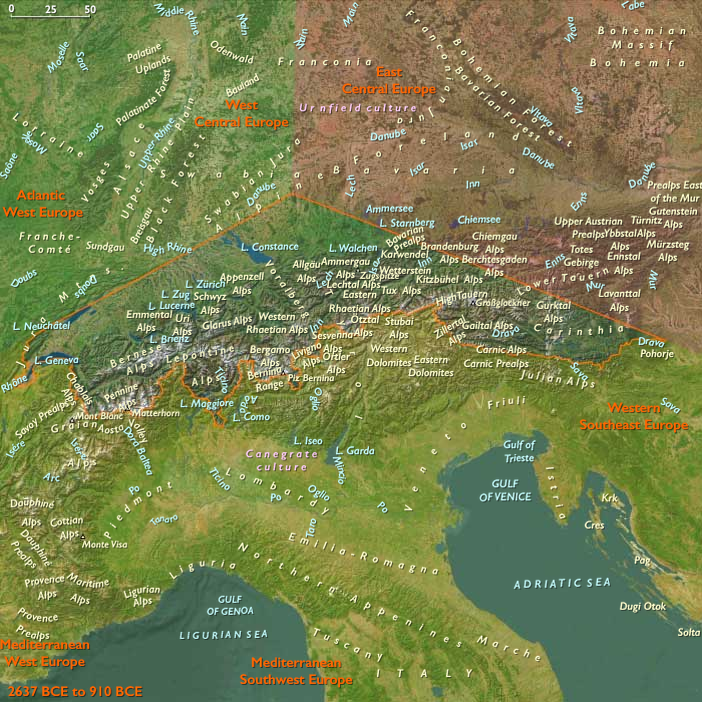
Across the Alpine arc and Swiss Plateau, Tumulus and Urnfield societies dominated, succeeded by early Hallstatt communities (c. 1200–800 BCE).
Mining towns near Hallstatt and in the Tyrol extracted salt and copper, while fortified hilltop villages guarded key passes.
These highland chiefdoms pioneered the alliance of trade and chieftain power that would characterize later Celtic aristocracies.
Western Sector
Along the Rhine and Jura, Urnfield cultures gave way to the first Hallstatt tumuli and elite hillforts.
Iron technology arrived early, intensifying agriculture and warfare.
By the late first millennium BCE, proto-urban oppida and riverine trade hubs connected Celtic societies to the Mediterranean through Etruscan and Greek merchants.
Economy and Technology
Agriculture was diverse and intensive—barley, wheat, millet, and legumes, with vineyards and orchards in warmer belts.
Bronze and later iron metallurgy transformed production, while wheel-turned pottery, loom weaving, and salt extraction underpinned domestic economies.
Trade networks radiated outward:
-
Amber from the Baltic,
-
Copper and tin from the Alps and Bohemia,
-
Wine and fineware from Italy and the Aegean.
Caravans and river barges moved these commodities along Danube and Rhine routes.
Belief and Symbolism
Mortuary practice mirrored social hierarchy:
Cremation cemeteries (Urnfields) democratized burial; later tumulus graves emphasized elite display with swords, wagons, and gold ornaments.
Sun motifs, spiral and geometric art, and ritual feasting vessels reflected a cosmology centered on solar cycles, fertility, and ancestry.
Hillfort shrines and spring sanctuaries connected warfare, water, and wealth in a unified spiritual landscape.
Movement and Interaction Corridors
-
Amber Route: Baltic to Adriatic through Bohemia and the Danube.
-
Danube corridor: the great east–west artery joining steppe and Aegean.
-
Alpine passes: Brenner, Gotthard, and Great St Bernard carried salt, copper, and wine.
-
Rhine–Moselle network: linked the North Sea to Mediterranean Gaul.
These corridors fostered exchange and cultural fusion on a continental scale.
Environmental Adaptation and Resilience
Mixed farming systems, transhumant herding, and surplus storage secured resilience against climatic swings.
Pass control and salt monopolies funded chieftaincies that reinvested in defense and infrastructure.
The transition to iron tools boosted productivity and allowed population growth even in marginal uplands.
Regional Synthesis and Long-Term Significance
By 910 BCE, Central Europe had become the dynamic core of continental prehistory:
a landscape of fortified hillforts, warrior aristocracies, and long-distance merchants.
From Bohemia to the Rhine, the Urnfield–Hallstatt continuum united metallurgy, mobility, and mythology, setting the stage for the Celtic La Tène world and, eventually, its confrontation and fusion with Rome.
Groups
- Corded Ware culture
- Bell-Beaker, or beaker, culture
- Unetice culture
- Tumulus culture
- Urnfield culture
- Lusatian culture
Topics
- Neolithic Europe
- Subboreal Period
- Abrolhos Transgression
- 4.2 kiloyear BP aridification event
- Rottnest Transgression
- Younger Subboreal Period
- Iron Age Europe
Commodoties
Subjects
Regions
Subregions
Years: 2637BCE - 910BCE
Groups
- Corded Ware culture
- Bell-Beaker, or beaker, culture
- Unetice culture
- Tumulus culture
- Urnfield culture
- Lusatian culture
Topics
- Neolithic Europe
- Subboreal Period
- Abrolhos Transgression
- 4.2 kiloyear BP aridification event
- Rottnest Transgression
- Younger Subboreal Period
- Iron Age Europe
Commodoties
Subjects
Regions
Subregions