
Central Europe (1828–1971 CE) Revolutions, Empires’ …
Years: 1828 - 1971
Central Europe (1828–1971 CE)
Revolutions, Empires’ Collapse, and Divided Modernities
Geography & Environmental Context
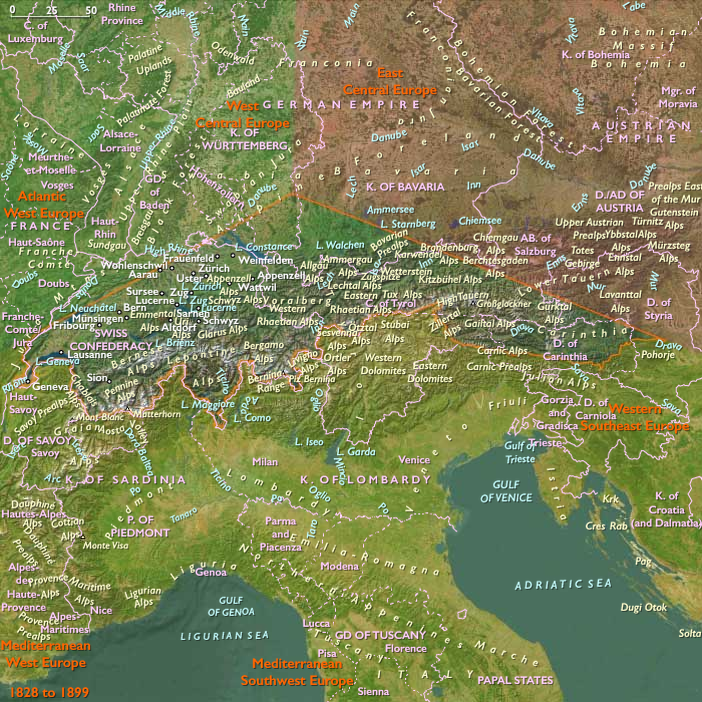
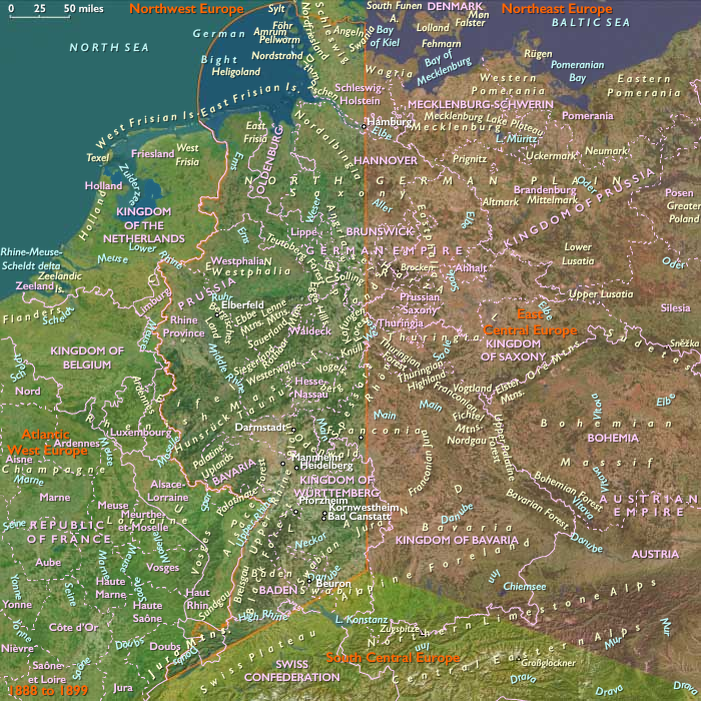
Central Europe includes three subregions:
-
East Central Europe — Germany east of 10°E, Czechia (Bohemia and Moravia), Slovakia, Poland, and Hungary.
-
West Central Europe — Germany west of 10°E, the Rhine-adjacent far northwest of Switzerland (Basel region), and parts of Luxembourg.
-
South Central Europe — western and southern Austria (except Salzburg), Liechtenstein, extreme southwestern Germany, and southeastern Switzerland, including Geneva and Zurich.
Anchors include the Rhine, Danube, and Elbe river systems; the Bohemian Massif, Alps, and Carpathian foothills; and the major cities of Berlin, Vienna, Munich, Warsaw, Budapest, Prague, Zurich, and Basel. The region’s continental climate favored cereals, vineyards, and industry, while its rivers and mountain passes made it Europe’s political and commercial hinge.
Climate & Environmental Shifts
Central Europe’s temperate climate supported intensive agriculture but was prone to seasonal floods and cold winters. Deforestation for coal and iron production expanded through the 19th century, giving way to reforestation and hydropower projects in the 20th. Industrial pollution grew around the Ruhr, Upper Silesia, and Vienna basins. After 1945, massive reconstruction and dam building (e.g., on the Danube and Rhine) reshaped river systems.
Subsistence & Settlement
-
Agrarian reform and industrialization: The 19th century brought enclosure of communal lands, railway expansion, and industrial zones in Saxony, Silesia, and Bohemia. Peasants became factory laborers; textile, iron, and machinery industries transformed cities like Lodz, Prague, and Leipzig.
-
Urban growth: Capitals such as Berlin, Vienna, and Budapest became imperial metropolises, centers of administration, culture, and intellectual life.
-
Postwar economies: After 1945, reconstruction divided trajectories: Western Germany and Switzerland pursued market economies, while Eastern bloc states collectivized agriculture and nationalized industries.
-
Migration: Millions of ethnic Germans, Poles, and Hungarians were displaced by wars and redrawn borders, particularly after World War II.
Technology & Material Culture
-
19th century innovations: Railways (Berlin–Vienna, Leipzig–Prague), telegraphs, and mechanized mills spread industrial modernity. Steelworks in Silesia and the Ruhr and engineering in Zurich and Vienna marked technological leadership.
-
20th century transformation: Electrification, automobiles (Volkswagen, Skoda), and modern architecture (Bauhaus, Werkbund) reshaped landscapes. Socialist-era prefabricated housing and Western modernist reconstruction reflected competing visions of progress.
-
Cultural industries: Printing, publishing, and music (Beethoven, Brahms, Dvořák, Liszt) gave the region global cultural authority that persisted into modern cinema and design.
Movement & Interaction Corridors
-
River routes: The Rhine–Danube corridor remained Europe’s main commercial artery.
-
Rail and road networks: Linked industrial centers to North Sea ports and Balkan markets.
-
Migration corridors: Seasonal labor moved from Poland and Galicia to Germany and Austria; postwar emigration carried intellectuals and refugees westward.
-
Air and Cold War lines: By mid-20th century, the Iron Curtain cut traditional corridors, dividing East Central Europe from West Germany, Austria, and Switzerland.
Cultural & Symbolic Expressions
Central Europe’s identity blended Enlightenment cosmopolitanism, nationalism, and later ideological rivalry.
-
Romantic nationalism: Poets and composers celebrated folk culture—Chopin, Smetana, Petőfi, Heine—fueling independence movements.
-
Modernism: The early 20th century produced Klimt, Kafka, Freud, and Schoenberg, whose works redefined art and thought.
-
Religious and philosophical diversity: Catholic, Protestant, and Jewish traditions coexisted, though the Holocaust annihilated much of Jewish life.
-
Postwar culture: Socialist realism dominated Eastern states, while Western zones embraced modernist abstraction and existentialism.
Environmental Adaptation & Resilience
Rural cooperatives, forest management, and Alpine water engineering stabilized agriculture and power. Urban reconstruction after WWII demanded massive planning and rebuilding; green belts and public transit shaped livable postwar cities. Pollution crises in mining basins spurred early environmental regulation by the 1960s.
Political & Military Shocks
-
Revolutions of 1848: Swept Vienna, Berlin, Budapest, and Prague; liberal constitutions and national aspirations briefly flourished before repression.
-
Unifications: The Austro-Hungarian Compromise (1867) created a dual monarchy; Germany unified under Prussia (1871).
-
World War I: Dissolved empires; Austria-Hungary and Germany collapsed; new states—Poland, Czechoslovakia, Yugoslavia, and Hungary—emerged.
-
Interwar fragility: Economic turmoil and fascist movements rose amid minority tensions.
-
World War II: Nazi expansion and genocide devastated the region; millions perished in camps such as Auschwitz, Theresienstadt, and Dachau.
-
Postwar division: Germany split into FRG and GDR; Eastern Europe entered the Soviet sphere. The Berlin Airlift (1948–49) and Hungarian Uprising (1956) symbolized Cold War polarization.
-
Reconstruction and détente: By the 1960s, West Germany’s “economic miracle” contrasted with Eastern stagnation; Prague Spring (1968) and its suppression revealed limits to reform.
Transition
Between 1828 and 1971, Central Europe transformed from a region of empires and revolutions into the symbolic heart of Europe’s ideological divide. Railways, factories, and universities forged modern society; wars and genocide shattered it; reconstruction and partition redefined it. The Rhine–Danube basin remained Europe’s industrial spine, while Vienna, Berlin, and Warsaw embodied its creative and political ferment. By 1971, Central Europe stood divided yet vital—where memory of empire, trauma of war, and promise of renewal continued to shape the continent’s future.
People
Groups
- Jews
- Hungarian people
- Poles (West Slavs)
- Slovaks (West Slavs)
- Czechs [formerly Bohemians] (West Slavs)
- Christians, Roman Catholic
- Austria, Archduchy of
- Protestantism
- Hungary, Kingdom of
- Prussia, Kingdom of
- Austrian Empire
- Saxony, Kingdom of
- Bavaria, Kingdom of
- Poland, Congress Kingdom of
- German Confederation
- Saxony, Prussian Province of
- German Confederation, North
- Austria-Hungary
- German Empire (“Second Reich”)
- Poland, (Regency) Kingdom of
- Saxony, German State of
- Czechoslovakia
- Poland, Second Republic of
- Hungary, Democratic Republic of
- Germany, Weimar Republic of
- Austria, (First) Republic of
- Bavaria, Republic of
- Bavaria, Free State of
- Hungarian Soviet Republic
- Hungary, Kingdom of
- Union of Soviet Socialist Republics (USSR), or Soviet Union
- Germany, Third Reich
- Polish “Secret State”
- Austria, Allied-occupied
- Czechoslovakia (restored)
- Bavaria, U.S.-occupied
- Saxony-Anhalt, German State of
- Hungary, Republic of
- Poland, Republic of
- Saxony, Lower, German Federal State of
- Germany, East (German Democratic Republic)
- Germany, West (Federal Republic of Germany)
- Hungary, Republic of
- Poland, People's Republic of Poland, or Polish People's Republic
- Austria, (Second) Republic of
- Czechoslovak Socialist Republic
Topics
- 1848, Revolutions of
- First World War on the Eastern front
- World War, First (World War I)
- Depression, Great
- World War, Second (World War II)
- Second World War on the Western Front
- Cold War
- Hungarian Revolt of 1956
- Berlin Wall Crisis
- Prague Spring
- Polish Revolt
Commodoties
Subjects
Regions

Subregions

Years: 1828 - 1971
People
Groups
- Jews
- Hungarian people
- Poles (West Slavs)
- Slovaks (West Slavs)
- Czechs [formerly Bohemians] (West Slavs)
- Christians, Roman Catholic
- Austria, Archduchy of
- Protestantism
- Hungary, Kingdom of
- Prussia, Kingdom of
- Austrian Empire
- Saxony, Kingdom of
- Bavaria, Kingdom of
- Poland, Congress Kingdom of
- German Confederation
- Saxony, Prussian Province of
- German Confederation, North
- Austria-Hungary
- German Empire (“Second Reich”)
- Poland, (Regency) Kingdom of
- Saxony, German State of
- Czechoslovakia
- Poland, Second Republic of
- Hungary, Democratic Republic of
- Germany, Weimar Republic of
- Austria, (First) Republic of
- Bavaria, Republic of
- Bavaria, Free State of
- Hungarian Soviet Republic
- Hungary, Kingdom of
- Union of Soviet Socialist Republics (USSR), or Soviet Union
- Germany, Third Reich
- Polish “Secret State”
- Austria, Allied-occupied
- Czechoslovakia (restored)
- Bavaria, U.S.-occupied
- Saxony-Anhalt, German State of
- Hungary, Republic of
- Poland, Republic of
- Saxony, Lower, German Federal State of
- Germany, East (German Democratic Republic)
- Germany, West (Federal Republic of Germany)
- Hungary, Republic of
- Poland, People's Republic of Poland, or Polish People's Republic
- Austria, (Second) Republic of
- Czechoslovak Socialist Republic
Topics
- 1848, Revolutions of
- First World War on the Eastern front
- World War, First (World War I)
- Depression, Great
- World War, Second (World War II)
- Second World War on the Western Front
- Cold War
- Hungarian Revolt of 1956
- Berlin Wall Crisis
- Prague Spring
- Polish Revolt
Commodoties
Subjects
Regions
Subregions