
East Central Europe (1792–1803 CE): Partition of …
Years: 1792 - 1803
East Central Europe (1792–1803 CE): Partition of Poland, Revolutionary Turmoil, and Napoleonic Reordering
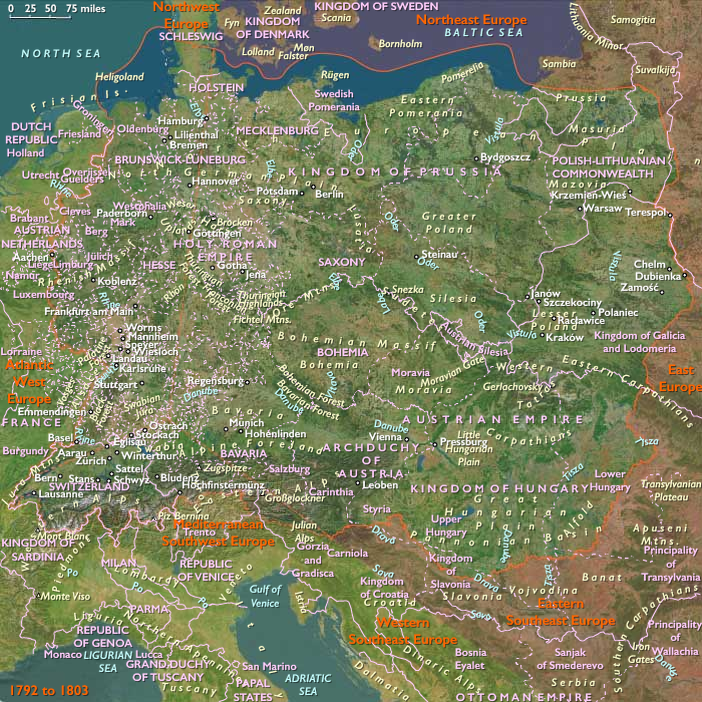
Between 1792 and 1803 CE, East Central Europe—including Poland, Czechia, Slovakia, Hungary, and territories within eastern Germany and Austria east of 10°E and north of the defined boundary—underwent dramatic geopolitical upheaval characterized by the final partitions of Poland, revolutionary turmoil linked to the aftermath of the French Revolution, and significant reshaping of political alliances due to the expanding influence of Napoleon Bonaparte. These developments fundamentally altered the region’s political landscape, decisively ending Polish statehood, challenging Austrian and Prussian dominance, and laying foundations for future nationalist movements.
Political and Military Developments
Final Partitions of Poland (1793, 1795)
-
Facing intense pressure from neighboring powers, the Polish–Lithuanian Commonwealth struggled to maintain sovereignty despite its progressive Constitution of 1791.
-
Second Partition (1793): Following the War in Defense of the Constitution (1792), Prussia and Russia annexed significant Polish territories, drastically weakening Polish autonomy.
-
Kościuszko Uprising (1794): Polish national hero Tadeusz Kościuszko led a significant but ultimately unsuccessful insurrection aimed at reclaiming independence, highlighting deepening patriotic sentiments but accelerating Poland’s dissolution.
-
Third Partition (1795): Austria, Prussia, and Russia completely dismantled the Commonwealth, eradicating independent Polish sovereignty for over a century.
Revolutionary Impact and Austrian Instability
-
The ideological turmoil unleashed by the French Revolution (1789) profoundly impacted East Central Europe, particularly within Habsburg Austria:
-
Emperor Francis II (1792–1835), alarmed by revolutionary ideals, adopted conservative policies, restricting political freedoms and tightening administrative control.
-
The region saw widespread social and intellectual ferment as revolutionary and nationalist ideas spread, despite intensified imperial censorship and police surveillance.
-
Prussian Ambitions and Territorial Expansion
-
Prussia, under King Frederick William II (1786–1797) and subsequently Frederick William III (1797–1840), expanded significantly by gaining Polish territories, notably Warsaw, through the partitions.
-
Strengthened economically and militarily, Prussia continued consolidating its eastern provinces, enhancing administrative efficiency, and extending its regional influence.
Napoleonic Reordering Begins
-
The rise of Napoleon profoundly affected East Central European politics:
-
Napoleon’s early victories (1796–1797) against Austria in northern Italy forced the Habsburg Monarchy into disadvantageous peace treaties (Treaty of Campo Formio, 1797), altering regional power balances and provoking extensive military and administrative reforms within Austria.
-
Economic and Technological Developments
Economic Realignments
-
The partitions of Poland shifted regional trade routes and economic structures, integrating Polish territories more deeply into Austrian, Prussian, and Russian economic frameworks.
-
Prussia capitalized economically by further developing agriculture, industry, and trade in newly acquired territories, enhancing prosperity in cities like Warsaw, Poznań (Posen), and Gdańsk (Danzig).
Industrial and Agricultural Progress
-
Industrial growth accelerated, notably in Austrian and Prussian regions, stimulated by modernized agricultural practices and increased demand from growing urban populations.
Cultural and Artistic Developments
Intensified National Identity and Cultural Revival
-
Despite political subjugation, Polish national identity deepened significantly, expressed in literature, music, and art that celebrated Polish history, culture, and struggle for independence.
-
Notable intellectual and cultural figures emerged, including poets and historians who laid the foundations for future nationalist movements in Poland, Bohemia, and Hungary.
Enlightenment and Romantic Influence
-
Enlightenment ideals and early Romanticism profoundly influenced regional intellectual and artistic culture, particularly in Prague, Vienna, and Budapest, fueling demands for greater cultural and political autonomy among the Czech and Hungarian intelligentsia.
Settlement and Urban Development
Urban Integration and Expansion
-
Major urban centers, notably Vienna, Warsaw, Prague, and Budapest, expanded infrastructure and economic activities, benefiting from increased administrative centralization and economic integration resulting from partition-driven reorganization.
Social and Religious Developments
Social Instability and Class Tensions
-
The partitions and revolutionary turmoil heightened social tensions, with increased dissatisfaction among peasants, urban workers, and the growing middle class due to rigid social hierarchies and limited political representation.
Conservative Religious Policies
-
Both Austria and Prussia enacted conservative religious policies aimed at countering revolutionary secularism, reinforcing traditional Catholic (Austria) and Protestant (Prussia) institutions to maintain social control.
Long-Term Consequences and Historical Significance
The period 1792–1803 CE marked a decisive turning point in East Central Europe’s history. The dissolution of Poland profoundly reshaped regional geopolitics, permanently altering political boundaries and intensifying nationalist aspirations. Revolutionary ideas continued spreading, significantly influencing cultural, social, and political developments throughout the region. The emergence of Napoleon Bonaparte as a dominant European figure began a transformative era, setting the stage for major realignments that would define East Central Europe’s trajectory in the early nineteenth century.
People
- Francis II, Holy Roman Emperor
- Frederick William II of Prussia
- Frederick William III of Prussia
- Frederick the Great
- Gotthold Ephraim Lessing
- Joseph Haydn
- Joseph II, Holy Roman Emperor
- Maria Theresa
- Napoleon
- Tadeusz Kościuszko
- Wolfgang Amadeus Mozart
Groups
- Jews
- Germany, Kingdom of (within the Holy Roman Empire)
- Holy Roman Empire
- Christians, Roman Catholic
- Christians, Eastern Orthodox
- Austria, Archduchy of
- Holy Roman Empire
- Saxony, Electorate of
- Protestantism
- Hungary, Kingdom of
- Polish-Lithuanian Commonwealth (Commonwealth of the Two Nations)
- Habsburg Monarchy, or Empire
- Bohemia, Kingdom of
- Bavaria, Electorate of
- Moravian Margravate
- Prussia, Kingdom of
- Russian Empire
- Galicia and Lodomeria, Kingdom of
- French First Republic
Topics
- French Revolution
- Polish-Russian War of 1792
- Poland, Second Partition of
- Warsaw Uprising of 1794
- Poland, Third Partition of
- Napoleonic Wars
Commodoties
Subjects
Regions
Subregions
Years: 1792 - 1803
People
- Francis II, Holy Roman Emperor
- Frederick William II of Prussia
- Frederick William III of Prussia
- Frederick the Great
- Gotthold Ephraim Lessing
- Joseph Haydn
- Joseph II, Holy Roman Emperor
- Maria Theresa
- Napoleon
- Tadeusz Kościuszko
- Wolfgang Amadeus Mozart
Groups
- Jews
- Germany, Kingdom of (within the Holy Roman Empire)
- Holy Roman Empire
- Christians, Roman Catholic
- Christians, Eastern Orthodox
- Austria, Archduchy of
- Holy Roman Empire
- Saxony, Electorate of
- Protestantism
- Hungary, Kingdom of
- Polish-Lithuanian Commonwealth (Commonwealth of the Two Nations)
- Habsburg Monarchy, or Empire
- Bohemia, Kingdom of
- Bavaria, Electorate of
- Moravian Margravate
- Prussia, Kingdom of
- Russian Empire
- Galicia and Lodomeria, Kingdom of
- French First Republic
Topics
- French Revolution
- Polish-Russian War of 1792
- Poland, Second Partition of
- Warsaw Uprising of 1794
- Poland, Third Partition of
- Napoleonic Wars
Commodoties
Subjects
Regions
Subregions