
East Central Europe (1780–1791 CE): Joseph II’s …
Years: 1780 - 1791
East Central Europe (1780–1791 CE): Joseph II’s Radical Reforms, Prussian Ascendancy, and Growing Polish Vulnerability
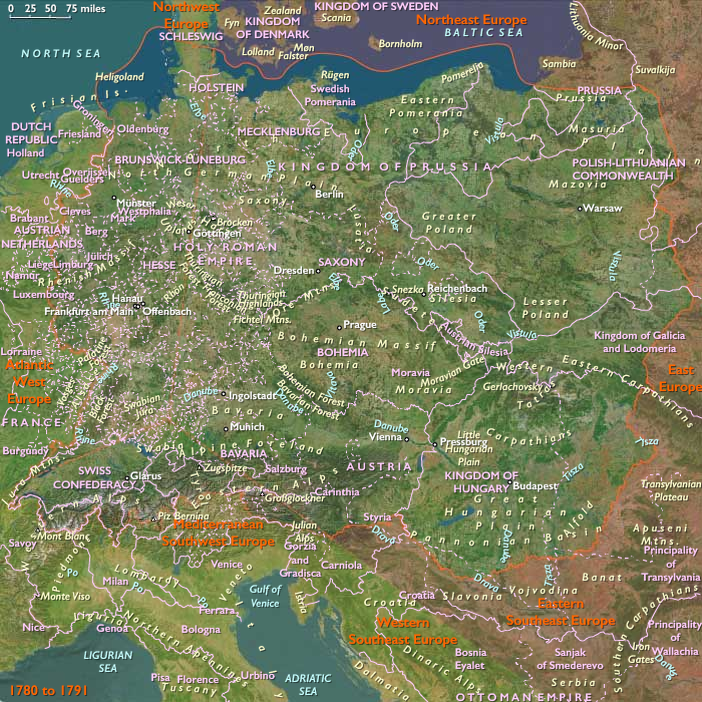
Between 1780 and 1791 CE, East Central Europe—comprising modern-day Poland, Czechia, Slovakia, Hungary, and those regions of eastern Germany and Austria east of 10°E and north of the defined boundary—experienced significant internal reforms, intensified geopolitical rivalries, and increasing vulnerability of the Polish–Lithuanian Commonwealth. Dominated by the ambitious reforms of Joseph II of Austria, the era saw heightened tensions between the Habsburg Monarchy and Prussia, and growing threats from an increasingly assertive Russia. These developments set the stage for dramatic political and territorial upheavals.
Political and Military Developments
Joseph II’s Radical Reforms in Austria (1780–1790)
-
Following the death of Maria Theresa in 1780, her son Joseph II (r. 1780–1790) accelerated extensive Enlightenment reforms in the Habsburg domains, aiming at radical modernization:
-
Abolition of serfdom (1781), dramatically reshaping rural social structures.
-
Centralization of administrative and judicial systems to reduce noble power.
-
Imposition of German as the official administrative language (1784), sparking resistance among non-German populations in Hungary, Czechia, Slovakia, and Galicia.
-
-
Although driven by Enlightenment ideals, Joseph’s reforms provoked widespread backlash, particularly among Hungarian nobles, Slovak and Czech intellectuals, and Polish elites in Galicia, ultimately leading to significant unrest and political instability.
Continued Polish Vulnerability and Constitutional Efforts
-
The Polish–Lithuanian Commonwealth, significantly weakened after the First Partition (1772), sought internal reforms to stave off further decline:
-
The Great Sejm (1788–1792) convened, aiming for sweeping constitutional reform to strengthen central authority and reduce foreign interference.
-
On May 3, 1791, Poland adopted the progressive Constitution of May 3, Europe's first modern codified national constitution, introducing significant political reforms, centralizing governance, and attempting to restore Polish sovereignty.
-
Prussian Ascendancy under Frederick II and Frederick William II
-
Frederick the Great (r. 1740–1786) consolidated Prussian territorial gains, enhancing the kingdom’s economic strength, administrative efficiency, and military power.
-
His successor, Frederick William II (1786–1797), pursued a cautious but assertive foreign policy, positioning Prussia as a critical rival to Austria and actively monitoring developments in Poland, setting the stage for future intervention.
Economic and Technological Developments
Economic Growth and Agricultural Modernization
-
Agricultural reforms, notably Joseph II’s abolition of serfdom in Austria and improved farming methods, significantly increased agricultural productivity and rural prosperity across the region, despite causing considerable social disruption.
-
Prussia continued agricultural and economic advancements, particularly in West Prussia, benefiting from fertile lands, Baltic trade, and efficient administrative practices.
Industrial and Commercial Advances
-
Industrial and commercial activities expanded notably in urban centers such as Vienna, Prague, Budapest, Leipzig, and Wrocław (Breslau), enhancing trade networks connecting East Central Europe to broader European markets.
Cultural and Artistic Developments
Intellectual Vibrancy and Enlightenment Influence
-
Joseph II’s reforms and patronage significantly influenced intellectual and cultural life, with Vienna and Prague emerging as prominent centers of Enlightenment thought, artistic innovation, and educational reform.
-
Key Enlightenment thinkers and cultural figures, including composers Wolfgang Amadeus Mozart and Joseph Haydn, flourished during this period, significantly enriching regional cultural heritage.
National Awakening in Hungary, Czechia, and Poland
-
Rising national consciousness emerged strongly in response to Joseph II’s centralizing reforms:
-
Hungarian nobles, Czech intellectuals, and Polish elites increasingly articulated distinctive national identities, advocating linguistic and cultural autonomy.
-
Literary and cultural movements strengthened national identities, laying the foundations for future national struggles and cultural revivals.
-
Settlement and Urban Development
Accelerated Urban Expansion
-
Major cities such as Vienna, Prague, Budapest, Leipzig, and Warsaw expanded significantly in size, infrastructure, and population, becoming vibrant centers of trade, culture, and intellectual discourse.
-
New administrative and civic structures supported urban growth, reflecting intensified central governance and cultural patronage.
Social and Religious Developments
Transformation of Social Structures
-
Joseph II’s abolition of serfdom profoundly altered social hierarchies, empowering peasants economically yet sparking significant noble resistance and societal tensions throughout Austria, Bohemia, Moravia, Hungary, and Galicia.
Religious Reform and Toleration
-
Joseph II continued to advocate religious tolerance and reform:
-
Edicts such as the Patent of Toleration (1781) significantly relaxed religious restrictions, allowing greater religious freedom for Protestants, Jews, and Orthodox Christians, though encountering opposition from conservative Catholic clergy.
-
Long-Term Consequences and Historical Significance
The period 1780–1791 CE was pivotal for East Central Europe. Joseph II’s ambitious but controversial reforms radically reshaped social, economic, and political landscapes within the Austrian domains, stimulating both modernization and nationalist backlash. Poland’s groundbreaking Constitution of May 3 represented a last attempt to reclaim sovereignty, though it intensified regional geopolitical tensions. Prussia continued to consolidate power, setting the stage for intensified rivalry with Austria and further partitions of Poland. Collectively, these transformations profoundly influenced the region’s historical trajectory, laying foundations for subsequent national movements, revolutionary upheavals, and geopolitical realignments into the nineteenth century.
People
- Frederick William II of Prussia
- Frederick the Great
- Gotthold Ephraim Lessing
- Joseph Haydn
- Joseph II, Holy Roman Emperor
- Maria Theresa
- Wolfgang Amadeus Mozart
Groups
- Jews
- Germany, Kingdom of (within the Holy Roman Empire)
- Holy Roman Empire
- Christians, Roman Catholic
- Christians, Eastern Orthodox
- Austria, Archduchy of
- Holy Roman Empire
- Saxony, Electorate of
- Protestantism
- Hungary, Kingdom of
- Polish-Lithuanian Commonwealth (Commonwealth of the Two Nations)
- Habsburg Monarchy, or Empire
- Bohemia, Kingdom of
- Bavaria, Electorate of
- Moravian Margravate
- Prussia, Kingdom of
- Russian Empire
- Galicia and Lodomeria, Kingdom of
Topics
Commodoties
Subjects
- Commerce
- Architecture
- Painting and Drawing
- Labor and Service
- Decorative arts
- Conflict
- Faith
- Government
- Scholarship
- Custom and Law
Regions
Subregions
Years: 1780 - 1791
People
- Frederick William II of Prussia
- Frederick the Great
- Gotthold Ephraim Lessing
- Joseph Haydn
- Joseph II, Holy Roman Emperor
- Maria Theresa
- Wolfgang Amadeus Mozart
Groups
- Jews
- Germany, Kingdom of (within the Holy Roman Empire)
- Holy Roman Empire
- Christians, Roman Catholic
- Christians, Eastern Orthodox
- Austria, Archduchy of
- Holy Roman Empire
- Saxony, Electorate of
- Protestantism
- Hungary, Kingdom of
- Polish-Lithuanian Commonwealth (Commonwealth of the Two Nations)
- Habsburg Monarchy, or Empire
- Bohemia, Kingdom of
- Bavaria, Electorate of
- Moravian Margravate
- Prussia, Kingdom of
- Russian Empire
- Galicia and Lodomeria, Kingdom of
Topics
Commodoties
Subjects
- Commerce
- Architecture
- Painting and Drawing
- Labor and Service
- Decorative arts
- Conflict
- Faith
- Government
- Scholarship
- Custom and Law
Regions
Subregions