
East Central Europe (1732–1743 CE): War of …
Years: 1732 - 1743
East Central Europe (1732–1743 CE): War of the Polish Succession, Pragmatic Sanction Diplomacy, and Prussian Strengthening
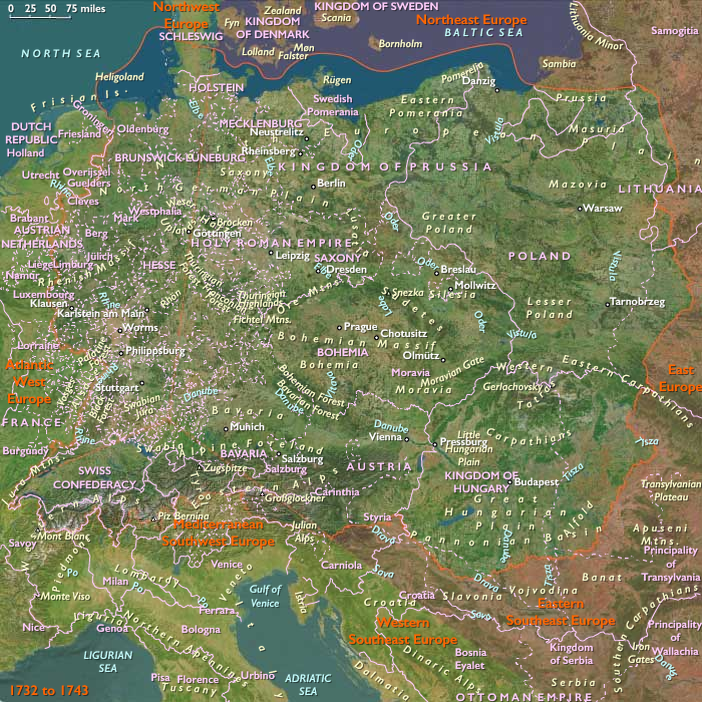
Between 1732 and 1743 CE, East Central Europe—including modern-day Poland, Czechia, Slovakia, Hungary, and eastern Germany and Austria east of 10°E and north of the defined boundary—experienced significant geopolitical upheaval, most notably the War of the Polish Succession (1733–1738), continued diplomatic maneuvering over the Habsburg succession, further strengthening of Prussian military and bureaucratic capabilities, and steady economic and cultural growth under Enlightenment influences. This era critically shaped the region’s political dynamics, setting the stage for subsequent pivotal mid-century conflicts.
Political and Military Developments
War of the Polish Succession (1733–1738)
-
Following the death of King Augustus II the Strong in 1733, Poland-Lithuania plunged into a succession crisis. The election of Stanisław Leszczyński, supported by France, triggered the War of the Polish Succession against Augustus II’s son, Augustus III, backed by Russia and Austria.
-
The conflict, primarily a proxy struggle among major European powers, saw Poland become a battleground for foreign armies, ultimately resulting in Augustus III’s victory (confirmed by the Treaty of Vienna, 1738), further deepening Polish political instability and dependence on external powers.
Continued Pragmatic Sanction Diplomacy and European Alignments
-
Emperor Charles VI’s persistent diplomatic efforts succeeded in formally securing acceptance of the Pragmatic Sanction by major powers, notably France, through the 1738 Treaty of Vienna, guaranteeing the succession of his daughter, Maria Theresa.
-
Despite diplomatic agreements, unresolved tensions lingered, anticipating future conflicts upon Charles VI’s death in 1740.
Death of Charles VI and the Outbreak of the War of the Austrian Succession (1740)
-
Charles VI’s death in 1740 ignited the War of the Austrian Succession, as rival powers challenged Maria Theresa’s right to inherit the Habsburg dominions.
-
Frederick II (the Great) of Prussia immediately invaded Austrian Silesia (1740–1742), initiating the First Silesian War, profoundly reshaping East Central European geopolitics.
Prussian Military Expansion and Strengthening
-
Prussia, under Frederick William I (1713–1740) and his successor Frederick II (from 1740), significantly enhanced its military strength, bureaucratic efficiency, and centralized governance, transforming the kingdom into a formidable regional power capable of challenging Habsburg authority.
Economic and Technological Developments
Regional Economic Resilience Amid Conflict
-
Despite ongoing conflicts, economic conditions across East Central Europe remained relatively robust. Urban centers such as Vienna, Prague, Leipzig, and Dresden maintained prosperity through regional trade and manufacturing.
-
Agricultural productivity continued rising, bolstered by improved cultivation methods, animal husbandry, and gradual adoption of crop rotations and new crops.
Infrastructure and Industrial Development
-
Prussian investment in infrastructure, including roads and canals, boosted regional economic efficiency, laying early foundations for industrial growth.
-
Austria and Bohemia improved river navigation and infrastructure, enhancing connectivity to broader European markets.
Cultural and Artistic Developments
Enlightenment Thought and Cultural Patronage
-
Enlightenment ideas continued influencing intellectual and cultural life, with royal courts in Vienna, Dresden, and Berlin patronizing intellectual societies, artistic circles, and educational institutions.
-
Architectural and artistic production flourished, notably in the Baroque and early Rococo styles, reflecting regional wealth and cultural sophistication.
Educational and Intellectual Advancement
-
Universities and intellectual societies in Vienna, Prague, and Berlin promoted education, science, and philosophical inquiry, significantly contributing to regional cultural vitality and intellectual exchange.
Settlement and Urban Development
Urban Growth Amid Political Turmoil
-
Urbanization continued steadily, driven by economic resilience and stable demographic conditions. Key cities—including Vienna, Prague, Dresden, Leipzig, Berlin, and Warsaw—maintained robust economic and demographic growth.
-
Infrastructure enhancements and improved urban planning further strengthened urban centers’ administrative and commercial roles across East Central Europe.
Social and Religious Developments
Aristocratic Power and Social Structures
-
Aristocratic power remained deeply entrenched, particularly in Poland-Lithuania, Hungary, and Bohemia, limiting centralized governance and reinforcing noble privileges, even as state centralization advanced in Prussia and Austria.
-
Social stability persisted despite aristocratic tensions, largely supported by economic prosperity and effective bureaucratic management.
Religious Tolerance and Continued Diversity
-
Moderate religious tolerance persisted across the region, notably in Austrian territories and Prussia, fostering social cohesion among diverse religious communities, including Protestants, Catholics, and Jewish minorities.
Long-Term Consequences and Historical Significance
The period from 1732 to 1743 CE critically reshaped East Central Europe, laying foundations for mid-century conflicts. The War of the Polish Succession deepened Poland’s vulnerability and political fragmentation, amplifying foreign influence. Diplomatic agreements surrounding the Pragmatic Sanction set the stage for major conflicts upon Charles VI’s death, leading directly to the transformative War of the Austrian Succession. Prussia’s emergence as a regional military powerhouse under Frederick II dramatically shifted the balance of power, decisively influencing subsequent geopolitical alignments. Continued economic resilience, urban expansion, and Enlightenment cultural flourishing underscored the region’s growing sophistication, providing essential foundations for future political, social, and economic developments.
People
- Augustus II the Strong
- Augustus III of Poland
- Charles VI, Holy Roman Emperor, King of the Romans (King of Germany)
- Frederick William I of Prussia
- Frederick the Great
- Maria Theresa
- Stanisław Leszczyński
Groups
- Jews
- Germany, Kingdom of (within the Holy Roman Empire)
- Holy Roman Empire
- Christians, Roman Catholic
- Christians, Eastern Orthodox
- Austria, Archduchy of
- Holy Roman Empire
- Saxony, Electorate of
- Protestantism
- Hungary, Kingdom of
- Polish-Lithuanian Commonwealth (Commonwealth of the Two Nations)
- Habsburg Monarchy, or Empire
- Bohemia, Kingdom of
- Prussia, Kingdom of
- Britain, Kingdom of Great
Topics
Commodoties
Subjects
Regions
Subregions
Related Events
Showing 10 events out of 27621 total
Years: 1732 - 1743
People
- Augustus II the Strong
- Augustus III of Poland
- Charles VI, Holy Roman Emperor, King of the Romans (King of Germany)
- Frederick William I of Prussia
- Frederick the Great
- Maria Theresa
- Stanisław Leszczyński
Groups
- Jews
- Germany, Kingdom of (within the Holy Roman Empire)
- Holy Roman Empire
- Christians, Roman Catholic
- Christians, Eastern Orthodox
- Austria, Archduchy of
- Holy Roman Empire
- Saxony, Electorate of
- Protestantism
- Hungary, Kingdom of
- Polish-Lithuanian Commonwealth (Commonwealth of the Two Nations)
- Habsburg Monarchy, or Empire
- Bohemia, Kingdom of
- Prussia, Kingdom of
- Britain, Kingdom of Great
Topics
Commodoties
Subjects
Regions
Subregions