
East Central Europe (1708–1719 CE): Swedish Decline, …
Years: 1708 - 1719
East Central Europe (1708–1719 CE): Swedish Decline, Russian Ascendancy, and Pragmatic Sanction
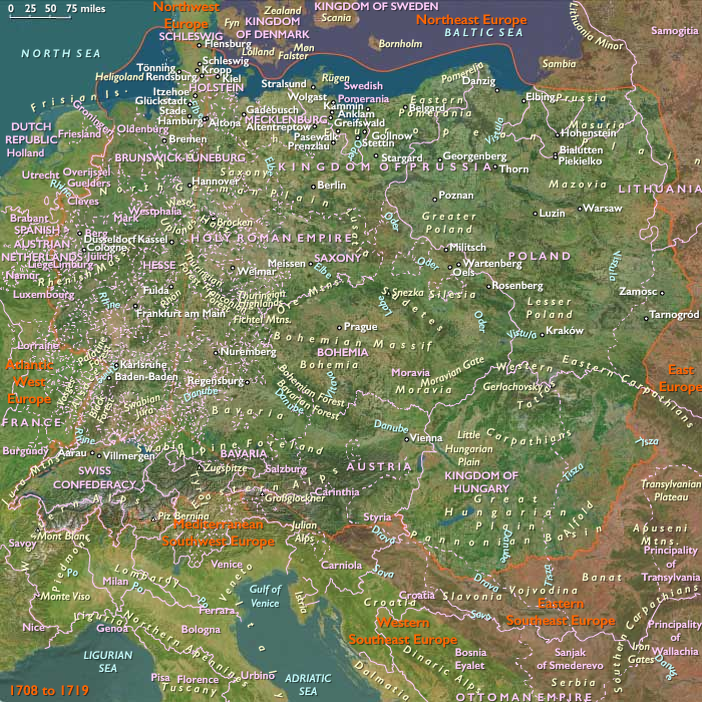
Between 1708 and 1719 CE, East Central Europe—including the territories of modern-day Poland, Czechia, Slovakia, Hungary, and eastern parts of Germany and Austria east of 10°E and north of the previously defined boundary—experienced decisive shifts resulting from the climax of the Great Northern War, further Habsburg consolidation under Emperor Charles VI, and the pivotal dynastic decision embodied in the Pragmatic Sanction of 1713.
Political and Military Developments
Decisive Turn of the Great Northern War (1709–1719)
-
The turning point of the Great Northern War came with the crushing defeat of Sweden's Charles XII by Russian forces under Peter the Great at the Battle of Poltava (1709). This event decisively ended Swedish dominance in the Baltic and drastically shifted regional power dynamics toward Russia.
-
Following Poltava, Saxon-Polish King Augustus II the Strong was restored to power, ending the brief reign of the pro-Swedish king Stanisław Leszczyński, and reaffirming Polish-Lithuanian ties to Saxony and Russia.
Habsburg Consolidation under Charles VI (1711–1719)
-
Charles VI succeeded Joseph I as Holy Roman Emperor (1711–1740), continuing Habsburg consolidation in Hungary and reinforcing imperial administration in Bohemia and the Austrian hereditary lands.
-
He successfully ended the Rákóczi Uprising (1703–1711) with the Treaty of Szatmár (1711), securing Habsburg authority in Hungary by offering amnesty, religious concessions, and the preservation of Hungarian estates' traditional privileges.
Pragmatic Sanction (1713)
-
To secure the Habsburg hereditary lands for his daughter Maria Theresa, Emperor Charles VI issued the Pragmatic Sanction of 1713, ensuring unified succession across Austria, Bohemia, Hungary, and other Habsburg territories. This measure, though initially accepted by many European powers, laid groundwork for future conflict upon his death.
Expansion and Stability of the Kingdom of Prussia
-
Under King Frederick William I (1713–1740), the recently established Kingdom of Prussia experienced significant administrative and military reform, laying foundations for future Prussian military might.
-
Frederick William I increased central control, enhanced state bureaucracy, and developed Europe's most disciplined and effective standing army, profoundly reshaping regional political dynamics.
Economic and Technological Developments
Post-War Economic Recovery and Trade Reorientation
-
The end of large-scale hostilities in Poland-Lithuania, Brandenburg-Prussia, and Hungary allowed significant economic recovery. Agriculture, manufacturing, and commerce rebounded, though trade routes increasingly realigned eastward toward growing Russian markets.
-
Prussia, in particular, benefited significantly from improved infrastructure and administrative reforms under Frederick William I, enhancing agricultural productivity, industry, and trade.
Habsburg Economic and Infrastructure Reforms
-
The Habsburg administration under Charles VI implemented comprehensive economic and administrative reforms, particularly in Hungary and Bohemia. These measures improved taxation, infrastructure, and agricultural output, promoting stability and growth.
Cultural and Artistic Developments
Continued Flourishing of Baroque Culture
-
Baroque culture remained dominant, particularly in Habsburg territories (Vienna, Prague, Budapest), Saxon Dresden, and newly stable Polish-Lithuanian cities like Kraków and Warsaw.
-
Court patronage under Augustus II in Dresden produced some of Europe's most opulent Baroque architecture and cultural patronage, notably in music and the arts.
Educational Expansion and Scientific Inquiry
-
Educational and intellectual institutions expanded significantly, notably in Brandenburg-Prussia, Austria, and Bohemia. These institutions increasingly focused on science, medicine, and modern philosophical inquiry, reflecting early Enlightenment influences from Western Europe.
Settlement and Urban Development
Urban Recovery and Infrastructure Improvements
-
Cities throughout East Central Europe recovered and expanded significantly after wartime disruptions, notably Berlin, Vienna, Prague, Dresden, Leipzig, Warsaw, and Kraków, marked by improved infrastructure, fortified defenses, and urban beautification projects.
-
In Prussia, administrative centralization fostered urban expansion, notably transforming Berlin into a thriving administrative, commercial, and military center.
Social and Religious Developments
Religious Policy and Tolerance in Habsburg Territories
-
Charles VI promoted moderate religious tolerance policies, especially in Hungary post-1711, easing tensions and stabilizing relations with Protestant Hungarian estates, thus significantly improving internal stability and loyalty to the crown.
Aristocratic Authority and Administrative Centralization
-
Aristocratic dominance remained influential throughout Poland-Lithuania, Hungary, and Saxony, although centralizing monarchs in Prussia and Habsburg lands steadily curtailed noble autonomy, advancing state centralization and bureaucratic control.
Long-Term Consequences and Historical Significance
The period 1708–1719 CE decisively reshaped East Central Europe’s political, economic, and cultural landscape. The catastrophic Swedish defeat at Poltava marked a permanent shift of Baltic dominance toward Russia, significantly impacting regional geopolitics. Augustus II's restoration strengthened Polish-Lithuanian connections to Saxony and Russia, though it deepened internal tensions. Habsburg consolidation under Charles VI secured stability in Hungary and Bohemia, while the Pragmatic Sanction significantly influenced future dynastic politics. Prussian military and administrative reforms under Frederick William I laid the foundations for its rise as a dominant European power. Collectively, these events established the conditions for significant transformations in East Central Europe, shaping the geopolitical and cultural order for the remainder of the 18th century.
People
- Augustus II the Strong
- Charles VI, Holy Roman Emperor, King of the Romans (King of Germany)
- Charles XII of Sweden
- Francis II Rákóczi
- Frederick William I of Prussia
- Joseph I
- Maria Theresa
- Peter the Great
- Stanisław Leszczyński
Groups
- Holy Roman Empire
- Germany, Kingdom of (within the Holy Roman Empire)
- Christians, Roman Catholic
- Christians, Eastern Orthodox
- Austria, Archduchy of
- Holy Roman Empire
- Salzburg, Archbishopric of
- Saxony, Electorate of
- Ottoman Empire
- Protestantism
- Sweden, (second) Kingdom of
- Hungary, Royal
- Russia, Tsardom of
- Swedish Empire
- Hungary, Kingdom of
- Polish-Lithuanian Commonwealth (Commonwealth of the Two Nations)
- Habsburg Monarchy, or Empire
- Brandenburg-Prussia
- Bohemia, Kingdom of
- Prussia, Kingdom of
Topics
Commodoties
Subjects
Regions
Subregions
Years: 1708 - 1719
People
- Augustus II the Strong
- Charles VI, Holy Roman Emperor, King of the Romans (King of Germany)
- Charles XII of Sweden
- Francis II Rákóczi
- Frederick William I of Prussia
- Joseph I
- Maria Theresa
- Peter the Great
- Stanisław Leszczyński
Groups
- Holy Roman Empire
- Germany, Kingdom of (within the Holy Roman Empire)
- Christians, Roman Catholic
- Christians, Eastern Orthodox
- Austria, Archduchy of
- Holy Roman Empire
- Salzburg, Archbishopric of
- Saxony, Electorate of
- Ottoman Empire
- Protestantism
- Sweden, (second) Kingdom of
- Hungary, Royal
- Russia, Tsardom of
- Swedish Empire
- Hungary, Kingdom of
- Polish-Lithuanian Commonwealth (Commonwealth of the Two Nations)
- Habsburg Monarchy, or Empire
- Brandenburg-Prussia
- Bohemia, Kingdom of
- Prussia, Kingdom of
Topics
Commodoties
Subjects
Regions
Subregions