
East Central Europe (1540–1683 CE): Reformations, Habsburg …
Years: 1540 - 1683
East Central Europe (1540–1683 CE): Reformations, Habsburg Frontiers, and the Thirty Years’ War
Geography & Environmental Context
East Central Europe includes the greater part of Germany east of 10°E (Berlin, Saxony, Thuringia, Brandenburg, Bavaria east of the Lech), together with the Middle Elbe, Oder, and Vistula basins, the Sudeten and Ore Mountains, and the upper Danube around Vienna. Anchors include the Elbe corridor (Dresden, Leipzig, Magdeburg), the Oder basin (Breslau/Wrocław), the Vistula headwaters, the Alpine forelands of Austria, and the great cities of Vienna, Prague, Munich, and Berlin. This subregion was the hinge between Western Europe, the Baltic, and the Danubian plain.
Climate & Environmental Shifts
The Little Ice Age persisted, bringing cooler summers and harsher winters. Grain harvests faltered in poor years, especially in upland Saxony and Silesia. The Elbe and Danube frequently flooded, damaging towns and crops, while plagues and famine cycles periodically thinned populations. Yet fertile alluvial plains and river trade sustained growing towns despite instability.
Subsistence & Settlement
-
Agriculture: Rye, barley, and oats dominated sandy soils; wheat and hops were raised in river valleys; vineyards dotted Franconia and Austria. Alpine valleys supported dairying. Peasants lived under manorial dues, though freeholding persisted in Saxony and Thuringia.
-
Urban centers: Prague and Vienna remained imperial capitals; Leipzig hosted major fairs; Berlin grew under the Hohenzollerns. University towns like Wittenberg and Jena became intellectual hubs.
-
Settlement pattern: A mix of fortified towns, episcopal sees, free cities, and rural villages. Warfare and epidemics, particularly during the Thirty Years’ War, reduced populations sharply in the early 17th century.
Technology & Material Culture
-
Agrarian tools: Wooden plows with iron tips, scythes, and water mills; new crops like potatoes had not yet widely diffused.
-
Crafts: Cloth weaving, mining (silver in Saxony, salt in Salzburg), and brewing flourished.
-
Architecture: Renaissance palaces, baroque churches (especially post-1650), and rebuilt Gothic cathedrals. Fortified towns thickened their walls in response to gunpowder artillery.
-
Everyday material life: Timber-framed houses, pottery, woolen textiles, and pewter; upper classes displayed imported luxuries via Leipzig fairs.
Movement & Interaction Corridors
-
Rivers: The Elbe linked Saxony to Hamburg and the North Sea; the Oder tied Silesia to Baltic ports; the Danube carried Austrian grain, salt, and wine to Hungary and beyond.
-
Trade fairs: Leipzig’s biannual fairs linked Italy, the Low Countries, and Poland-Lithuania.
-
Pilgrimages & scholarship: Wittenberg and Jena became Protestant study centers; Vienna, a Catholic fortress and pilgrimage site.
-
Military corridors: Armies marched across Saxony, Bohemia, and Austria during the Thirty Years’ War, using river valleys as invasion routes.
Cultural & Symbolic Expressions
-
Reformations:
-
Protestantism spread from Wittenberg (Luther’s theses, 1517) into Saxony, Brandenburg, and much of Germany east of the Rhine.
-
Catholic Counter-Reformation regained ground in Austria, Bavaria, and Bohemia through Jesuit colleges and baroque revival.
-
-
Arts: Bach family predecessors in Thuringia, Silesian baroque poetry, and Bohemian glassmaking signaled cultural vitality.
-
Religion & ritual: Village life revolved around church festivals, processions, and seasonal calendars, though divided by confessional allegiances.
Environmental Adaptation & Resilience
-
Communal fields: Three-field rotation remained standard; open fields distributed risk.
-
Forests: Timber for fuel and construction, regulated increasingly by lords.
-
Famine resilience: Town granaries and parish charity helped buffer crises.
-
Rebuilding: After war and plague, communities resettled abandoned fields and rebuilt churches with baroque grandeur.
Political & Military Shocks
-
Habsburg consolidation: Austria became the seat of the Catholic Habsburgs, who fought Ottomans on their eastern front and Protestants at home.
-
Schmalkaldic War (1546–47): Protestant princes challenged the emperor; temporary Catholic victory but Protestantism persisted.
-
Thirty Years’ War (1618–1648): Began with the Bohemian Revolt; devastated Bohemia, Saxony, and Austria. Cities sacked, villages burned, and populations halved in some regions.
-
Peace of Westphalia (1648): Confirmed religious pluralism and fragmented the Holy Roman Empire, though Habsburg Austria emerged stronger in Central Europe.
-
Ottoman pressure: Sieges of Vienna (1529 earlier; 1683 at the end of this period) defined Austria’s role as Christendom’s bulwark.
-
Hohenzollerns: Brandenburg-Prussia began to rise, building a disciplined army and efficient bureaucracy.
Transition
Between 1540 and 1683, East Central Europe was a contested frontier of empire, confession, and war. Protestant and Catholic reformations tore apart its religious unity, culminating in the devastation of the Thirty Years’ War. Habsburg Austria held against Ottoman expansion, culminating in the siege of Vienna in 1683. Economic life revolved around grain, mining, and fairs, while cultural vitality flourished in universities and churches despite catastrophe. By the late 17th century, the subregion was battered but poised: the Habsburgs consolidated Austria and Bohemia, Brandenburg-Prussia emerged as a new power, and the Ottoman frontier pressed hard—shaping the struggles of the century to come.
People
- Charles V, Holy Roman Emperor
- Ferdinand I
- Frederick William, Elector of Brandenburg
- Leopold I
- Rudolf II
- Sigismund II Augustus Jagiello
Groups
- Thuringia, Duchy of
- Passau, Bishopric of
- Saxony, Duchy of
- Germany, Kingdom of (within the Holy Roman Empire)
- Holy Roman Empire
- Hanseatic league (informally organized)
- Slovaks (West Slavs)
- Carinthia, Duchy of
- Austria, Margravate of
- Czechs [formerly Bohemians] (West Slavs)
- Hungary, Kingdom of
- Bamberg, Prince-Bishopric of
- Poland, Greater
- Mazovia, Duchy of
- Austria, Archduchy of
- Bohemia, Kingdom of
- Styria, Duchy of
- Lübeck, Free City of
- Brunswick-Lüneburg, Duchy of
- Regensburg (Ratisbon), Imperial Free City of
- Cammin, Prince-Bishopric of
- Regensburg, Prince-Bishopric of
- Anhalt-Bernburg, Principality of
- Anhalt-Zerbst, Principality of
- Holy Roman Empire
- Brunswick-Wolfenbüttel, Duchy of
- Salzburg, Archbishopric of
- Poland of the later Piasts, Kingdom of
- Lithuania, Grand Duchy of
- Mecklenburg, Duchy of
- Ottoman Empire
- Saxony, Electorate of
- Palatinate, Electoral (Wittelsbach)
- Poland of the Jagiellonians, Kingdom of
- Crown of the Kingdom of Poland
- Lithuania, Grand Duchy of
- Saxe-Lauenburg, Duchy of
- Brandenburg, (Hohenzollern) Margravate of
- Prussian Confederation
- Crimean Khanate
- Transylvania (Hungarian governate)
- Ottoman Empire
- Prussia, Royal (autonomous subject of the Polish Crown)
- Bavaria, Wittelsbach Duchy of
- Lutheranism
- Sweden, (second) Kingdom of
- Hungary, Royal
- Calvinists
- Jesuits, or Order of the Society of Jesus
- Hungary, Ottoman
- Hungary (Transylvania), Ottoman vassal Kingdom of
- Russia, Tsardom of
- Swedish Empire
- Anhalt-Köthen, Principality of
- Saxe-Weimar, Duchy of
- Saxe-Coburg, Duchy of
- Saxe-Eisenach, Duchy of
- France, (Bourbon) Kingdom of
- Mecklenburg-Güstrow, Duchy of
- Mecklenburg-Schwerin, Duchy of
- Anhalt-Plotzkau, Principality of
- Anhalt-Dessau
- Anhalt-Dessau, Principality of
- Brandenburg-Prussia
Topics
- Protestant Reformation
- Counter-Reformation (also Catholic Reformation or Catholic Revival)
- Schmalkaldic War
- Bohemian Revolt
- Thirty Years' War
- White Mountain, Battle of
- Deluge, the (Poland)
- Vienna, Battle of
Commodoties
Subjects
Regions
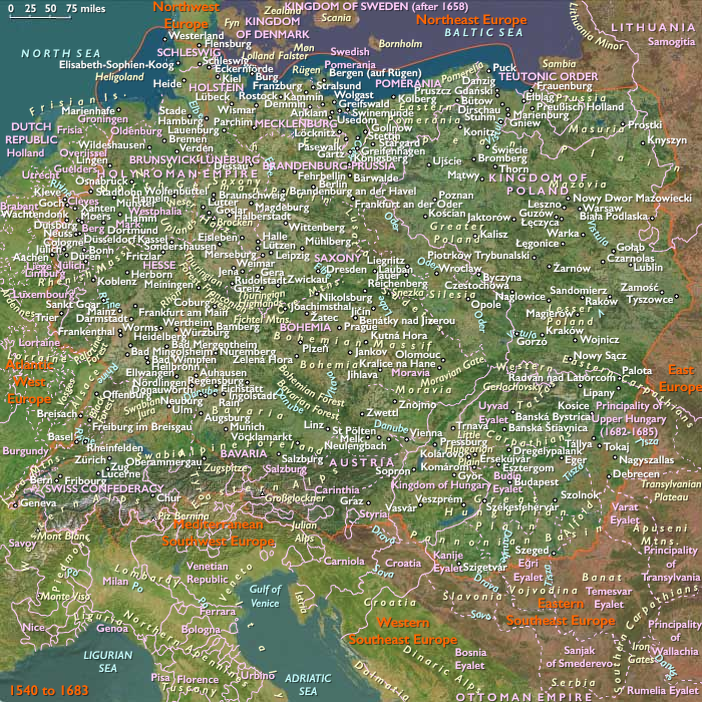
Subregions
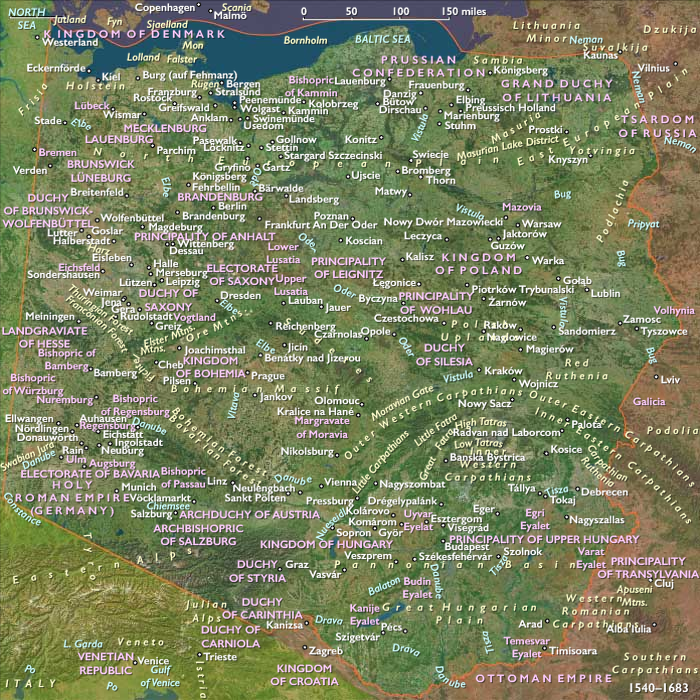
Years: 1540 - 1683
People
- Charles V, Holy Roman Emperor
- Ferdinand I
- Frederick William, Elector of Brandenburg
- Leopold I
- Rudolf II
- Sigismund II Augustus Jagiello
Groups
- Thuringia, Duchy of
- Passau, Bishopric of
- Saxony, Duchy of
- Germany, Kingdom of (within the Holy Roman Empire)
- Holy Roman Empire
- Hanseatic league (informally organized)
- Slovaks (West Slavs)
- Carinthia, Duchy of
- Austria, Margravate of
- Czechs [formerly Bohemians] (West Slavs)
- Hungary, Kingdom of
- Bamberg, Prince-Bishopric of
- Poland, Greater
- Mazovia, Duchy of
- Austria, Archduchy of
- Bohemia, Kingdom of
- Styria, Duchy of
- Lübeck, Free City of
- Brunswick-Lüneburg, Duchy of
- Regensburg (Ratisbon), Imperial Free City of
- Cammin, Prince-Bishopric of
- Regensburg, Prince-Bishopric of
- Anhalt-Bernburg, Principality of
- Anhalt-Zerbst, Principality of
- Holy Roman Empire
- Brunswick-Wolfenbüttel, Duchy of
- Salzburg, Archbishopric of
- Poland of the later Piasts, Kingdom of
- Lithuania, Grand Duchy of
- Mecklenburg, Duchy of
- Ottoman Empire
- Saxony, Electorate of
- Palatinate, Electoral (Wittelsbach)
- Poland of the Jagiellonians, Kingdom of
- Crown of the Kingdom of Poland
- Lithuania, Grand Duchy of
- Saxe-Lauenburg, Duchy of
- Brandenburg, (Hohenzollern) Margravate of
- Prussian Confederation
- Crimean Khanate
- Transylvania (Hungarian governate)
- Ottoman Empire
- Prussia, Royal (autonomous subject of the Polish Crown)
- Bavaria, Wittelsbach Duchy of
- Lutheranism
- Sweden, (second) Kingdom of
- Hungary, Royal
- Calvinists
- Jesuits, or Order of the Society of Jesus
- Hungary, Ottoman
- Hungary (Transylvania), Ottoman vassal Kingdom of
- Russia, Tsardom of
- Swedish Empire
- Anhalt-Köthen, Principality of
- Saxe-Weimar, Duchy of
- Saxe-Coburg, Duchy of
- Saxe-Eisenach, Duchy of
- France, (Bourbon) Kingdom of
- Mecklenburg-Güstrow, Duchy of
- Mecklenburg-Schwerin, Duchy of
- Anhalt-Plotzkau, Principality of
- Anhalt-Dessau
- Anhalt-Dessau, Principality of
- Brandenburg-Prussia
Topics
- Protestant Reformation
- Counter-Reformation (also Catholic Reformation or Catholic Revival)
- Schmalkaldic War
- Bohemian Revolt
- Thirty Years' War
- White Mountain, Battle of
- Deluge, the (Poland)
- Vienna, Battle of
Commodoties
Subjects
Regions
Subregions