
East Central Europe (172–183 CE): The Marcomannic …
Years: 172 - 183
East Central Europe (172–183 CE): The Marcomannic Wars, Antonine Plague, and Frontier Crisis
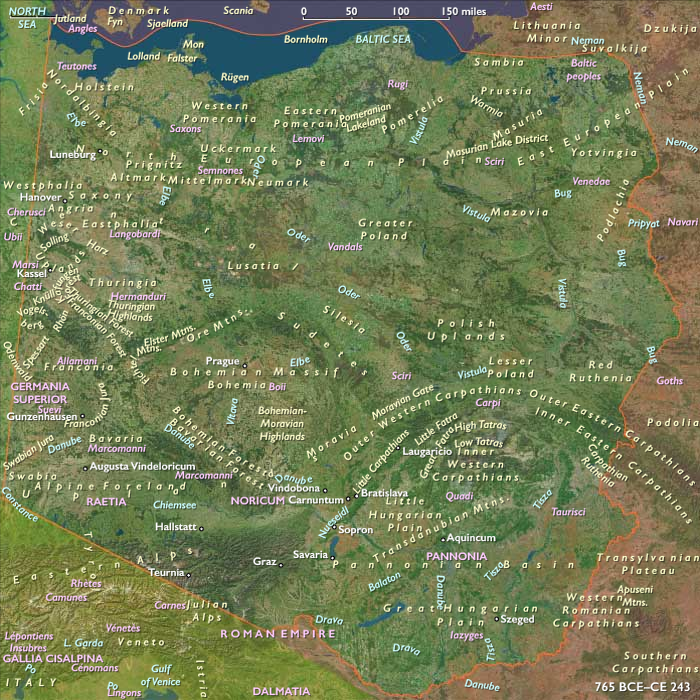
Between 172 and 183 CE, East Central Europe—covering Poland, Czechia, Slovakia, Hungary, and those portions of Germany and Austria lying east of 10°E and north of a line stretching from roughly 48.2°N at 10°E southeastward to the Austro-Slovenian border near 46.7°N, 15.4°E—was profoundly disrupted by the Marcomannic Wars (166–180 CE) and further destabilized by the devastating Antonine Plague (165–180 CE). Under Emperor Marcus Aurelius (161–180 CE), intense military conflicts with tribal confederations (Marcomanni, Quadi, and the Sarmatian Iazyges) coincided with severe demographic and economic stress caused by widespread illness, dramatically reshaping frontier conditions and regional stability.
Political and Military Developments
Peak of the Marcomannic Wars
-
During Marcus Aurelius’s reign, Roman provinces (Pannonia Superior, Pannonia Inferior, and Noricum) faced significant invasions from the Marcomanni, Quadi, and Iazyges, severely challenging Roman defensive lines along the Danube.
Antonine Plague and Military Weakness
-
The Antonine Plague (165–180 CE) further weakened Roman military capabilities along the frontier, resulting in substantial manpower shortages and logistical challenges.
-
Roman forces, already under intense pressure from warfare, found it increasingly difficult to maintain effective defense and counteroffensives due to the widespread loss of personnel to disease.
Major Battles and Roman Counteroffensive
-
Major confrontations occurred near frontier settlements, notably Carnuntum, Vindobona, and Aquincum, as Roman forces sought to repel tribal incursions.
-
Despite plague-induced setbacks, Marcus Aurelius successfully conducted counteroffensives by 175 CE, temporarily restoring stability. Sporadic warfare continued until his death in 180 CE.
Economic and Technological Developments
Severe Economic Disruption
-
Trade networks along the Danube frontier experienced severe disruptions due to combined pressures of warfare and the Antonine Plague. Frontier settlements faced declining populations, reduced productivity, and impaired economic vitality.
Military and Defensive Innovation
-
The conflicts and plague encouraged improvements in Roman military fortifications, logistics, and defensive strategies. New structures and technologies emerged to adapt to this heightened crisis.
Cultural and Artistic Developments
Militarization and Crisis Reflected in Artifacts
-
Artifacts from this period increasingly emphasized military themes, protection motifs, and practical defensive use, reflecting societal responses to warfare and disease.
Settlement and Urban Development
Reinforced Frontier Fortifications
-
Significant defensive improvements reshaped urban settlements such as Carnuntum, Vindobona, and Aquincum, which transformed into heavily fortified towns responding to increased threats and reduced population.
Population Decline and Migration
-
Warfare and plague caused notable population declines and migration away from vulnerable frontier zones, creating demographic shifts throughout the region.
Social and Religious Developments
Altered Tribal Social Structures
-
Tribal societies experienced intensified pressure from conflict and economic hardship, increasing the prominence of warrior elites who provided leadership through crisis conditions.
Religious Intensification During Crisis
-
Traditional tribal religious practices intensified amid conflict and disease, emphasizing protective rites, warrior culture, and communal solidarity rituals.
Long-Term Consequences and Historical Significance
The period 172–183 CE significantly reshaped East Central Europe due to the combined devastation of the Marcomannic Wars and the Antonine Plague. Demographic losses weakened Roman frontier control, allowed temporary tribal advances, and shifted regional dynamics, laying important groundwork for future tribal migrations and regional realignments.
People
Groups
- Iazyges, or Iazygians
- Marcomanni (Germanic tribe)
- Lombards (West Germanic tribe)
- Germans
- Quadi (Germanic tribe)
- Noricum (Roman province)
- Roman Empire (Rome): Nerva-Antonine dynasty
- Pannonia Superior (Roman province)
- Pannonia Inferior (Roman province)
Topics
Commodoties
Subjects
Regions

Subregions
Years: 172 - 183
People
Groups
- Iazyges, or Iazygians
- Marcomanni (Germanic tribe)
- Lombards (West Germanic tribe)
- Germans
- Quadi (Germanic tribe)
- Noricum (Roman province)
- Roman Empire (Rome): Nerva-Antonine dynasty
- Pannonia Superior (Roman province)
- Pannonia Inferior (Roman province)
Topics
Commodoties
Subjects
Regions
Subregions