
Central Europe (1396–1539 CE): Little Ice Age …
Years: 1396 - 1539
Central Europe (1396–1539 CE): Little Ice Age Worlds—Mines, Markets, and Faith in Revolt
Geographic & Environmental Context
Late-medieval Central Europe was never a single land but a constellation of three natural worlds linked by rivers and passes—and often more closely tied to their external neighbors than to each other.
-
East Central Europe (Poland–Bohemia–Hungary with eastern Austria/Bavaria): open Vistula and Danube basins, Carpathian arcs, Bohemian uplands—grain plains meeting silver–copper districts and Ottoman-facing frontiers.
-
South Central Europe (Swiss–Tyrolean–Styrian Alps and the Swiss Plateau): high passes and valleys that funneled Italy’s goods to German markets; pasture, dairying, and mining under harsh alpine climate.
-
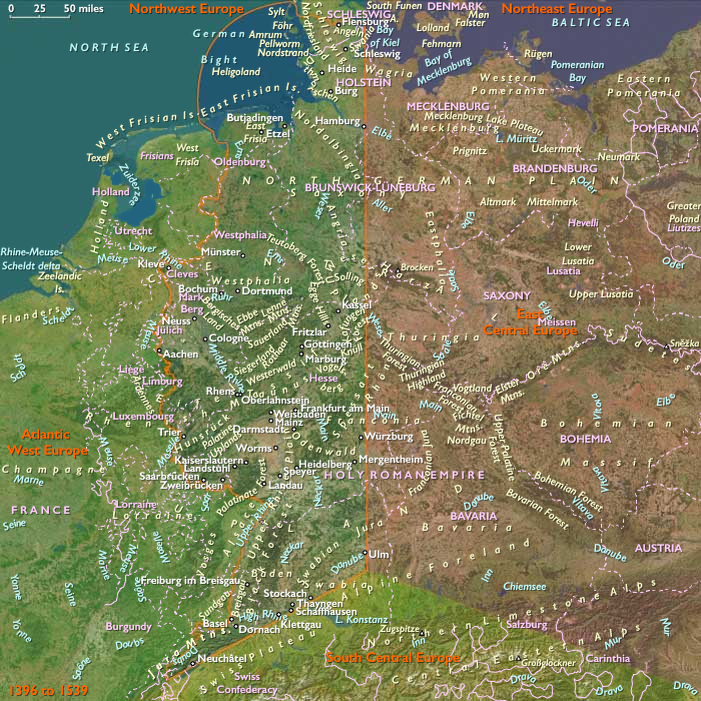
West Central Europe (Rhine–Moselle–Main and the northern Jura): riverine corridors and vineyard slopes, dense towns and bishoprics, and the crucible of printing and Reformation.
This triptych stitched the Baltic, Adriatic, and North Sea worlds together—a region by corridors, not by unity.
Climate & Environmental Shifts (Little Ice Age)
Across all three subregions the Little Ice Age sharpened extremes:
-
Alpine & Carpathian highlands: longer winters, advancing glaciers, destructive spring thaws (floods/landslides).
-
Vistula plain & Hungarian Alföld: oscillation between bumper harvests and shortfalls; drought–flood cycles shaped cattle and grain rhythms.
-
Rhine–Moselle–Main: periodic flooding; tougher vintages but resilient wine culture.
Communities responded with storage, transhumance, and inter-regional grain movements via rivers and fairs.
Subsistence, Settlement & Economies
-
Rural matrices: rye–oats–barley in Poland/Silesia; wheat/millet on the Hungarian plain; vineyards in Moravia, Austria, Bavaria, and the Swiss–Rhine belts; alpine dairy cooperatives (cheese, butter) buffered poor years.
-
Mining & metallurgy: silver/copper at Kutná Hora, Kremnica/Banská Štiavnica, Tyrol–Salzburg; salt at Wieliczka/Hallstatt; ironworks in Bavaria/Styria—cash engines for states and princes.
-
Urban networks: Prague, Kraków, Vienna, Buda; Zurich, Bern, Geneva, Innsbruck; Cologne, Mainz, Strasbourg, Basel, Nuremberg, Augsburg—guilds, universities, fairs (Leipzig/Kraków/Nuremberg) moved surpluses and ideas across subregional borders.
Each subregion’s economy leaned outward: East Central grain and metals into Baltic/Hanse and Danube markets; South Central transit tolls and Tyrolean ore into Italian–German circuits; West Central river towns into the Low Countries’ cloth and finance.
Technology & Material Culture
-
Agrarian & hydraulic: heavy plows, mills, three-field rotations; terraced vineyards; communal granaries.
-
Mining tech: water-powered bellows and stamps; deep timbered shafts; mints financing rulers.
-
Architecture & arts: High Gothic cathedrals and walled towns; Renaissance forms seeped in via Italy and the Upper Rhine; panel painting and courtly polyphony flourished.
-
Printing (after c. 1450): Gutenberg’s Mainz breakthrough spread to Cologne, Strasbourg, Basel, Nuremberg, Vienna, Kraków—an information infrastructure that would carry humanism and, after 1517, Reformation fire.
Movement & Interaction Corridors
-
Vistula moved grain/timber to Gdańsk, into Baltic–Hanse circuits.
-
Danube tied Vienna–Buda–Belgrade, but drew the Ottoman frontier ever closer.
-
Alpine passes (Brenner, St. Gotthard, Arlberg, Simplon) moved Venetian silks/spices north and German silver south.
-
Rhine–Moselle–Main bound Basel to Cologne and the North Sea; pilgrimages and imperial diets layered political traffic atop trade.
These arteries made Central Europe a through-region—its subregions metabolized external flows as much as their own.
Cultural & Symbolic Expressions
-
Catholic Christendom framed civic ritual; monasteries and feast days structured time and charity.
-
Bohemia’s Hussite Reformation (1419–1434)—ignited by Jan Hus’s martyrdom—pioneered vernacular worship (utraquism) and radical lay militias.
-
Humanism spread from Basel, Nuremberg, Vienna, and Kraków (where Copernicus studied).
-
After 1517, Lutheran ideas coursed down the Rhine and over the Alps; pamphlets and woodcuts remapped belief at street level. Zwingli in Zurich (1519) and Calvin in Geneva (late 1530s) recast South Central religious life.
Conflict Dynamics & Power Shifts
-
Hussite Wars: wagon-fort tactics, hand-guns, and disciplined infantry reshaped warfare; utraquism endured within Bohemia’s settlement.
-
Jagiellon Zenith to Shock: c. 1500 the Jagiellons held Poland–Lithuania, Bohemia, and Hungary; Mohács (1526) shattered Hungary—king Louis II fell, splitting the realm into Ottoman pashaliks, Habsburg Royal Hungary, and Transylvania.
-
Habsburg Rise: claimed Bohemia and Hungary after 1526; Vienna became a bulwark against the Porte.
-
Polish–Teutonic Frontier: 1525 secularization created Ducal Prussia as a Polish fief.
-
Swiss Confederation: military prestige (Burgundian Wars) and autonomy (Swabian War, 1499); but Kappel (1531) exposed confessional fracture (Zwingli’s death).
-
Rhine–German lands: Peasants’ War (1524–26) convulsed Swabia/Franconia; princes crushed it, but the social–religious question remained.
Environmental Adaptation & Resilience
-
Peasants rotated cereals, intercropped legumes, pooled risk in commons; highlanders practiced transhumance, stocking cheese and hides for lean years.
-
Mining towns diversified into crafts; imported grain via rivers in crises.
-
Urban councils regulated bread, stockpiled grain, and mobilized confraternities for relief; fairs redistributed regional surpluses when harvests failed.
Subregional Signatures (in one glance)
-
East Central Europe: grain-and-metal powerhouse under Jagiellons, then Ottoman shock; Hussite legacy in Bohemia; Danube as lifeline and threat.
-
South Central Europe: Swiss–Tyrolean confederacies and Habsburg frontiers; alpine dairying/mining; Reformation bifurcation (Zurich/Geneva) amid military autonomy.
-
West Central Europe: Rhine printing belt from Mainz to Basel; humanism → Reformation; wealthy towns, but social fissures (Peasants’ War).
Each subregion often shared more with adjacent external worlds (Baltic, Italian, Low Countries, Balkans) than with its Central European neighbors—precisely the point of The Twelve Worlds: regions are envelopes; subregions are the living units.
Transition by 1539
Central Europe stood at a hinge:
-
Poland–Lithuania prospered as a grain-exporting monarchy;
-
Bohemia remained confessionally mixed under Habsburg suzerainty;
-
Hungary lay partitioned;
-
Austria/Tyrol consolidated mining wealth and fortified the Danube;
-
Swiss cantons were sovereign yet split by faith;
-
Rhine towns pulsed with presses and reform, but rural discontent smoldered.
From 1396 to 1539, the region moved from dynastic zenith to confessional fracture, from medieval corridors to early-modern networks—its destiny now defined by the twin rivalries that would shape the next century: Habsburg–Ottoman war and Reformation–Counter-Reformation at the very center of Europe.
People
- Casimir IV Jagiellon
- Jan Hus
- Jogaila (Władysław II)
- Matthias Corvinus
- Sigismund
- Wenceslaus IV of Bohemia
Groups
- Germans
- Hungarian people
- Wends, or Sorbs (West Slavs)
- Christianity, Chalcedonian
- Bavarians (West Germanic tribe)
- Passau, Bishopric of
- Germany, Kingdom of (within the Holy Roman Empire)
- Holy Roman Empire
- Slovaks (West Slavs)
- Carinthia, Duchy of
- Czechs [formerly Bohemians] (West Slavs)
- Hanseatic league (informally organized)
- Hungary, Kingdom of
- Bamberg, Prince-Bishopric of
- Poland, Greater
- Mazovia, Duchy of
- Austria, Archduchy of
- Brandenburg (Ascanian) Margravate of
- Bohemia, Kingdom of
- Styria, Duchy of
- Ordensstaat (Monastic state of the Teutonic Knights)
- Lübeck, Free City of
- Brunswick-Lüneburg, Duchy of
- Regensburg (Ratisbon), Imperial Free City of
- Cammin, Prince-Bishopric of
- Anhalt-Bernburg, Principality of
- Anhalt-Zerbst, Principality of
- Regensburg, Prince-Bishopric of
- Holy Roman Empire
- Galicia–Volhynia, Kingdom of
- Brunswick-Wolfenbüttel, Duchy of
- Salzburg, Archbishopric of
- Saxe-Ratzeburg-Lauenburg, Duchy of
- Saxe-Mölln-Bergedorf, Duchy of
- Poland of the later Piasts, Kingdom of
- Bavaria, Wittelsbach Duchy of
- Lithuania, Grand Duchy of
- Mecklenburg, Duchy of
- Bavaria-Straubing, Wittelsbach Duchy of
- Ottoman Empire
- Bavaria-Landshut, Wittelsbach Duchy of
- Saxony, Electorate of
- Crown of the Kingdom of Poland
- Poland of the Jagiellonians, Kingdom of
- Lithuania, Grand Duchy of
- Bavaria-Munich, Wittelsbach Duchy of
- Bavaria-Ingolstadt, Wittelsbach Duchy of
- Anhalt-Köthen, Principality of
- Anhalt-Dessau, Principality of
- Saxe-Lauenburg, Duchy of
- Ottoman Empire
- Brandenburg, (Hohenzollern) Margravate of
- Hussites
- Ottoman Empire
- Regensburg (Ratisbon), Imperial Free City of
- Bavaria, Wittelsbach Duchy of
- Protestantism
Topics
Commodoties
Subjects
Regions

Subregions


Years: 1396 - 1539
People
- Casimir IV Jagiellon
- Jan Hus
- Jogaila (Władysław II)
- Matthias Corvinus
- Sigismund
- Wenceslaus IV of Bohemia
Groups
- Germans
- Hungarian people
- Wends, or Sorbs (West Slavs)
- Christianity, Chalcedonian
- Bavarians (West Germanic tribe)
- Passau, Bishopric of
- Germany, Kingdom of (within the Holy Roman Empire)
- Holy Roman Empire
- Slovaks (West Slavs)
- Carinthia, Duchy of
- Czechs [formerly Bohemians] (West Slavs)
- Hanseatic league (informally organized)
- Hungary, Kingdom of
- Bamberg, Prince-Bishopric of
- Poland, Greater
- Mazovia, Duchy of
- Austria, Archduchy of
- Brandenburg (Ascanian) Margravate of
- Bohemia, Kingdom of
- Styria, Duchy of
- Ordensstaat (Monastic state of the Teutonic Knights)
- Lübeck, Free City of
- Brunswick-Lüneburg, Duchy of
- Regensburg (Ratisbon), Imperial Free City of
- Cammin, Prince-Bishopric of
- Anhalt-Bernburg, Principality of
- Anhalt-Zerbst, Principality of
- Regensburg, Prince-Bishopric of
- Holy Roman Empire
- Galicia–Volhynia, Kingdom of
- Brunswick-Wolfenbüttel, Duchy of
- Salzburg, Archbishopric of
- Saxe-Ratzeburg-Lauenburg, Duchy of
- Saxe-Mölln-Bergedorf, Duchy of
- Poland of the later Piasts, Kingdom of
- Bavaria, Wittelsbach Duchy of
- Lithuania, Grand Duchy of
- Mecklenburg, Duchy of
- Bavaria-Straubing, Wittelsbach Duchy of
- Ottoman Empire
- Bavaria-Landshut, Wittelsbach Duchy of
- Saxony, Electorate of
- Crown of the Kingdom of Poland
- Poland of the Jagiellonians, Kingdom of
- Lithuania, Grand Duchy of
- Bavaria-Munich, Wittelsbach Duchy of
- Bavaria-Ingolstadt, Wittelsbach Duchy of
- Anhalt-Köthen, Principality of
- Anhalt-Dessau, Principality of
- Saxe-Lauenburg, Duchy of
- Ottoman Empire
- Brandenburg, (Hohenzollern) Margravate of
- Hussites
- Ottoman Empire
- Regensburg (Ratisbon), Imperial Free City of
- Bavaria, Wittelsbach Duchy of
- Protestantism
Topics
Commodoties
Subjects
Regions
Subregions