
East Central Europe (1252 – 1395 CE): …
Years: 1252 - 1395
East Central Europe (1252 – 1395 CE): Přemyslid–Luxembourg Bohemia, Angevin Hungary, and the Polish–Lithuanian Union
Geographic and Environmental Context
East Central Europe includes Poland, Czechia (Bohemia and Moravia), Slovakia, Hungary, northeastern Austria, and the greater part of Germany (including Berlin, Munich, Hamburg).
-
Strategic river axes: Vistula–Oder–Elbe, Danube–Morava, and Upper Dnieper–Vistula corridors.
-
Resource belts: silver (Kutná Hora), salt (Wieliczka–Bochnia), gold (Kremnica), dense forests and fertile loess soils.
Climate and Environmental Shifts
-
Late Medieval Warm Period tails into the early Little Ice Age after c. 1300: slightly cooler, more variable precipitation.
-
Harvest volatility increased in marginal zones, but river-valley and loess basins sustained surpluses; plague years (1348–1352) punctuated demographic growth.
Societies and Political Developments
-
Bohemia & Moravia (Přemyslid → Luxembourg):
-
Ottokar II (r. 1253–1278) expanded into Austria–Styria before defeat at Marchfeld (1278).
-
From 1310, the Luxembourgs (John, then Charles IV, r. 1346–1378) made Prague an imperial capital: Golden Bull (1356), Charles University (1348), reforms, and urban patronage; Wenceslaus IV (1378–1419) faced magnate unrest.
-
-
Hungary & Slovakia (Árpád → Angevin → Luxembourg):
-
After the Árpád extinction (1301), Charles I (Angevin) (1308–1342) restored royal power; Louis I “the Great” (1342–1382) expanded influence (including personal union with Poland 1370–1382).
-
Mining–monetary reforms (gold florins, Kremnica mint); after 1387 Sigismund of Luxembourg took the crown. Slovakia (Upper Hungary) was the mining and urban core.
-
-
Poland (fragmentation → reunification → union):
-
Władysław I Łokietek crowned (1320) reunified the kingdom; Casimir III “the Great” (1333–1370) reformed law, founded Kraków University (1364), and took Red Ruthenia (1340s); after 1370, union with Hungary under Louis I.
-
Union of Krewo (1385): Jogaila marries Jadwiga, becomes Władysław II Jagiełło (1386), inaugurating the Polish–Lithuanian polity.
-
-
Northeastern Austria (Habsburgs):
-
After 1278 the Habsburgs consolidated Austria–Styria; Vienna grew as a Danube market and (from 1365) university town.
-
-
Germany (eastern zones: Brandenburg, Saxony, Bavaria):
-
Electoral order fixed by Golden Bull (1356) (King of Bohemia, Margrave of Brandenburg, Duke of Saxony among electors).
-
Brandenburg passed from Ascanian to Wittelsbach to Luxembourg control (1373); Munich anchored Upper Bavaria; Berlin–Cölln rose on Spree–Havel trade.
-
-
Order states on the Baltic rim (context to Poland/Lithuania):
-
The Teutonic Order state in Prussia and Livonia pressed the Vistula–Neman frontier, shaping Polish–Lithuanian strategy (the great reckoning at Grunwald lies just beyond 1395).
-
Economy and Trade
-
Mining & mints:
-
Kutná Hora silver funded Luxembourg grandeur (Prague groschen).
-
Kremnica gold struck florins for Hungary; salt from Wieliczka–Bochnia underpinned Polish revenue.
-
-
Agriculture & towns: three-field rotations spread; German-law towns (Ostsiedlung legacy) structured markets from Silesia to Little Poland and Upper Hungary.
-
Trade corridors:
-
Danube–Morava–Vienna funneled Adriatic and Alpine goods into the plain.
-
Vistula–Baltic carried Polish grain, timber, and salt to Gdańsk, linking into Hanseatic circuits.
-
Elbe–Oder routes tied Bohemia/Silesia to Saxon–Brandenburg markets.
-
-
Hanseatic connections: eastern German and Polish ports traded cloth, beer, wax, and furs; inland towns brokered metals and salt.
Subsistence and Technology
-
Hydraulic & agrarian tools: heavy ploughs on loess, watermills on rivers, drainage and vineyard terraces in Bohemia and along the Danube.
-
Urban craft clusters: Prague metalwork and glass; Kraków cloth and salt; Upper Hungary mining technologies (adits, water-powered pumps).
-
Fortifications & courts: stone kremlins, castles, and walled towns; law codes (Magdeburg/Lübeck law, Casimir’s statutes) standardized justice and commerce.
Movement and Interaction Corridors
-
Danube trunk: Vienna ⇄ Bratislava (Pressburg) ⇄ Esztergom/Buda integrated Habsburg and Hungarian nodes.
-
Vistula spine: Kraków ⇄ Toruń/Gdańsk linked the Polish heartland to the Baltic.
-
Elbe–Oder passes: Bohemia ⇄ Saxony/Brandenburg; Moravian Gate tied the Danube to the Vistula–Oder basins.
-
Carpathian routes: salt, wine, and livestock over Transcarpathian passes into Poland and Hungary.
Belief and Symbolism
-
Latin Christianity: cathedral and monastic expansion (Prague, Kraków, Vienna); mendicant orders in towns; scholastic culture around the new universities.
-
Orthodoxy & Unions: Ruthenian borderlands under Lithuania remained Orthodox; Latin-rite Poland extended bishoprics into Red Ruthenia.
-
Popular piety: pilgrimage, confraternities, and plague-era devotions; Jewish communities vital to urban finance faced periodic persecution during the Black Death years.
-
Crown ideology: imperial Prague under Charles IV; Angevin regalia and chivalric display in Hungary; Jagiellonian union rhetoric in Poland–Lithuania.
Adaptation and Resilience
-
Institutional depth: estates and diets (Bohemian land diets, Polish sejmik beginnings, Hungarian diets) mediated taxation and war.
-
Demographic shocks: Black Death mortality (from 1348) hit towns hardest; frontier colonization and mining towns helped recovery.
-
Route redundancy: Danube, Vistula, and Baltic carried trade when war blocked overland links; Hanseatic convoys stabilized supply.
-
Dynastic flexibility: Luxembourg, Habsburg, Angevin, and Jagiellonian strategies (marriage, enfeoffment, union) minimized fragmentation costs.
Long-Term Significance
By 1395, East Central Europe had become a constellation of powerful crowns and rising unions:
-
Prague led an imperial–university renaissance;
-
Hungary monetized mining and projected power into the Balkans;
-
Poland–Lithuania formed a durable union that would reshape the northeast;
-
Habsburg Austria entrenched along the Danube.
Shared corridors of metals, salt, grain, and ideas forged an integrated region poised for 15th-century conflicts and cultural efflorescence—from Hussite revolutions to Jagiellonian and Habsburg ascendancy.
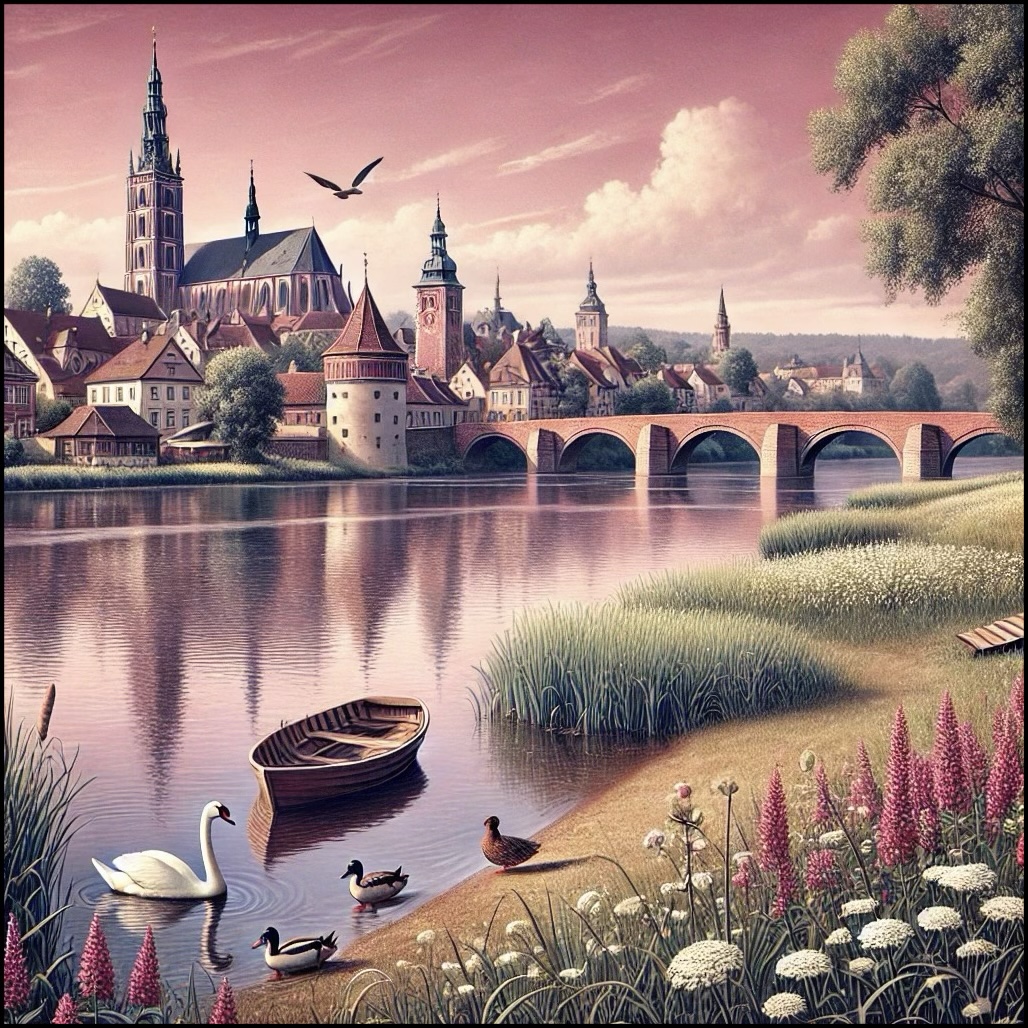
East Central Europe (with civilization) ©2024-25 Electric Prism, Inc. All rights reserved.
People
- Casimir III the Great
- Charles I of Hungary
- Charles IV, Holy Roman Emperor
- Henry I
- Jadwiga of Poland
- Jogaila (Władysław II)
- Louis I of Hungary
- Ottokar II of Bohemia
- Rudolf I of Germany
- Sigismund
- Wenceslaus IV of Bohemia
- Wladyslaw I the Elbow-high
Groups
- Polytheism (“paganism”)
- Germans
- Hungarian people
- Wends, or Sorbs (West Slavs)
- Christianity, Chalcedonian
- Bavarians (West Germanic tribe)
- Thuringia, Duchy of
- Passau, Bishopric of
- Saxony, Duchy of
- Germany, Kingdom of (within the Holy Roman Empire)
- Holy Roman Empire
- Hanseatic league (informally organized)
- Slovaks (West Slavs)
- Carinthia, Duchy of
- Czechs [formerly Bohemians] (West Slavs)
- Hungary, Kingdom of
- Habsburg, House of
- Bamberg, Prince-Bishopric of
- Saxons, Transylvanian
- Poland, Greater
- Poland during the period of fragmentation, Kingdom of
- Mazovia, Duchy of
- Austria, Archduchy of
- Brandenburg (Ascanian) Margravate of
- Bohemia, Kingdom of
- Mecklenburg, House of
- Bavaria, Wittelsbach Duchy of
- Styria, Duchy of
- Anhalt, Principality of
- Ordensstaat (Monastic state of the Teutonic Knights)
- Lübeck, Free City of
- Brunswick-Lüneburg, Duchy of
- Regensburg (Ratisbon), Imperial Free City of
- Cammin, Prince-Bishopric of
- Anhalt-Bernburg, Principality of
- Anhalt-Aschersleben, Principality of
- Anhalt-Zerbst, Principality of
- Holy Roman Empire
- Bavaria, Upper, Duchy of
- Bavaria, Lower, Duchy of
- Galicia–Volhynia, Kingdom of
- Brunswick-Wolfenbüttel, Duchy of
- Salzburg, Archbishopric of
- Saxe-Wittenberg, Duchy of
- Saxe-Ratzeburg-Lauenburg, Duchy of
- Saxe-Mölln-Bergedorf, Duchy of
- Teutonic Knights of Prussia, or Monastic state of the Teutonic Knights (House of the Hospitalers of Saint Mary of the Teutons in Jerusalem)
- Poland of the later Piasts, Kingdom of
- Brandenburg, Wittelsbach
- Bavaria, Wittelsbach Duchy of
- Lithuania, Grand Duchy of
- Mecklenburg, Duchy of
- Bavaria-Straubing, Wittelsbach Duchy of
- Bavaria-Landshut, Wittelsbach Duchy of
- Saxony, Electorate of
- Brandenburg, (Luxembourg) Margravate of
- Poland of the Jagiellonians, Kingdom of
- Lithuania, Grand Duchy of
- Bavaria-Munich, Wittelsbach Duchy of
- Bavaria-Ingolstadt, Wittelsbach Duchy of
Topics
- Ostsiedlung (German: Settlement in the East), a.k.a. German eastward expansion
- Poland, Fragmentation of
- Western Architecture: 1252 to 1396
- Marchfeld, Battle of
- Black Death, or Great Plague
Subjects
Regions
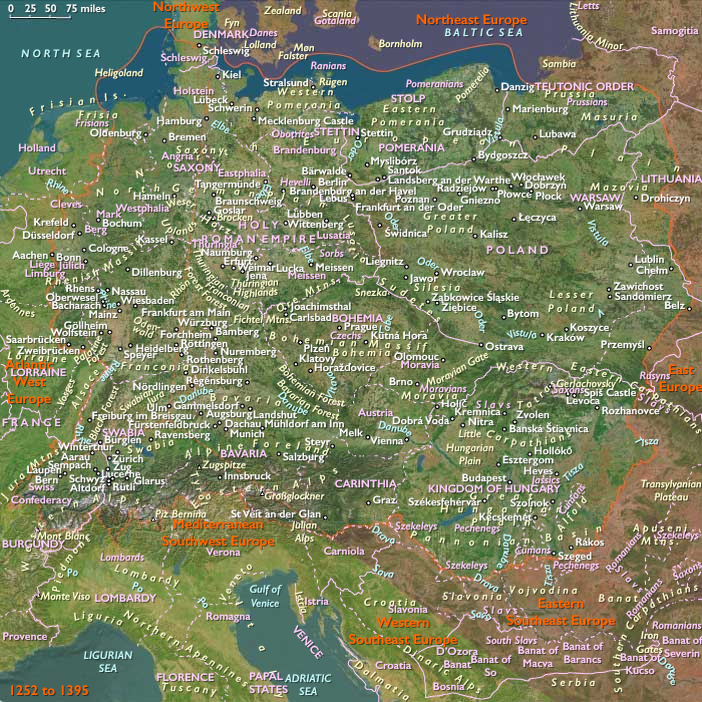
Subregions
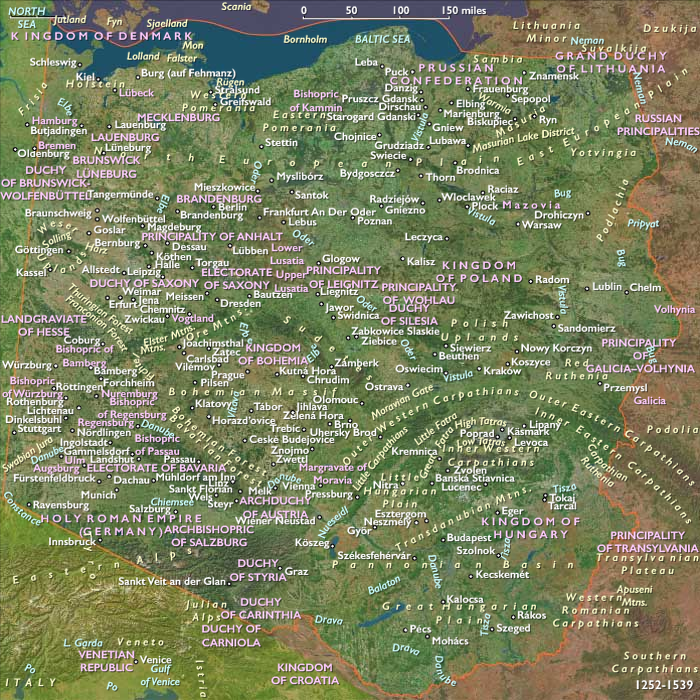
Years: 1252 - 1395
East Central Europe (with civilization) ©2024-25 Electric Prism, Inc. All rights reserved.
People
- Casimir III the Great
- Charles I of Hungary
- Charles IV, Holy Roman Emperor
- Henry I
- Jadwiga of Poland
- Jogaila (Władysław II)
- Louis I of Hungary
- Ottokar II of Bohemia
- Rudolf I of Germany
- Sigismund
- Wenceslaus IV of Bohemia
- Wladyslaw I the Elbow-high
Groups
- Polytheism (“paganism”)
- Germans
- Hungarian people
- Wends, or Sorbs (West Slavs)
- Christianity, Chalcedonian
- Bavarians (West Germanic tribe)
- Thuringia, Duchy of
- Passau, Bishopric of
- Saxony, Duchy of
- Germany, Kingdom of (within the Holy Roman Empire)
- Holy Roman Empire
- Hanseatic league (informally organized)
- Slovaks (West Slavs)
- Carinthia, Duchy of
- Czechs [formerly Bohemians] (West Slavs)
- Hungary, Kingdom of
- Habsburg, House of
- Bamberg, Prince-Bishopric of
- Saxons, Transylvanian
- Poland, Greater
- Poland during the period of fragmentation, Kingdom of
- Mazovia, Duchy of
- Austria, Archduchy of
- Brandenburg (Ascanian) Margravate of
- Bohemia, Kingdom of
- Mecklenburg, House of
- Bavaria, Wittelsbach Duchy of
- Styria, Duchy of
- Anhalt, Principality of
- Ordensstaat (Monastic state of the Teutonic Knights)
- Lübeck, Free City of
- Brunswick-Lüneburg, Duchy of
- Regensburg (Ratisbon), Imperial Free City of
- Cammin, Prince-Bishopric of
- Anhalt-Bernburg, Principality of
- Anhalt-Aschersleben, Principality of
- Anhalt-Zerbst, Principality of
- Holy Roman Empire
- Bavaria, Upper, Duchy of
- Bavaria, Lower, Duchy of
- Galicia–Volhynia, Kingdom of
- Brunswick-Wolfenbüttel, Duchy of
- Salzburg, Archbishopric of
- Saxe-Wittenberg, Duchy of
- Saxe-Ratzeburg-Lauenburg, Duchy of
- Saxe-Mölln-Bergedorf, Duchy of
- Teutonic Knights of Prussia, or Monastic state of the Teutonic Knights (House of the Hospitalers of Saint Mary of the Teutons in Jerusalem)
- Poland of the later Piasts, Kingdom of
- Brandenburg, Wittelsbach
- Bavaria, Wittelsbach Duchy of
- Lithuania, Grand Duchy of
- Mecklenburg, Duchy of
- Bavaria-Straubing, Wittelsbach Duchy of
- Bavaria-Landshut, Wittelsbach Duchy of
- Saxony, Electorate of
- Brandenburg, (Luxembourg) Margravate of
- Poland of the Jagiellonians, Kingdom of
- Lithuania, Grand Duchy of
- Bavaria-Munich, Wittelsbach Duchy of
- Bavaria-Ingolstadt, Wittelsbach Duchy of
Topics
- Ostsiedlung (German: Settlement in the East), a.k.a. German eastward expansion
- Poland, Fragmentation of
- Western Architecture: 1252 to 1396
- Marchfeld, Battle of
- Black Death, or Great Plague
Subjects
Regions
Subregions