
East Central Europe (1144–1155 CE): Polish Fragmentation …
Years: 1144 - 1155
East Central Europe (1144–1155 CE): Polish Fragmentation Deepens, Géza II Strengthens Hungary, and Vladislaus II’s Bohemian Ascendancy
Between 1144 and 1155 CE, East Central Europe—encompassing modern-day Poland, Czechia, Slovakia, Hungary, and the eastern portions of Germany and Austria east of 10°E and north of the defined southeastern boundary—faced critical political shifts and consolidation amid dynastic struggles and territorial expansion. Poland’s internal fragmentation deepened under Bolesław III’s successors; Hungary, under Géza II, experienced increased stability, territorial expansion, and institutional strengthening; while in Bohemia, the Přemyslid duke Vladislaus II rose prominently, asserting dynastic authority and regional influence with imperial support. These developments profoundly shaped regional politics and stability during this pivotal era.
Political and Military Developments
Deepening Fragmentation in Poland
-
After the divisive seniorate system established by Bolesław III, Poland continued to fragment into increasingly autonomous duchies ruled by rival Piast princes. This period saw frequent internal conflicts, weakening royal authority and significantly altering Poland’s political unity.
-
Duchies such as Silesia, Greater Poland, and Lesser Poland operated largely independently, shifting the power balance toward local aristocratic families and regional princes.
Géza II’s Hungarian Expansion and Consolidation
-
King Géza II (r. 1141–1162) succeeded Béla II and vigorously strengthened Hungarian royal power, consolidating territorial gains, expanding eastward into territories of present-day Romania (Transylvania), and asserting dominance in Dalmatia and the Balkans.
-
Géza’s effective administration improved internal stability, fortified Hungary’s frontiers, and deepened diplomatic and economic connections with Western Europe and Byzantium.
Vladislaus II’s Bohemian Ascendancy
-
Vladislaus II of Bohemia (r. 1140–1172) rose to prominence through strategic alliance with Emperor Conrad III and, after 1152, Emperor Frederick Barbarossa. Vladislaus strengthened Přemyslid authority, gaining significant imperial favor, eventually achieving royal status later (1158).
-
His reign witnessed significant political stabilization, territorial security, and economic prosperity within Bohemia, reinforced by close cooperation with imperial authorities.
Imperial Influence: Conrad III to Frederick Barbarossa
-
Imperial power remained influential in East Central Europe under Holy Roman Emperors Conrad III (1138–1152) and Frederick Barbarossa (from 1152), shaping Bohemian political alignments, territorial boundaries, and regional power dynamics. Barbarossa’s accession particularly strengthened Bohemia’s imperial connections under Vladislaus II.
Economic and Technological Developments
Continued Economic Prosperity and Trade Expansion
-
The region’s economies flourished, benefiting from increased stability in Hungary and Bohemia and maintaining commercial vitality despite Polish fragmentation. Expanded trade networks linked Baltic, Byzantine, and Western European markets, enhancing urban prosperity and regional commerce.
Agricultural Productivity and Technological Innovation
-
Agricultural productivity continued to improve due to widespread adoption of advanced agricultural technologies, supporting urban growth, population increase, and sustained economic expansion across East Central Europe.
Cultural and Artistic Developments
Hungarian Royal Patronage under Géza II
-
Géza II strongly supported ecclesiastical institutions and religious foundations, facilitating cultural and scholarly activities throughout Hungary. His patronage enriched Hungarian intellectual life and artistic achievements.
Bohemian Cultural Revival under Vladislaus II
-
Vladislaus II actively promoted cultural and artistic activities, supporting significant ecclesiastical building programs, manuscript production, and monastic foundations in Prague and elsewhere, further enhancing Bohemia’s cultural prominence.
Cultural Continuity in Fragmented Poland
-
Despite political fragmentation, Polish cultural life remained resilient through sustained ecclesiastical and monastic activities, preserving scholarly and religious traditions in major urban and ecclesiastical centers.
Settlement and Urban Development
Hungarian Urban Expansion and Infrastructure Development
-
Under Géza II, Hungarian cities such as Esztergom, Székesfehérvár, and regional towns flourished, benefiting from enhanced infrastructure, administrative stability, and vibrant commerce.
Bohemian Urban and Administrative Growth
-
Bohemian towns, notably Prague, experienced significant urban development, infrastructure enhancements, and fortification under Vladislaus II, reinforcing Bohemia’s economic and administrative strength.
Polish Urban Resilience
-
Polish urban centers, including Kraków, Wrocław, and Gniezno, maintained economic vitality despite political fragmentation, continuing local administrative growth and regional commercial activity.
Social and Religious Developments
Strengthening Ecclesiastical Institutions
-
Christianity remained deeply entrenched in regional governance and cultural identity, supported by royal patronage and ecclesiastical expansion in Hungary and Bohemia, and continued religious influence despite political divisions in Poland.
Dynastic Authority and Aristocratic Influence
-
Aristocratic power and dynastic authority intensified, particularly evident in Hungary’s centralized monarchy under Géza II and Bohemia’s Přemyslid consolidation under Vladislaus II. In fragmented Poland, local nobility increasingly dominated regional governance and territorial politics.
Long-Term Consequences and Historical Significance
The era 1144–1155 CE was pivotal for East Central Europe’s medieval trajectory. Hungary’s strengthened royal authority under Géza II secured enduring regional power, Bohemia’s Přemyslid dynasty achieved heightened prestige and imperial favor under Vladislaus II, while Poland’s deepening fragmentation profoundly shaped its political landscape for centuries. These shifts reinforced regional governance structures, economic prosperity, cultural identity, and societal stability, significantly influencing East Central Europe’s medieval development and shaping the region’s long-term historical evolution.
People
- Béla II of Hungary
- Conrad III of Germany
- Frederick I, Holy Roman Emperor
- Géza
- Vladislaus II of Bohemia
Groups
- Polytheism (“paganism”)
- Franks
- Saxons
- Germans
- Hungarian people
- Wends, or Sorbs (West Slavs)
- Christianity, Chalcedonian
- Bavarians (West Germanic tribe)
- Polans, Western (West Slavic tribe)
- Thuringia, Duchy of
- Carantania
- Carantanians
- Saxony, Duchy of
- Bavaria, Ottonian Duchy of
- Germany, Kingdom of (within the Holy Roman Empire)
- German, or Ottonian (Roman) Empire
- Holy Roman Empire
- Austria, Margravate of
- Czechs [formerly Bohemians] (West Slavs)
- Slovaks (West Slavs)
- Carinthia, Duchy of
- Hungary, Kingdom of
- Poland of the first Piasts, Kingdom of
- Bohemia, Duchy of
- Poland, Greater
Commodoties
Subjects
Regions
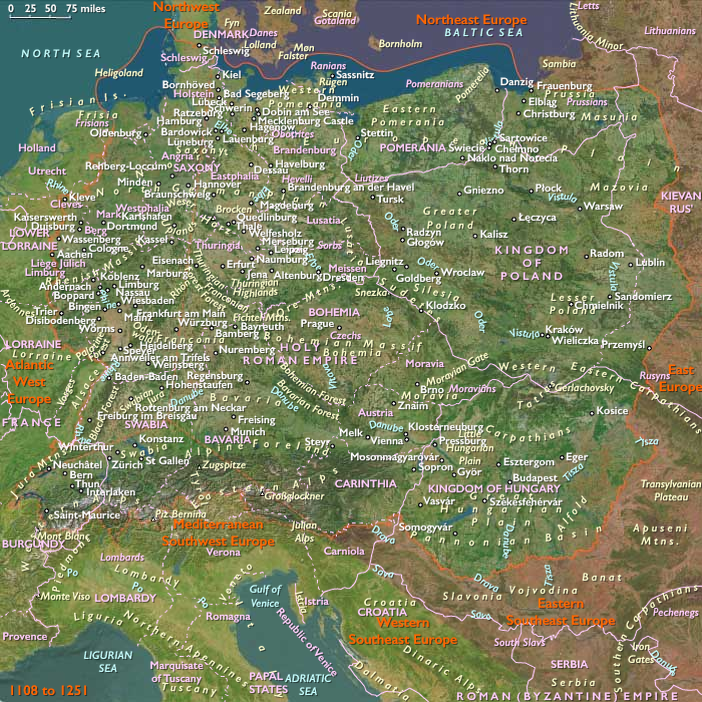
Subregions
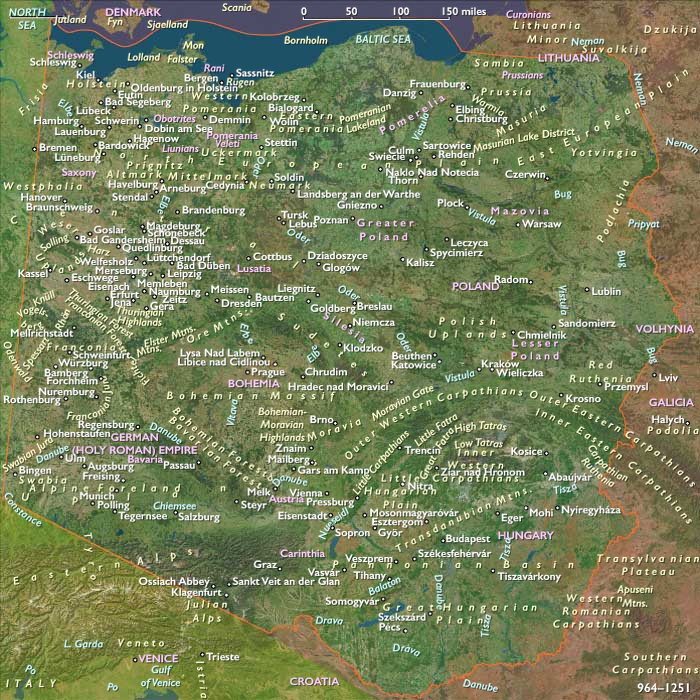
Years: 1144 - 1155
People
- Béla II of Hungary
- Conrad III of Germany
- Frederick I, Holy Roman Emperor
- Géza
- Vladislaus II of Bohemia
Groups
- Polytheism (“paganism”)
- Franks
- Saxons
- Germans
- Hungarian people
- Wends, or Sorbs (West Slavs)
- Christianity, Chalcedonian
- Bavarians (West Germanic tribe)
- Polans, Western (West Slavic tribe)
- Thuringia, Duchy of
- Carantania
- Carantanians
- Saxony, Duchy of
- Bavaria, Ottonian Duchy of
- Germany, Kingdom of (within the Holy Roman Empire)
- German, or Ottonian (Roman) Empire
- Holy Roman Empire
- Austria, Margravate of
- Czechs [formerly Bohemians] (West Slavs)
- Slovaks (West Slavs)
- Carinthia, Duchy of
- Hungary, Kingdom of
- Poland of the first Piasts, Kingdom of
- Bohemia, Duchy of
- Poland, Greater
Commodoties
Subjects
Regions
Subregions