
Central Europe (1108 – 1251 CE): Imperial …
Years: 1108 - 1251
Central Europe (1108 – 1251 CE): Imperial Reform, Urban Expansion, and the Ostsiedlung
Between 1108 and 1251 CE, Central Europe—the heartland of the Holy Roman Empire and its eastern marches—entered an era of extraordinary growth. The Medieval Warm Period brought demographic expansion and agricultural innovation, while political fragmentation fostered new towns, laws, and civic institutions.
From the Rhineland cathedrals and Alpine passes to the plains of Poland and Hungary, Europe’s central belt fused feudal lordship, ecclesiastical reform, and the eastward movement of settlers into one of the most dynamic transformations of the medieval world.
Geographic and Environmental Context
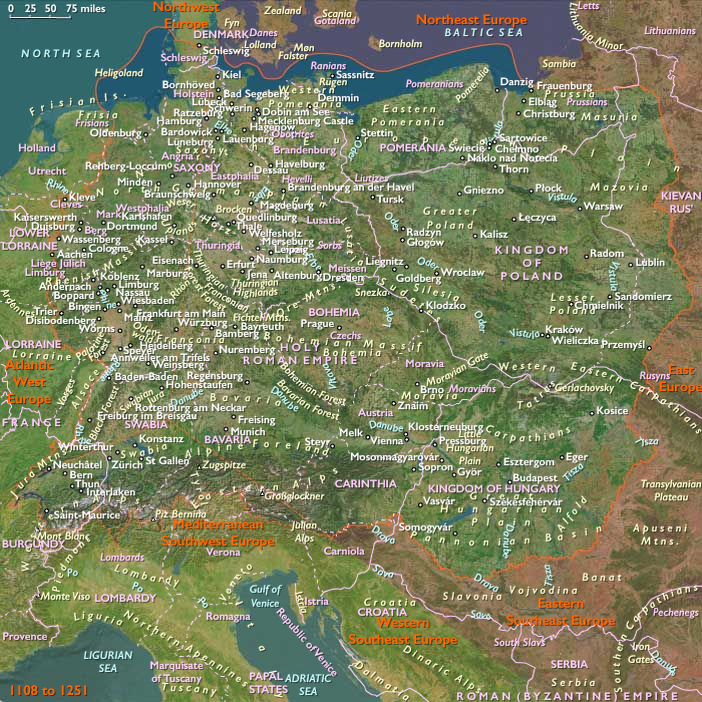
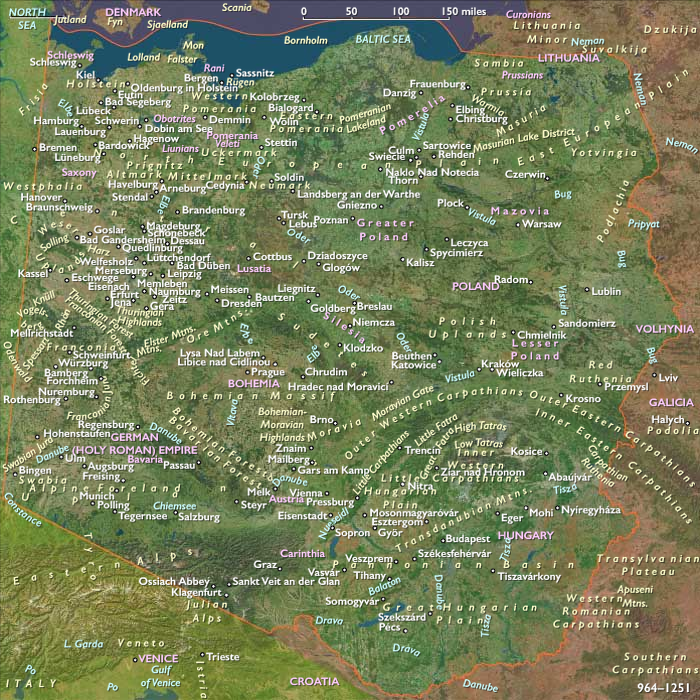
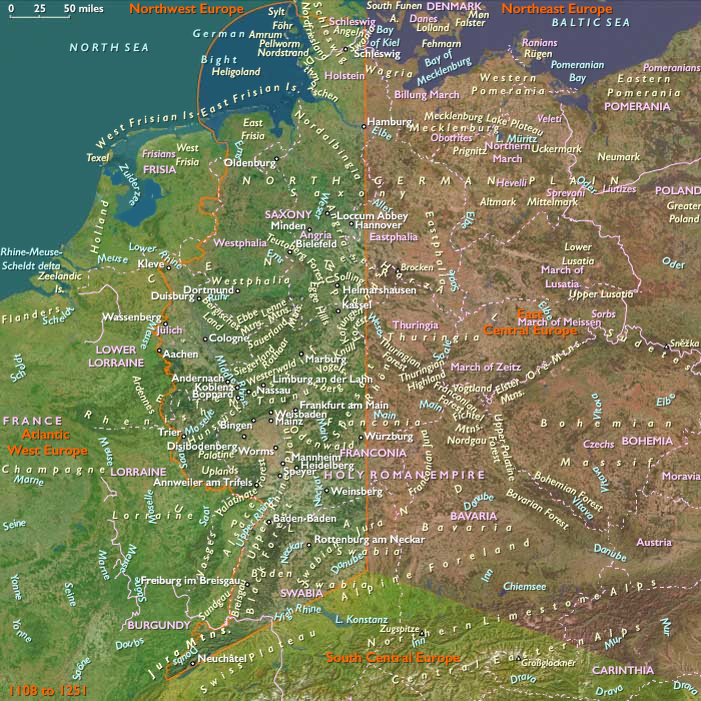
Central Europe stretched from the Rhine to the Vistula and from the Baltic coast to the Alpine valleys and Pannonian plain, encompassing:
-
The Rhineland heartlands of Cologne, Mainz, and Strasbourg;
-
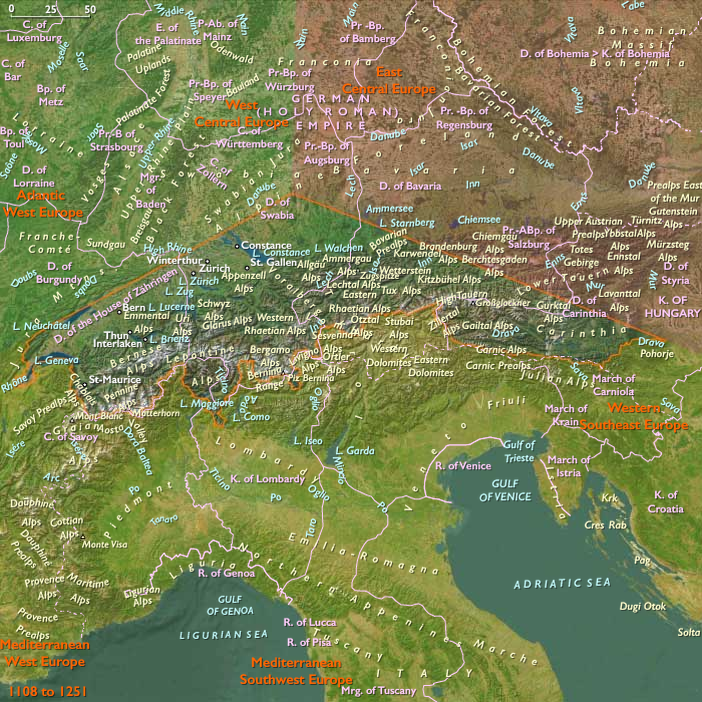
The Alpine crossroads of Tyrol, Zürich, and Geneva;
-
The eastern plains of Silesia, Poland, Bohemia, Moravia, and Hungary.
This was a continent within a continent—a network of fertile valleys, wooded uplands, and trade arteries defined by the Rhine, Elbe, Oder, Vistula, and Danube. Forest clearance and settlement transformed once-marginal lands into the agrarian and urban centers of late medieval Europe.
Climate and Environmental Shifts
The Medieval Warm Period (c. 950–1250) provided long growing seasons, enabling population growth and the spread of viticulture and grain farming north and east.
Favorable weather encouraged three-field rotation, iron ploughs, and horse collars, which revolutionized yields.
Localized floods along the Rhine and Danube enriched soils even as they reshaped towns and dikes.
The forests of Silesia, the Carpathians, and Bavaria yielded timber, salt, and silver—the mineral backbone of Central Europe’s economy.
Political and Institutional Developments
The Imperial Core:
The Holy Roman Empire, though politically fragmented, remained Europe’s constitutional and spiritual axis.
The Hohenstaufen emperors (1138–1254) sought to balance imperial unity with the autonomy of princes and cities.
Archbishops of Mainz, Trier, and Cologne, as imperial electors, embodied this duality of sacred and secular authority.
East Central Kingdoms:
-
Poland (Piast dynasty): The Testament of Bolesław III (1138) divided the realm among dukes, initiating two centuries of fragmentation. Kraków remained the senior duchy, while Silesia and Pomerania invited German settlers under Magdeburg Law, integrating Poland into the Ostsiedlung.
-
Bohemia and Moravia (Přemyslids): Secured hereditary kingship through the Golden Bull of Sicily (1212); Prague emerged as a royal and cultural capital, with silver mining at Kutná Hora enriching the crown.
-
Hungary (Árpád dynasty): The Golden Bull of 1222 codified noble rights; after the Mongol invasion (1241–42), Béla IV rebuilt the kingdom with stone fortifications and foreign settlers, initiating a second wave of colonization and urbanization.
Alpine and South Central Principalities:
Feudal fragmentation defined the Alps: counts of Tyrol, bishops of Geneva, and abbots of Einsiedeln and St. Gallcontrolled passes and tolls.
Urban communes in Zürich and Geneva asserted autonomy; local assemblies in Alpine valleys laid early foundations for Swiss communal governance.
The Rhineland Electorates:
Cologne, Mainz, and Trier dominated the political and spiritual life of the Empire.
Imperial cities such as Strasbourg, Worms, Speyer, and Basel gained privileges, fostering the growth of guilds, markets, and civic culture.
This west–east continuum—imperial in form, feudal in structure, and civic in aspiration—defined Central Europe’s political pluralism.
Economy and Trade
Agrarian Expansion:
Forest clearance and colonization extended cultivation across Silesia, Brandenburg, Bohemia, and Hungary. Heavy ploughs, crop rotation, and watermills drove rural productivity.
Mining and Industry:
Silver at Kutná Hora and Jihlava, salt at Wieliczka, and iron in the Alps and Swabia financed courts and monasteries.
Cistercian abbeys coordinated land reclamation and proto-industrial production.
Trade and Urban Growth:
-
Rhineland: The Rhine served as Europe’s commercial artery, connecting Cologne, Mainz, Strasbourg, and Basel to Flanders and Italy.
-
Alpine routes: Brenner and St. Gotthard passes moved Italian silk and spices north, returning with German metals and wool.
-
Eastern trade: The Oder–Elbe–Danube corridors linked Kraków, Wrocław, Prague, and Buda to Baltic and Adriatic markets.
German urban law (Magdeburg, Lübeck) standardized administration, embedding civic governance across Central Europe.
Urban and Technological Development
Cities expanded rapidly. Cologne, with over 40,000 inhabitants, ranked among Europe’s largest; Cologne Cathedral(begun 1248) inaugurated the Gothic age north of the Alps.
Stone castles, bridges, and Romanesque monasteries transformed the landscape; later Gothic cathedrals rose in Strasbourg, Prague, and Bamberg.
Watermills and guild industries powered textiles, glassmaking, and metalwork.
The Ostsiedlung infused new technology and law across Slavic lands, blending German civic models with local traditions.
Belief and Symbolism
Catholic Christianity unified the region’s culture and law.
-
The archbishoprics of Gniezno, Esztergom, and Prague became national spiritual centers.
-
The Cistercians, Dominicans, and Franciscans spread reform and education, while monasteries became agents of colonization and literacy.
-
Royal sanctity—seen in cults of St. Elizabeth of Hungary and St. Wenceslaus—legitimized dynastic rule.
Pilgrimage and relic cults (notably the Three Kings of Cologne) bound devotion to geography, turning the Rhine and Danube into sacred corridors.
Movement and Interaction Corridors
-
Rhine River: North–south trade spine from Basel to the North Sea.
-
Danube River: Crossed by the Hungarian plain and Bohemian frontier.
-
Elbe–Oder–Vistula basins: Arteries of the Ostsiedlung and grain export.
-
Alpine passes: Brenner and St. Gotthard linking Italy with Germany and Burgundy.
-
Pilgrimage and crusade routes: Swabian knights joined Crusades; Rhineland ports provisioned Mediterranean fleets.
These routes knit the region into Christendom’s spiritual, commercial, and military systems.
Adaptation and Resilience
-
Multipolar politics—Piast duchies, Přemyslid Bohemia, Árpád Hungary—prevented systemic collapse and encouraged local autonomy.
-
Alpine communes and imperial cities institutionalized cooperation and self-defense.
-
Ecclesiastical reform reinforced continuity amid dynastic change.
-
After the Mongol invasion, Hungary’s reconstruction and the eastward settlement drive demonstrated unparalleled resilience.
Fragmentation became an engine of innovation, not decline.
Long-Term Significance
By 1251 CE, Central Europe stood as the pivot of medieval Christendom:
-
The Empire’s Rhineland heartlands led in urbanization, cathedral culture, and commerce.
-
The Alpine passes bound Italy, Germany, and Burgundy into one economic zone.
-
The eastern kingdoms—Poland, Bohemia, and Hungary—had absorbed German colonists and Western institutions, laying the foundations of modern Central Europe.
Fragmented yet interconnected, the region’s plural order and settlement revolution made it Europe’s engine of transformation and resilience.
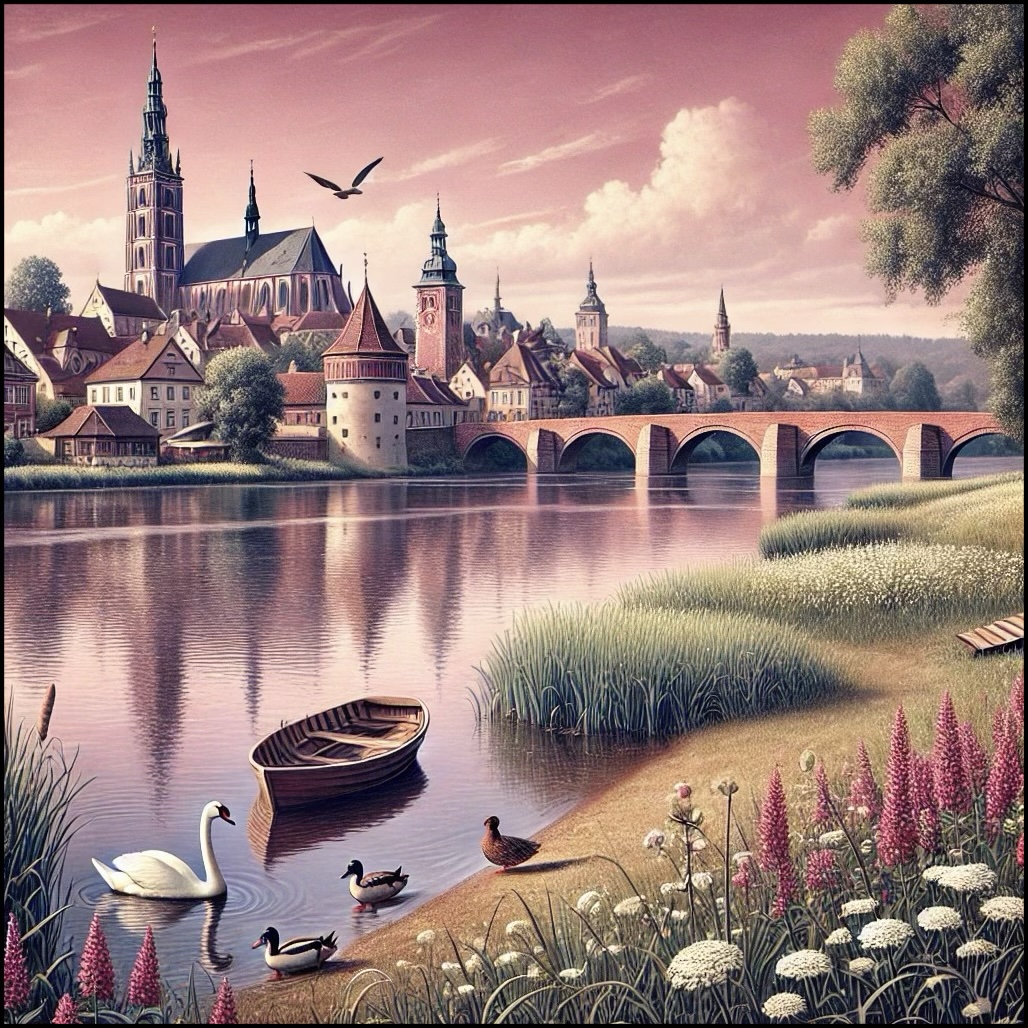
East Central Europe (with civilization) ©2024-25 Electric Prism, Inc. All rights reserved.
People
Groups
- Germans
- Hungarian people
- Slavs, West
- Germany, Kingdom of (within the Holy Roman Empire)
- Holy Roman Empire
- Hanseatic league (informally organized)
- Hungary, Kingdom of
- Poland of the first Piasts, Kingdom of
- Christians, Roman Catholic
- Bavaria, Welf Duchy of
- Roman Empire, Eastern: Komnenos dynasty, restored
- Bohemia, Kingdom of
- Bohemia, Duchy of
- Cistercians, Order of the (White Friars)
- Mongols
- Poland during the period of fragmentation, Kingdom of
- Poland, Greater
- Bohemia, Kingdom of
- Bohemia, Duchy of
- Bavaria, Wittelsbach Duchy of
- Moravian Margravate
- Roman Empire, Eastern: Angelid dynasty
- Bohemia, Kingdom of
- Mongol Empire
- Franciscans, or Order of St. Francis
- Dominicans, or Order of St. Dominic
- Hungary, Kingdom of
Topics
- Medieval Warm Period (MWP) or Medieval Climate Optimum
- Ostsiedlung (German: Settlement in the East), a.k.a. German eastward expansion
- Western Architecture: 1108 to 1252
- Poland, Fragmentation of
- Mongol Conquests
- Mongol Invasion of Europe
- Mongol Invasion of Poland
- Legnica, (Liegnitz) or Wahlstadt, Battle of
- Mohi, Battle of
Commodoties
- Weapons
- Hides and feathers
- Gem materials
- Domestic animals
- Grains and produce
- Textiles
- Ceramics
- Strategic metals
- Salt
Subjects
- Commerce
- Symbols
- Architecture
- Decorative arts
- Conflict
- Government
- Custom and Law
- Technology
- Metallurgy
- Human Migration
Regions
Subregions
Related Events
Showing 10 events out of 49873 total
Years: 1108 - 1251
East Central Europe (with civilization) ©2024-25 Electric Prism, Inc. All rights reserved.
People
Groups
- Germans
- Hungarian people
- Slavs, West
- Germany, Kingdom of (within the Holy Roman Empire)
- Holy Roman Empire
- Hanseatic league (informally organized)
- Hungary, Kingdom of
- Poland of the first Piasts, Kingdom of
- Christians, Roman Catholic
- Bavaria, Welf Duchy of
- Roman Empire, Eastern: Komnenos dynasty, restored
- Bohemia, Kingdom of
- Bohemia, Duchy of
- Cistercians, Order of the (White Friars)
- Mongols
- Poland during the period of fragmentation, Kingdom of
- Poland, Greater
- Bohemia, Kingdom of
- Bohemia, Duchy of
- Bavaria, Wittelsbach Duchy of
- Moravian Margravate
- Roman Empire, Eastern: Angelid dynasty
- Bohemia, Kingdom of
- Mongol Empire
- Franciscans, or Order of St. Francis
- Dominicans, or Order of St. Dominic
- Hungary, Kingdom of
Topics
- Medieval Warm Period (MWP) or Medieval Climate Optimum
- Ostsiedlung (German: Settlement in the East), a.k.a. German eastward expansion
- Western Architecture: 1108 to 1252
- Poland, Fragmentation of
- Mongol Conquests
- Mongol Invasion of Europe
- Mongol Invasion of Poland
- Legnica, (Liegnitz) or Wahlstadt, Battle of
- Mohi, Battle of
Commodoties
- Weapons
- Hides and feathers
- Gem materials
- Domestic animals
- Grains and produce
- Textiles
- Ceramics
- Strategic metals
- Salt
Subjects
- Commerce
- Symbols
- Architecture
- Decorative arts
- Conflict
- Government
- Custom and Law
- Technology
- Metallurgy
- Human Migration
Regions
Subregions