
East Central Europe (1024–1035 CE): End of …
Years: 1024 - 1035
East Central Europe (1024–1035 CE): End of the Ottonians, Polish Consolidation under Mieszko II, and Hungary's Royal Authority under Stephen I
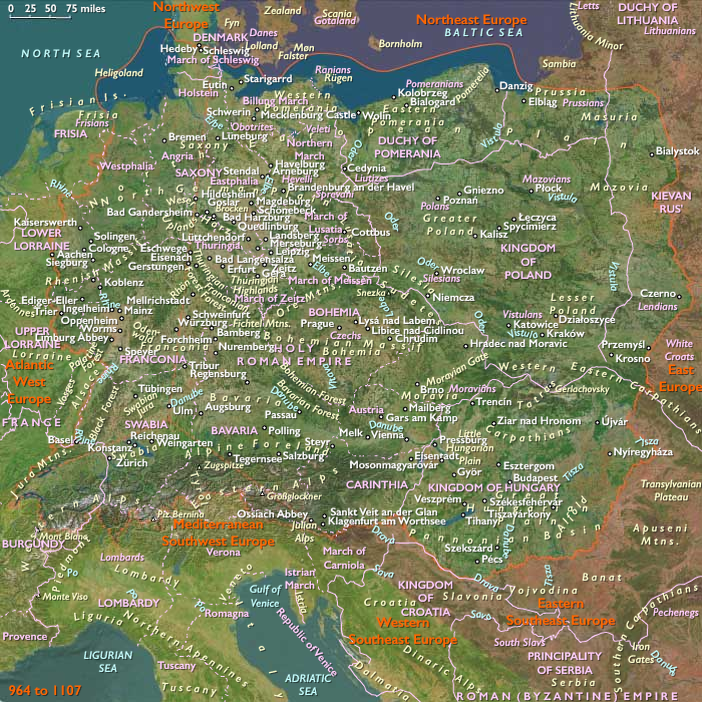
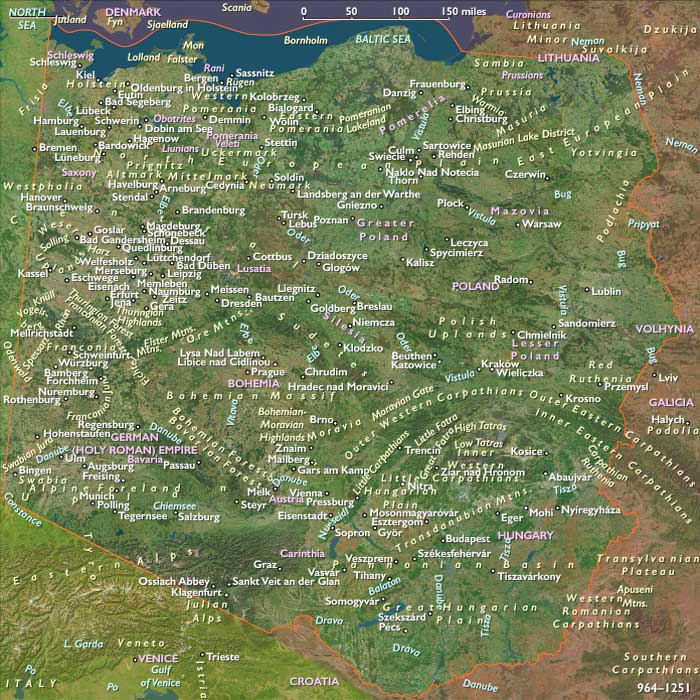
Between 1024 and 1035 CE, East Central Europe—encompassing modern-day Poland, Czechia, Slovakia, Hungary, and eastern parts of Germany and Austria east of 10°E and north of the defined southeastern boundary—underwent critical political realignments and cultural developments. The period witnessed the end of the Ottonian dynasty and the rise of the Salian dynasty in the Holy Roman Empire, internal challenges to Polish unity following Bolesław I’s death, and the continued strengthening of royal authority and Christian institutionalization under Hungary’s first king, Stephen I. These events significantly reshaped the medieval political landscape of the region.
Political and Military Developments
Transition from Ottonians to Salians in the Holy Roman Empire
-
After the death of Emperor Henry II in 1024, the Ottonian dynasty ended, and the Salian dynasty began under Emperor Conrad II (r. 1024–1039). Conrad continued assertive policies towards East Central Europe, seeking influence over Bohemia and Poland, affecting regional political stability and alignments.
Challenges in Poland under Mieszko II
-
Upon Bolesław I’s death in 1025, his son Mieszko II Lambert (r. 1025–1034) faced significant internal and external difficulties. Internal divisions, dynastic conflicts, and pressure from neighboring states weakened Poland’s previously extensive territorial control, diminishing its regional dominance.
Hungarian Stability and Expansion under Stephen I
-
King Stephen I (r. 1000–1038) maintained Hungary’s internal stability, continuing extensive administrative reforms, strengthening royal authority, and expanding Hungary’s influence into adjacent territories. His rule solidified Hungary’s political organization and Christian identity.
Přemyslid Stability in Bohemia under Oldřich
-
Duke Oldřich of Bohemia (r. 1012–1033, intermittently) stabilized Bohemia following earlier dynastic turmoil, consolidating Přemyslid authority, strengthening administrative structures, and maintaining a balanced diplomatic stance between the Holy Roman Empire and Poland.
Economic and Technological Developments
Continuity and Expansion of Trade Networks
-
Despite political disruptions in Poland, trade networks in Hungary and Bohemia remained robust, exchanging goods such as textiles, amber, metals, and agricultural products, promoting regional economic stability and prosperity.
Development of Fortified Urban Centers
-
Fortifications and urban growth continued across the region. Hungary (Esztergom, Székesfehérvár), Bohemia (Prague), and Poland (Gniezno, Kraków, Poznań) enhanced their defensive infrastructure, urban administration, and commercial vitality.
Cultural and Artistic Developments
Polish Cultural Continuity amid Political Turmoil
-
Although facing political fragmentation, Poland retained a vibrant ecclesiastical and cultural life through continued artistic patronage, monastic expansion, and manuscript production, reflecting ongoing integration into broader European culture.
Hungarian Ecclesiastical and Royal Culture under Stephen I
-
Stephen I’s sustained patronage of ecclesiastical institutions and cultural projects, including construction of cathedrals, monasteries, and royal residences, profoundly shaped Hungary’s religious, cultural, and royal identity.
Přemyslid Cultural Patronage in Bohemia
-
Under Duke Oldřich, Bohemia enjoyed renewed cultural vitality, evident in ecclesiastical architecture, manuscript illumination, and religious institutions, reinforcing Prague’s status as a central cultural and ecclesiastical hub.
Settlement and Urban Development
Growth of Hungarian Royal and Administrative Centers
-
Stephen I’s Hungary experienced significant urban and administrative growth, notably at Esztergom and Székesfehérvár, solidifying their roles as royal, ecclesiastical, and economic centers.
Polish Urban Stability Amid Dynastic Challenges
-
Despite internal struggles, urban centers such as Gniezno, Kraków, and Poznań maintained their importance as administrative and ecclesiastical hubs, underpinning Poland’s continued social cohesion.
Consolidation of Bohemian Towns
-
Under Přemyslid rule, Bohemian towns—especially Prague—experienced renewed urbanization and fortification, strengthening Bohemia’s administrative and cultural coherence.
Social and Religious Developments
Strengthening of Christianity and Ecclesiastical Structures
-
Christianity’s societal role solidified further across East Central Europe. Ecclesiastical institutions played central roles in governance, education, and cultural life in Poland, Hungary, and Bohemia.
Dynastic and Aristocratic Consolidation
-
Despite instability in Poland, regional dynastic and aristocratic structures strengthened, defining clear social hierarchies and governance models critical for future medieval societal stability.
Long-Term Consequences and Historical Significance
The era 1024–1035 CE represented a transitional period in East Central Europe’s history. The shift from Ottonian to Salian imperial dominance, internal challenges in Poland following Bolesław’s reign, and continued stability and expansion under Stephen I in Hungary significantly shaped regional political alignments and cultural identities. These developments laid crucial foundations for future medieval kingdoms and their evolving relationships within the broader European context.
People
- Boleslaw I Chrobry
- Conrad II
- Henry II, Holy Roman Emperor
- Mieszko II Lambert
- Oldrich
- Stephen I of Hungary
Groups
- Polytheism (“paganism”)
- Franks
- Saxons
- Germans
- Hungarian people
- Wends, or Sorbs (West Slavs)
- Christianity, Chalcedonian
- Bavarians (West Germanic tribe)
- Polans, Western (West Slavic tribe)
- Thuringia, Duchy of
- Carantania
- Carantanians
- Frankish, or Carolingian (Roman) Empire
- Saxony, Duchy of
- Moravia, Great, Kingdom of
- Francia Orientalis (East Francia), Kingdom of
- Roman Empire, Eastern: Macedonian dynasty
- Bohemia, Duchy of
- Bavaria, Ottonian Duchy of
- Holy Roman Empire
- German, or Ottonian (Roman) Empire
- Germany, Kingdom of (within the Holy Roman Empire)
- Poland, Principality of
- Carinthia, Duchy of
- Austria, Margravate of
- Hungary, Kingdom of
Topics
Commodoties
Subjects
Regions
Subregions
Years: 1024 - 1035
People
- Boleslaw I Chrobry
- Conrad II
- Henry II, Holy Roman Emperor
- Mieszko II Lambert
- Oldrich
- Stephen I of Hungary
Groups
- Polytheism (“paganism”)
- Franks
- Saxons
- Germans
- Hungarian people
- Wends, or Sorbs (West Slavs)
- Christianity, Chalcedonian
- Bavarians (West Germanic tribe)
- Polans, Western (West Slavic tribe)
- Thuringia, Duchy of
- Carantania
- Carantanians
- Frankish, or Carolingian (Roman) Empire
- Saxony, Duchy of
- Moravia, Great, Kingdom of
- Francia Orientalis (East Francia), Kingdom of
- Roman Empire, Eastern: Macedonian dynasty
- Bohemia, Duchy of
- Bavaria, Ottonian Duchy of
- Holy Roman Empire
- German, or Ottonian (Roman) Empire
- Germany, Kingdom of (within the Holy Roman Empire)
- Poland, Principality of
- Carinthia, Duchy of
- Austria, Margravate of
- Hungary, Kingdom of
Topics
Commodoties
Subjects
Regions
Subregions