
East Central Europe (124–135 CE): Hadrianic Frontier …
Years: 124 - 135
East Central Europe (124–135 CE): Hadrianic Frontier Strengthening and Intensified Roman-Germanic Integration
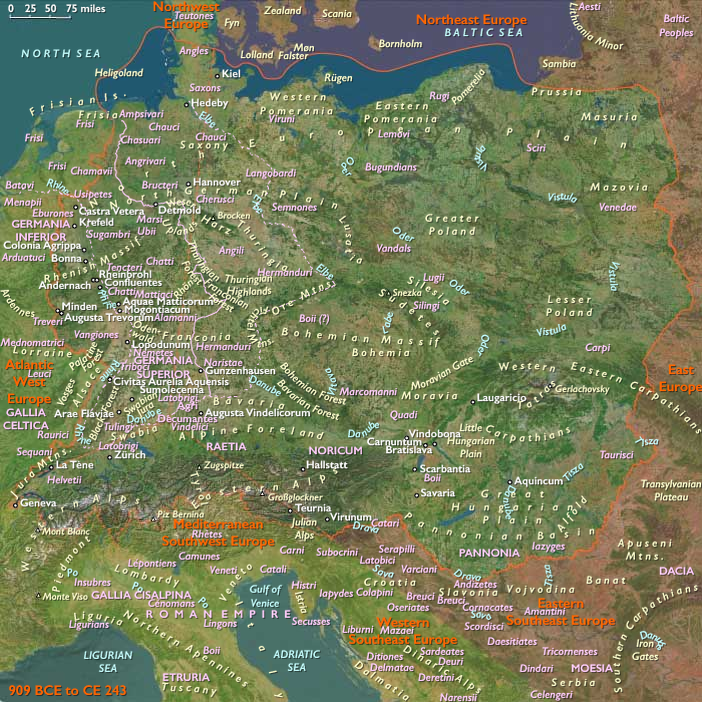
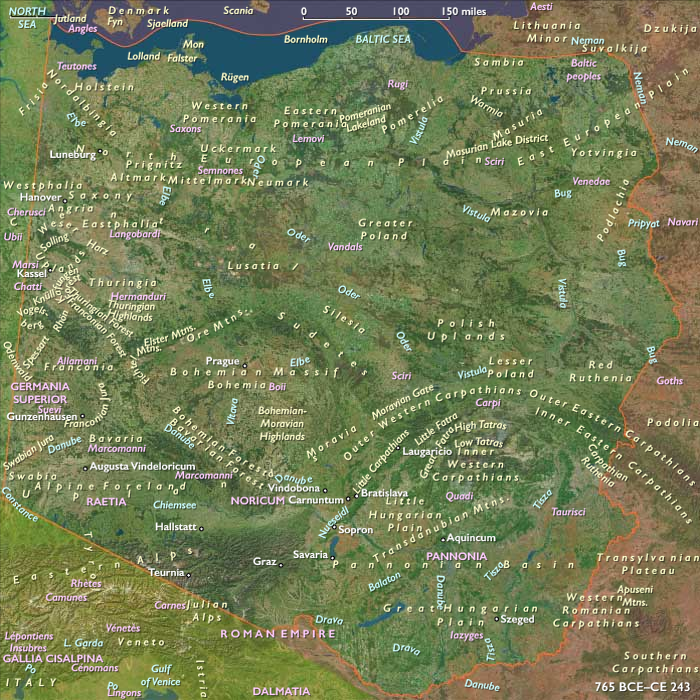
Between 124 and 135 CE, East Central Europe—encompassing Poland, Czechia, Slovakia, Hungary, and those portions of Germany and Austria lying east of 10°E and north of a line stretching from roughly 48.2°N at 10°E southeastward to the Austro-Slovenian border near 46.7°N, 15.4°E—continued to benefit from stability along the Roman Danube frontier. Under Emperor Hadrian (117–138 CE), Roman defensive fortifications were extensively strengthened and reorganized, further solidifying peaceful interactions with regional Germanic tribes. This era saw increased economic integration, expanded cultural exchanges, and stable political conditions, reinforcing relationships between Roman provinces and their Germanic neighbors.
Political and Military Developments
Hadrian’s Frontier Reinforcement
-
Emperor Hadrian reinforced and reorganized the Danube frontier extensively, strengthening fortifications, watchtowers, and defensive structures in Pannonia Superior (Carnuntum, Vindobona) and Pannonia Inferior (Aquincum), as well as in Noricum (modern Austria).
-
The reinforced Roman frontier promoted regional security, enabling sustained diplomatic relationships and peaceful trade with neighboring tribes.
Diplomatic Stability with Germanic Tribes
-
The primary Germanic tribal confederations—Marcomanni and Quadi—maintained stable diplomatic ties and cooperative trade with Roman provincial authorities.
-
The Langobardi (Lombards), settled north and northeast of the Roman frontier, further solidified their territorial presence and engaged in peaceful economic interactions, reinforcing stability across the region.
Economic and Technological Developments
Flourishing Cross-Border Trade
-
Roman provincial economies experienced continued prosperity through extensive trade networks connecting Roman towns along the Danube frontier with Germanic tribal territories. Goods exchanged included Roman manufactured items—pottery, glassware, textiles, and coins—in return for regional commodities such as amber, iron goods, livestock, and grain.
-
Roman coinage circulated widely, facilitating a standardized monetary economy and deeper economic integration among frontier communities.
Agricultural and Industrial Advances
-
Germanic groups continued to adopt and adapt Roman agricultural techniques, significantly improving productivity and agricultural sustainability.
-
Technological exchanges, particularly in iron metallurgy and pottery production, enhanced local craftsmanship and economic specialization.
Cultural and Artistic Developments
Continued Cultural Integration
-
Increased cultural interaction between Roman provincial settlements and neighboring Germanic populations produced distinctive hybrid styles in ceramics, metalwork, jewelry, and weaponry, blending Roman motifs with local Germanic traditions.
-
Artifacts from this era reflect the deepening integration and mutual influence of Roman and Germanic cultures.
Artistic Flourishing
-
Local artisans and craftsmen benefited from economic prosperity and produced sophisticated objects, demonstrating a harmonious fusion of Roman technical skill and Germanic aesthetic preferences.
Settlement and Urban Development
Expansion of Roman Frontier Towns
-
Roman frontier towns and military camps—such as Carnuntum, Vindobona (Vienna), and Aquincum (Budapest)—experienced continued growth, functioning as major administrative, economic, and cultural centers on the Danube frontier.
Stable Germanic Agricultural Communities
-
North of the frontier, Germanic settlements remained stable and prosperous, characterized by agricultural villages, communal farming practices, and specialized production areas, benefiting significantly from peaceful trade relations with Roman provinces.
Social and Religious Developments
Stability of Tribal Leadership
-
Germanic tribal societies maintained hierarchical structures dominated by warrior elites and tribal chieftains, whose authority rested upon trade relationships, military strength, and diplomatic alliances with Roman authorities.
Religious Continuity and Growing Syncretism
-
Traditional religious practices among Germanic groups—nature worship, ancestral veneration, and communal rituals—persisted strongly, though increasingly influenced by Roman religious customs and cultural practices, fostering early examples of religious syncretism.
Long-Term Consequences and Historical Significance
The period from 124 to 135 CE under Hadrian represented sustained frontier stability, robust economic prosperity, and intensified cultural integration in East Central Europe. Hadrian's defensive enhancements along the Danube facilitated peaceful cross-border interactions, economic growth, and cultural exchange, significantly shaping regional societies. These positive conditions established long-lasting foundations for subsequent historical developments, strengthening economic structures, cultural identities, and diplomatic traditions between Roman provinces and their Germanic neighbors.
People
Groups
- Marcomanni (Germanic tribe)
- Lombards (West Germanic tribe)
- Quadi (Germanic tribe)
- Germans
- Noricum (Roman province)
- Roman Empire (Rome): Nerva-Antonine dynasty
- Pannonia Superior (Roman province)
- Pannonia Inferior (Roman province)
Topics
Commodoties
Subjects
Regions
Subregions
Years: 124 - 135
People
Groups
- Marcomanni (Germanic tribe)
- Lombards (West Germanic tribe)
- Quadi (Germanic tribe)
- Germans
- Noricum (Roman province)
- Roman Empire (Rome): Nerva-Antonine dynasty
- Pannonia Superior (Roman province)
- Pannonia Inferior (Roman province)
Topics
Commodoties
Subjects
Regions
Subregions