
Maritime East Asia (1252–1395 CE): Mongol Oceans, …
Years: 1252 - 1395
Maritime East Asia (1252–1395 CE): Mongol Oceans, Coastal Polities, and Early Ming Retrenchment
Geographic & Environmental Context
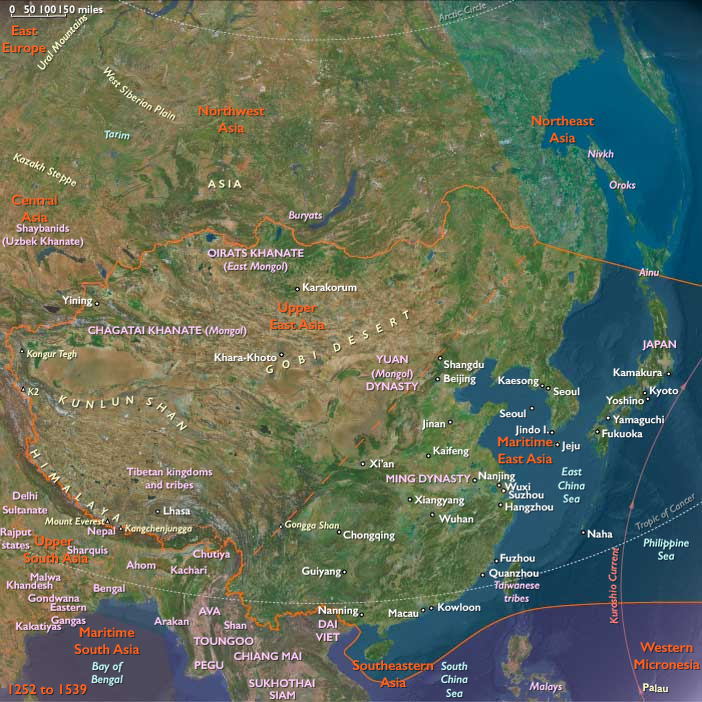
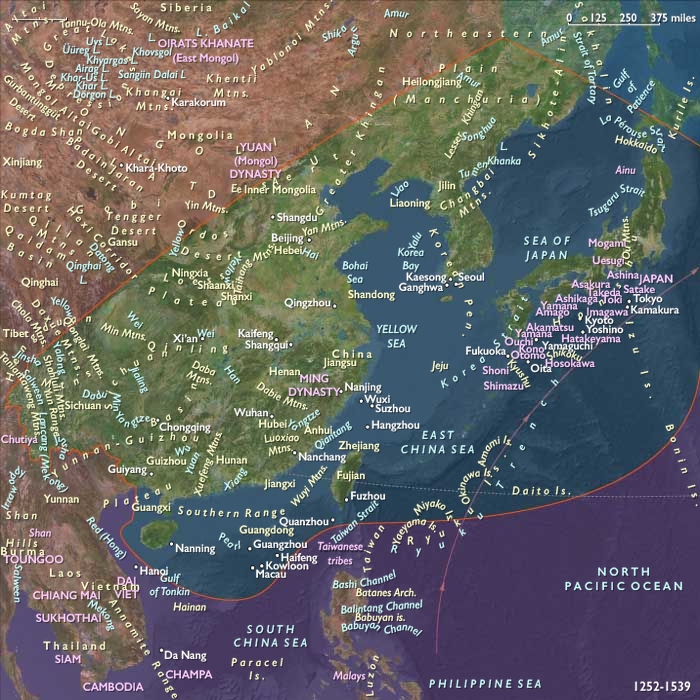
Maritime East Asia in this era ran from the South China Sea and East China Sea shelves up through the Korean Peninsula and Primorsky coast to Kyushu–Honshu–Shikoku–southwestern Hokkaidō, including Taiwan and the Ryukyu–Izu chains. The Little Ice Age’s cooler phases sharpened winter monsoon winds, while typhoons remained seasonally destructive—nowhere more consequential than in 1274 and 1281, when storms helped destroy the Mongol invasion fleets against Japan. Lower-frequency drought–flood swings shaped harvests along the Yangtze–Yellow basins and on the peninsula, and episodic earthquakes and storm surges reworked deltaic and bayhead settlements.
Political & Social Developments
-
Southern Song → Yuan (1271–1368): The Mongol conquest culminated at sea: Song naval resistance was finally crushed off the Pearl River delta (1279). Under the Yuan, coastal prefectures were militarized and reorganized; Quanzhou (Zayton) stood as a cosmopolitan entrepôt with Muslim merchant communities, while northern arsenals and river fleets supported Mongol campaigns.
-
Goryeo under Mongol suzerainty: After invasions (1230s–1270), Goryeo integrated into the Yuan imperial sphere, supplying ships and men for the failed Japan expeditions. Court–provincial balances shifted; coastal defense and tribute logistics intensified.
-
Japan: Kamakura → Kenmu → Muromachi (Ashikaga): The Kamakura bakufu repelled the Mongols but never recovered its fiscal footing; political rupture produced the Kenmu Restoration (1333), then the Ashikaga shogunate (1336) and the Northern–Southern Courts period (Nanbokuchō). Maritime lords and inland sea coalitions grew; piracy and coastal privateering (early wakō) swelled in the vacuum.
-
Ryukyu & Taiwan: The Ryukyu archipelago remained divided among polities (Chūzan, Hokuzan, Nanzan), mediating regional trade; Taiwan was home to Austronesian societies interacting with Fujian fishers and traders on a seasonal, extra-official basis.
-
Ming founding (1368): Hongwu’s early Ming state reconsolidated river–coast governance, imposed maritime bans (haijin) on private overseas trade, and reshaped the tribute order—partly to curtail piracy and curb coastal warlord power.
Economy & Trade
Yuan China kept the maritime silk road humming via Quanzhou, Fuzhou, Ningbo, and Guangzhou, linking to Southeast Asia and the Indian Ocean. Paper money and tax-in-kind systems coexisted uneasily; the Black Death (1340s) destabilized networks, undermining labor and revenue. In Korea, grain–textile tribute and coastal salt/fish trades endured despite exactions. In Japan, with Song coin imports dwindling, regional markets leaned on rice taxes, barter, and local mint substitutes; Seto Inland Sea routes flourished under maritime leagues. The haijin after 1368 throttled private Chinese shipping but could not fully suppress extra-legal exchange—especially across the Fujian–Ryukyu–Kyushu triangle.
Technology & Material Culture
Compass navigation, sternpost rudders, multi-masted junks, and riverine–coastal arsenals characterized Yuan maritime power. Gunpowder weapons proliferated in siege and shipboard use. Ceramics—Longquan celadons, Cizhou wares, and early underglaze blue—moved in volume. In Korea, Goryeo celadon reached its late maturity; in Japan, Zen aesthetics shaped temple carpentry and garden craft; swordsmithing remained a prestige technology.
Movement & Interaction Corridors
-
Tsushima/Korea/Japan straits: tribute, hostage exchanges, and anti-piracy negotiations.
-
Fujian–Ryukyu–Kyushu coastal arc: semi-licit circuits for copper, salt, ceramics, timber, sulfur, and fish.
-
Grand Canal–Yangtze–East China Sea: grain tribute to northern capitals; Ningbo and Quanzhou as seaward gates.
Flows of people included Central Asian merchants, maritime soldiers, and religious communities (Muslim, Nestorian remnants) under the Yuan; after 1368, controlled tribute missions replaced open commerce.
Cultural & Symbolic Expressions
Chan/Zen Buddhism linked Song–Yuan China to Japan’s Kamakura–Muromachi culture (temples, ink painting, tea). Neo-Confucian learning deepened in Goryeo academies; literati poetry and theater circulated with envoys. The “divine wind” (kamikaze) mythos crystallized in Japan’s memory; coastal epigraphy at Quanzhou recorded a pluralistic maritime society.
Environmental Adaptation & Resilience
Coastal communities shifted port sites after siltation, rebuilt after storms, and diversified from rice to salt, mulberry, and fisheries. Goryeo reclaimed tidal flats; Japanese inland sea polities fortified narrows and stockpiled grain. Early Ming haijin protected some coastlines from slaving raids but displaced livelihoods; smuggling and wakō adapted in turn.
Transition to the Next Age
By 1395, Ming consolidation and Joseon’s imminent founding (1392) recast peninsular and continental orders; Ryukyu was poised for unification and tributary brokerage; Japan’s Ashikaga polity stabilized but remained factional. The stage was set for state-managed seas—and for the paradox of Ming maritime ambition and prohibition to come

Lower East Asia (with civilization) ©2024 - 25 Electric Prism, Inc. All rights reserved.
People
Groups
- Aborigines, Taiwanese
- Austronesian peoples
- Shinto
- Buddhists, Zen or Chán
- Goryeo
- Chinese Empire, Pei (Northern) Song Dynasty
- Japan, Kamakura Period
- Mongol Empire
- Chinese Empire, Yüan, or Mongol, Dynasty
- Japan, Muromachi Period
- Chinese Empire, Ming Dynasty
- Joseon (Yi) kingdom of
Topics
- Mongol Conquests
- Mongol Conquest of the Song Dynasty
- Mongol Invasion of Japan, First
- Mongol Invasion of Japan, Second
- Little Ice Age (LIA)
- Little Ice Age, Warm Phase I
- Kenmu Restoration
- Black Death, or Great Plague
- Red Turban Rebellion
- Red Turban invasions of Goryeo
Commodoties
- Weapons
- Hides and feathers
- Domestic animals
- Grains and produce
- Textiles
- Ceramics
- Strategic metals
- Salt
- Stimulants
- Spices
Subjects
- Commerce
- Writing
- Watercraft
- Painting and Drawing
- Labor and Service
- Decorative arts
- Conflict
- Government
- Custom and Law
- Technology
- Piracy
Regions
Subregions
Years: 1252 - 1395
Lower East Asia (with civilization) ©2024 - 25 Electric Prism, Inc. All rights reserved.
People
Groups
- Aborigines, Taiwanese
- Austronesian peoples
- Shinto
- Buddhists, Zen or Chán
- Goryeo
- Chinese Empire, Pei (Northern) Song Dynasty
- Japan, Kamakura Period
- Mongol Empire
- Chinese Empire, Yüan, or Mongol, Dynasty
- Japan, Muromachi Period
- Chinese Empire, Ming Dynasty
- Joseon (Yi) kingdom of
Topics
- Mongol Conquests
- Mongol Conquest of the Song Dynasty
- Mongol Invasion of Japan, First
- Mongol Invasion of Japan, Second
- Little Ice Age (LIA)
- Little Ice Age, Warm Phase I
- Kenmu Restoration
- Black Death, or Great Plague
- Red Turban Rebellion
- Red Turban invasions of Goryeo
Commodoties
- Weapons
- Hides and feathers
- Domestic animals
- Grains and produce
- Textiles
- Ceramics
- Strategic metals
- Salt
- Stimulants
- Spices
Subjects
- Commerce
- Writing
- Watercraft
- Painting and Drawing
- Labor and Service
- Decorative arts
- Conflict
- Government
- Custom and Law
- Technology
- Piracy
Regions
Subregions