
Each of the three competing regimes—Cao Wei, …
Years: 228 - 228
Each of the three competing regimes—Cao Wei, Shu Han and Eastern Wu—have the purpose of reunifying the empire of the fallen Han Dynasty.
Beginning in 228, Zhuge Liang launches the first of Shu Han’s five Northern Expeditions against Wei.
The strategic thinking behind these ventures can be traced back as early as 207, when the tweny-seven-year-old Zhuge Liang outlined his Longzhong Plan to his lord Liu Bei.
In it, he explained in very general terms the need to gain a viable geographical base, and then went on to detail a two-pronged strike north for mastery of the north.
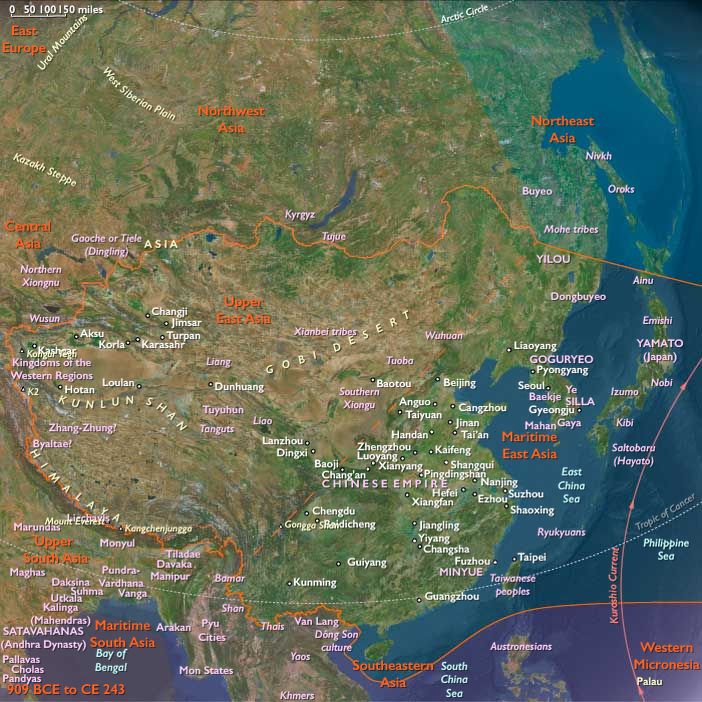
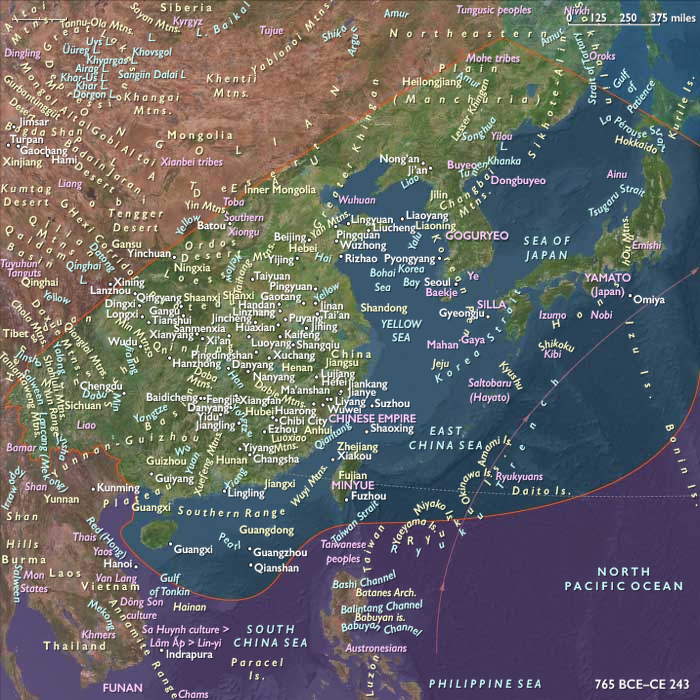
One advance would be from Yi Province in the west (covering the Sichuan Basin), north through the Qin Mountains, debouching into the Wei River valley and achieving a strategic position at the great metropolis Chang'an from which to dominate the great bend of the Yellow River.
The second advance would be from Jing Province (covering present-day Hubei and Hunan) north toward the political center of Luoyang.
After Liu Bei established himself in Yi Province in 215, the essential prerequisites of the plan had been completed.
The geopolitical arrangement envisaged by Zhuge Liang proved, however, to be a militarily unstable one.
The alliance with the state of Wu in the east had broken down over the issue of the occupation of Jing Province.
By 223, the province had been lost and Liu Bei, as well as some of his top generals, were dead.
Even after Zhuge Liang reestablished friendly relations with Wu, his original plan has been markedly altered since only the left prong could be executed.
In Zhuge Liang's much quoted memorial Chu Shi Biao of 227, submitted to Liu Shan before his departure for the north, the prime minister explains in highly ideological terms the reasoning for the expedition against Wei: "We should lead the three armies to secure the Central Plain in the north.
Contributing my utmost, we shall exterminate the wicked, restore the house of Han and return to the old capital.
Such is this subject's duty in repaying the Former Emperor and affirming allegiance to Your Majesty."
The Chu Shi Biao, which also advised Liu Shan on governing the kingdom, can be roughly divided into four different sections.
Zhuge Liang first addressed the dangerous situation of Shu Han, still the weakest out of the Three Kingdoms.
In the second, he gave three main pieces of advice: transparency and willingness to accept criticism, fair judgment, and the avoidance of petty and corrupt officials.
In the third section, Zhuge Liang illustrated his own history and in the fourth addressed the roles of Liu Shan.
All except one of the five expeditions will be military failures (albeit not military disasters) in that Zhuge Liang's forces run out of food before they are able to inflict significant damage on Wei and therefore are forced to withdraw.
Locations
People
Groups
- Nanman
- Chinese (Han) people
- Cao Wei, (Chinese) kingdom of
- Shu Han (minor Han), (Chinese) kingdom of
- Wu, Eastern, (Chinese) kingdom of
Topics
Commodoties
Subjects
Regions
Subregions
Related Events
Showing 10 events out of 60617 total
Years: 228 - 228
Locations
People
Groups
- Nanman
- Chinese (Han) people
- Cao Wei, (Chinese) kingdom of
- Shu Han (minor Han), (Chinese) kingdom of
- Wu, Eastern, (Chinese) kingdom of
Topics
Commodoties
Subjects
Regions
Subregions