
Dutch troops drive the Portuguese from the …
Years: 1602 - 1602
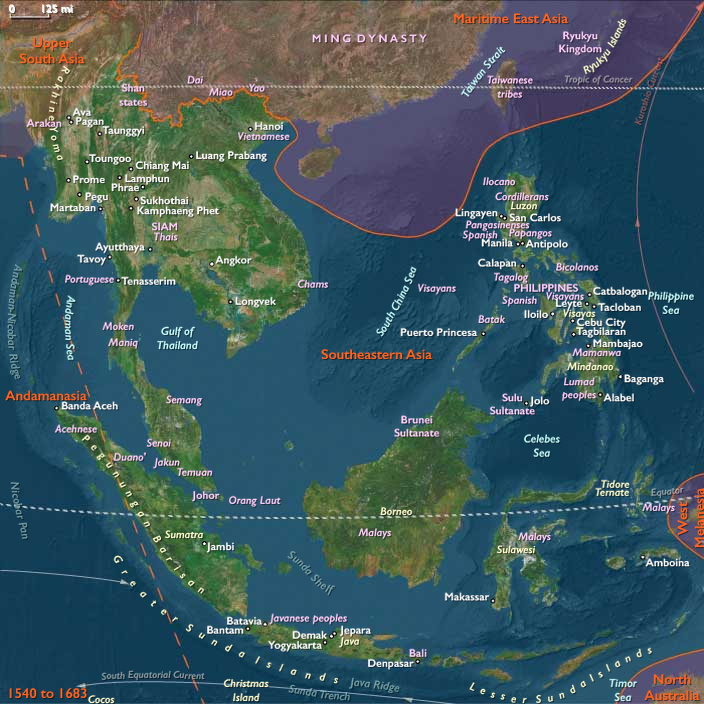
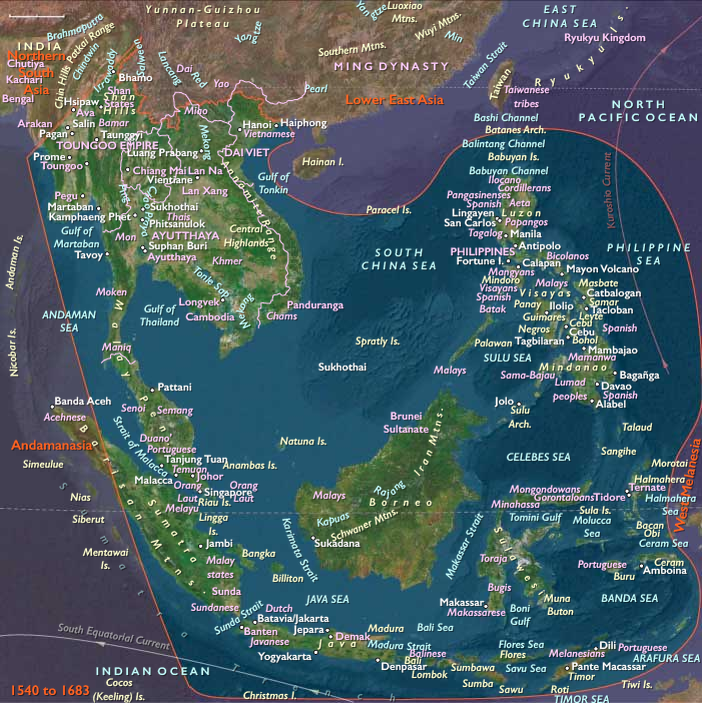
Dutch troops drive the Portuguese from the Moluccas.
Locations
Groups
- Tidore, Sultanate of
- Spain, Habsburg Kingdom of
- Portugal, Habsburg (Philippine) Kingdom of
- Dutch East India Company in Indonesia
- Dutch East India Company (Vereenigde Oostindische Compagnie or VOC in Dutch, literally "United East Indies Company")
Topics
- Colonization of Asia, Dutch
- Eighty Years War (Netherlands, or Dutch, War of Independence)
- Colonization of the Americas, Dutch
Commodoties
Subjects
Regions
Subregions
Related Events
Filter results
Showing 10 events out of 33859 total
Li Zhi, a prominent Chinese philosopher, historian and writer in the late Ming dynasty, had been born in Jinjiang, Fujian province, the descendant of a Persian woman whom his seventh-generation ancestor married.
He is also often referred to by his courtesy name Zhuowu.
His ancestor was Li Nu, the son of Li Lu, who had visited Hormuz in Persia in 1376, converted to Islam, married a Persian or an Arab girl, and brought her back to Quanzhou.
Li Zhi’s philosophy is based upon Neo-Confucianism.
Strongly disagreeing with assimilating oneself to conventional behavior, Li Zhi had tried to spread his ideas.
He can be seen as having been influenced by Wang Yangming (1472-1529), and he preaches a form of moral relativism.
He denies that women are inferior to men.
However, he is accused for his attempt to spread "dangerous ideas" along with other transgressions and is ultimately jailed.
He commits suicide in prison in 1602.
Chodkiewicz at Wesenberg (Rakvere) defeats a Swedish reinforcement force under Arvid Eriksson Stålarm sent to relieve the Swedish troops in Dorpat.
Kepler's primary obligation as imperial mathematician is to provide astrological advice to the emperor: though Kepler takes a dim view of the attempts of contemporary astrologers to precisely predict the future or divine specific events, he has been casting detailed horoscopes for friends, family and patrons since his time as a student in Tübingen.
In addition to horoscopes for allies and foreign leaders, the emperor will seek Kepler's advice in times of political trouble (though Kepler's recommendations are based more on common sense than the stars).
Rudolph is actively interested in the work of many of his court scholars (including numerous alchemists) and keeps up with Kepler's work in physical astronomy as well.
Officially, the only acceptable religious doctrines in Prague are Catholic and Utraquist, but Kepler's position in the imperial court allows him to practice his Lutheran faith unhindered.
The emperor nominally provide an ample income for his family, but the difficulties of the overextended imperial treasury mean that actually getting hold of enough money to meet financial obligations is a continual struggle.
Partly because of financial troubles, his life at home with Barbara is unpleasant, marred with bickering and bouts of sickness.
Court life, however, brings Kepler into contact with other prominent scholars (Johannes Matthäus Wackher von Wackhenfels, Jost Bürgi, David Fabricius, Martin Bachazek, and Johannes Brengger, among others) and astronomical work proceeds rapidly.
King Alexander II of Kakheti had officially pledged his allegiance to Tsar Feodor I of Russia, but the alliance had never actually been implemented in practice.
Alexander’s son, David, had revolted against the royal authority and in October 1601 seized the crown I, forcing his father to retire to a monastery.
David’s brother, George, had masterminded a plot which quickly collapsed and led to repression; David had George imprisoned while seventeen of his supporters were executed.
David’s foreign policy was a continuation of his father’s line.
He receives a Russian embassy in 1602 and reaffirms his loyalty to the tsar.
He then marches against Nugzar, the defiant lord of the Aragvi river basin, and forces him into submission.
David dies suddenly a year later, on October 2, 1602, and Alexander is able to resume the throne.
The power vacuum in Bahrain resulting from the Bharani rebellion is almost immediately filled by the Persian Shah, whose commander Imam-Quli Khan invades the island in 1602 with the help of the English, subsuming it within the Safavid Empire.
The Iranians expel the Portuguese from the rest of the Persian Gulf, with the exception of Muscat.
The Iranian rulers are to retain sovereignty over the islands, with some interruptions, for nearly two centuries.
The Portuguese have meanwhile returned to the Persian Gulf as allies of Afrasiyab, the Pasha of Basra, against the Persians.
Afrasiyab was formerly an Ottoman vassal but has been effectively independent since 1612.
The Portuguese never return to Ormus.
Abbas' tolerance towards Christians is part of his policy of establishing diplomatic links with European powers to try to enlist their help in the fight against their common enemy, the Ottoman Empire.
The idea of such an anti-Ottoman alliance is not a new one—over a century before, Uzun Hassan, then ruler of part of Iran, had asked the Venetians for military aid—but none of the previous Safavids had made diplomatic overtures to Europe.
Abbas' attitude is in marked contrast to that of his grandfather, Tahmasp I, who had expelled the English traveler Anthony Jenkinson from his court on hearing he was a Christian.
For his part, Abbas had declared that he "preferred the dust from the shoe soles of the lowest Christian to the highest Ottoman personage."
Abbas had in 1599 sent his first diplomatic mission to Europe.
The group had crossed the Caspian Sea and spent the winter in Moscow, before proceeding through Norway, Germany (where it had been received by Emperor Rudolf II) to Rome where Pope Clement VIII had given the travelers a long audience.
They finally arrive at the court of Philip III of Spain in 1602.
Although the expedition never manages to return to Iran, being shipwrecked on the journey around Africa, it marks an important new step in contacts between Iran and Europe and Europeans begin to be fascinated by the Iranians and their culture.
The number of diplomatic missions to and fro will greatly increase.
Tiny San Marino, which still faces many potential threats, signs with the Pope in 1602 a treaty of protection that will come into force in 1631.
The family of Spinola is one of great antiquity, wealth and power in Genoa.
Ambrogio Spinola is the eldest son of Filippo Spinola, marquis of Sesto and Benafro, and his wife Polissena, daughter of the prince of Salerno.
Don Ambrogio's sister Donna Lelia is married to Don Giulio Cesare Squarciafico, 2nd Marquess of Galatone, from whom descend the Princes of Belmonte.
The Italian Republic of Genoa is in practical terms a protected state of the Spanish Empire; the Genoese are the bankers of the Spanish monarchy and have control of its finances.
Several of the younger brothers of Ambrogio Spinola have sought their fortune in Spain, and one of them, Federico, has distinguished himself greatly as a soldier in the Army of Flanders.
The eldest brother, who had remained at home to marry and continue the family, was in 1592 married to Giovanna Baciadonna, daughter of the count of Galerata.
The houses of Spinola and Doria are rivals for authority within the republic.
Ambrogio Spinola has continued the rivalry with the count of Tursi, the chief of the Dorias.
Unsuccessful in tghis, and having lost a lawsuit into which he had entered to enforce a right of preemption of a palace belonging to the Salerno family which the Doria wished to purchase, he had decided to withdraw from the city and advance the fortunes of his house by serving the Spanish monarchy in Flanders.
He and his brother Federico enter into a contract with the Spanish government—a condotta on the old Italian model—in 1602.
It is a speculation on which Spinola has risked the whole of the great fortune of his house.
Ambrogio Spinola undertakes to raise one thousand men for land service, and Federico to form a squadron of galleys for service on the coast.
One of Caravaggio's secular pieces from these years is Amor Victorious, painted in 1602 for Vincenzo Giustiniani, a member of Del Monte's circle.
The model is named in a memoir of the early seventeenth century as "Cecco", the diminutive for Francesco.
He is possibly Francesco Boneri, identified with an artist active in the period 1610-1625 and known as Cecco del Caravaggio ('Caravaggio's Cecco'), carrying a bow and arrows and trampling symbols of the warlike and peaceful arts and sciences underfoot.
He is unclothed, and it is difficult to accept this grinning urchin as the Roman god Cupid—as difficult as it is to accept Caravaggio's other semi-clad adolescents as the various angels he paints in his canvases, wearing much the same stage-prop wings.
The point, however, is the intense yet ambiguous reality of the work: it is simultaneously Cupid and Cecco, as Caravaggio's Virgins are simultaneously the Mother of Christ and the Roman courtesans who model for them.
Years: 1602 - 1602
Locations
Groups
- Tidore, Sultanate of
- Spain, Habsburg Kingdom of
- Portugal, Habsburg (Philippine) Kingdom of
- Dutch East India Company in Indonesia
- Dutch East India Company (Vereenigde Oostindische Compagnie or VOC in Dutch, literally "United East Indies Company")
Topics
- Colonization of Asia, Dutch
- Eighty Years War (Netherlands, or Dutch, War of Independence)
- Colonization of the Americas, Dutch
