Dushan now offers to lead an alliance …
Years: 1353 - 1353
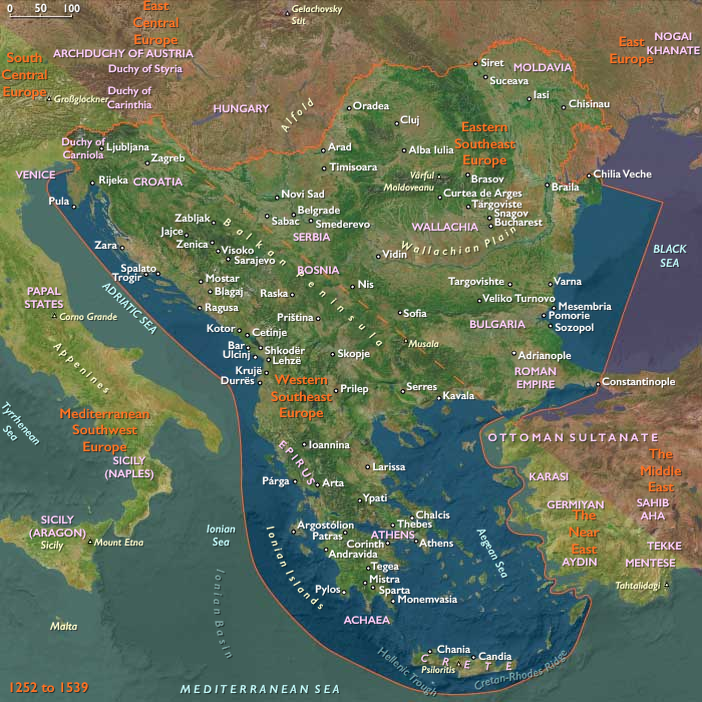
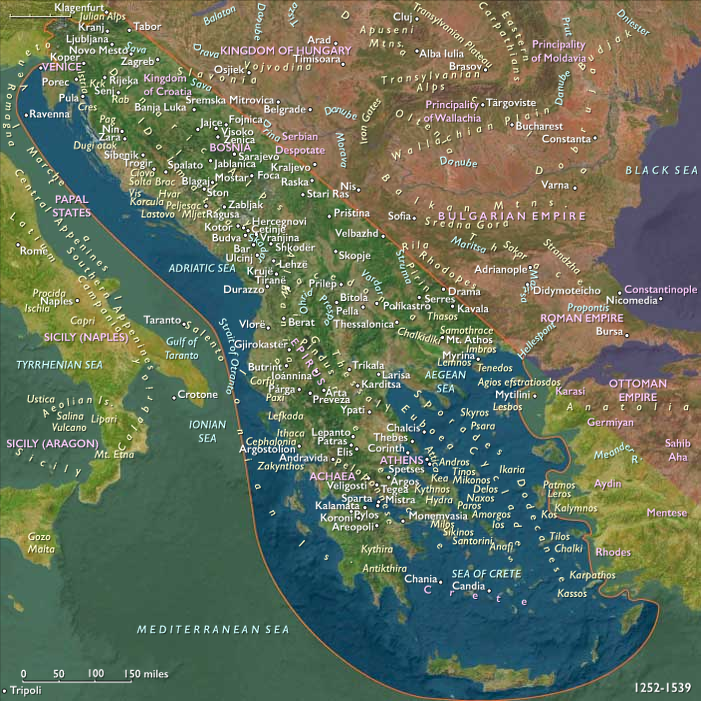
Dushan now offers to lead an alliance against the Turks and recognize the pope, but these gambits also are rejected.
Locations
People
Groups
Commodoties
Subjects
Regions
Subregions
Related Events
Filter results
Showing 10 events out of 44154 total
The Laotian prince Fa Ngum assumes the throne of Muong Swa (Luang Prabang, or Louangphrabang, situated on the Mekong River, about one hundred and twenty-five miles (two hundred kilometers) northwest of present Vientiane) and in 1353 establishes the kingdom of Lan Xang independently of the Khmer Empire of which Laos had previously been a part.
Theravada Buddhism, adopted from the Khmers, becomes the state religion.
Chernihiv was first mentioned in the Rus'-Byzantine Treaty of 907 but the time of establishment is not known.
According to the items uncovered by archaeological excavations of a settlement which included artifacts from the Khazar Khaganate, it seems to have existed at least in the ninth century.
Towards the end of the tenth century, the city probably had its own rulers.
It is here that the Black Grave, one of the largest and earliest royal mounds in Eastern Europe, will be excavated in the nineteenth century.
In the southern portion of the Kievan Rus' polity, the city was the second by importance and wealth.
From the early eleventh century, it was the seat of powerful Grand Principality of Chernigov, whose rulers at times vied for power with Kievan Grand Princes, and often overthrew them and took the primary seat in Kiev for themselves.
The grand principality was the largest in Kievan Rus and included not only the Severian towns but even such remote regions as Murom, Ryazan and Tmutarakan.
The golden age of Chernihiv, when the city population peaked at twenty-five thousand, lasted until 1239 when the city was sacked by the hordes of Batu Khan, which started a long period of relative obscurity.
The area falls under the Grand Duchy of Lithuania in 1353.
Charles attempts to expand the Bohemian crown lands outside of Prague, using his imperial authority to acquire fiefs in Silesia, the Upper Palatinate, and Franconia.
The latter regions comprise "New Bohemia," a string of possessions intended to link Bohemia with the Luxembourg territories in the Rhineland.
The Bohemian estates are not, however, willing to support Charles in these ventures.
Kantakouzenos has tried but failed to weaken the economic stranglehold of the Genoese by rebuilding an imperial war fleet and merchant navy.
The effort has involved him in warfare, first on his own and then as an unwilling partner of the Venetians against the Genoese, from which Constantinople emerges as the loser.
The revenue of the Genoese colony at Galata, derived from custom dues, is now far greater than that of Constantinople.
The empire's poverty is reflected in dilapidated buildings and falling standards of luxury.
The crown jewels had been pawned to Venice during the civil war, and the imperial gold coin, hopelessly devalued, has given place in international trade to the Venetian ducat.
Increasingly, Constantinople is at the mercy of its foreign competitors and enemies, who promote and exploit the political and family rivalries among the ruling class.
Bosnia’s hereditary ban Stjepan II Kotromanic, having reigned from 1314, has expanded his nation as far north as the Sava River and …
…annexed that part of Herzecgovina/Hum that lies west of the Serbian state ruled by Stefan Dusan.
Bosnia’s hereditary ban Stjepan II Kotromanic dies in 1353; his nephew, Tvrtko, claims descent from Serbia’s powerful Nemanja dynasty, to which Serbian ruler Stefan Dusan belongs.
Tvrtko is the firstborn child of Vladislaus of Bosnia and Jelena Šubić, who had been married at the Šubić's Klis Fortress in Croatia during summerlong festivities open to the whole population.
Tvrtko's father was the son of Stephen I, Ban of Bosnia, and Elizabeth of Serbia.
Tvrtko's mother Jelena Šubić is the daughter of Count George II Šubić from the noble Šubić family.
Tvrtko is the first cousin of Elizabeth of Bosnia, the daughter of Vladislaus's brother, Ban Stephen II Kotromanić.
During the years when the plague was devastating the region, Jelena had been in charge of the household, which, among others, included her ailing husband Vladislaus, and the family of her ailing in-laws of Stephen II Kotromanić.
Jelena has brought up her own children, Tvrtko, his younger brother Stephen Vuk, and his sister Catherine, together with her niece and adopted daughter Elizabeth.
Tvrtko succeeds his uncle as Ban of Bosnia in the Hungarian King's name in 1353 at the age of fifteen.
He is a minor, so his father Vladislav Kotromanić rules in his name.
The first year of Tvrtko's reign passes mostly in confirming and issuing new edicts.

Bern, a free imperial city since 1218, joins the Swiss Confederacy in 1353, becoming one of the "eight cantons" of the formative period of 1353 to 1481.
Taddeo Gaddi’s altarpiece of the Madonna and Child with saints, executed in 1353 for the Cathedral of Pistoia, displays the complex figural detail characteristic of his mature work.
According to Giorgio Vasari, Gaddi was considered Giotto's most talented pupil: in 1347 he was placed at the top in a list of Florence's most renowned painters.
Alghero, captured by the forces of the Crown of Aragon under Bernardo de Cabrera in 1353, lies in the province of Sassari in northwestern Sardinia, next to the Mediterranean Sea.
Due to its strategic position, Alghero has been built around a fortified port, founded around 1102 by the Genoese Doria family, whose members have ruled it for centuries, apart from a brief period under the rule of Pisa (1283–84).
Marianus of Arborea realizes that the political aim of Aragon’s King Peter IV is nothing less than the annexation of Sardinia.
Following the conquest of Alghero in 1353 by Peter and his Venetian and Catalan allies, Marianus parts ways with the Catalans.
He allies with the Genoese and the Doria and makes himself an enemy of the Aragonese.