Hazen is living on half-pay in Saint-Jean …
Years: 1775 - 1775
September
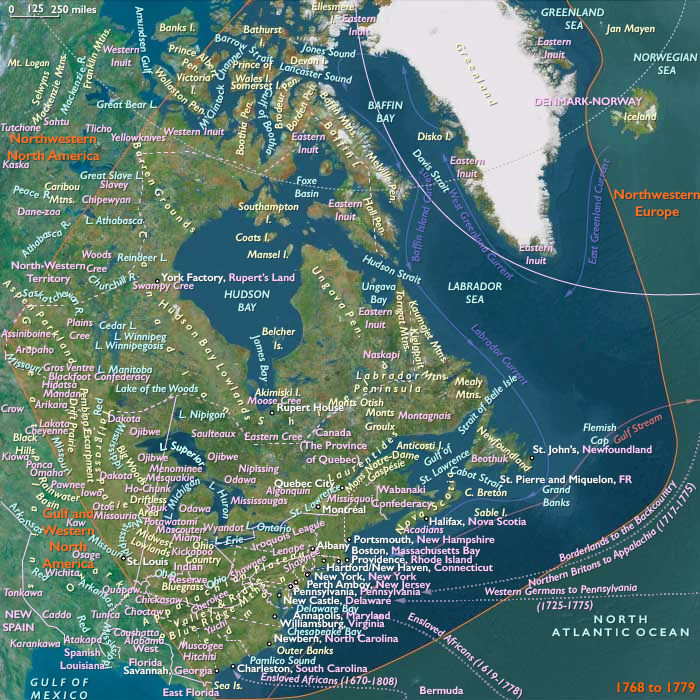
When Benedict Arnold raided Fort Saint-Jean on May 18, Hazen had reported the news of that raid (as well as the capture of Fort Ticonderoga) first to the military authorities in Montreal, then to Governor Guy Carleton in Quebec, before returning home to consider the consequences the conflict might have on him and his lands.
The American invasion of Quebec arrives near his home at Saint-Jean on September 6.
On this day, Hazen meets with General Philip Schuyler, explaining to him that Fort Saint-Jean is well-defended and unlikely to be taken by siege, and that the local habitants are unlikely to assist the American effort.
This gloomy portrait leads Schuyler to consider retreating; but the arrival of additional American troops, and a more optimistic assessment from James Livingston, a grain merchant living near Chambly, encourages the Americans to renew the attack.
Livingston will go on to form the 1st Canadian Regiment in November 1775.
Locations
People
Groups
- New France (French Colony)
- France, (Bourbon) Kingdom of
- Britain, Kingdom of Great
- Nova Scotia (British Colony)
- Quebec (British Province)
Topics
- Colonization of the Americas, French
- Colonization of the Americas, British
- Acadians, Expulsion of the
- Seven Years' War
Subjects
Regions
Subregions
Related Events
Filter results
Showing 5 events out of 5 total
Northwest Europe (1888–1899): Late Victorian Britain, Imperial Strains, and Political Transformations
Imperial Strength and Victorian Symbolism
Between 1888 and 1899, Britain continued as a leading global power, its imperial influence and cultural prestige underscored by Queen Victoria’s symbolic stature. Though politically passive, Victoria remained the emblem of British stability, domestic virtue, and imperial dignity. Yet, beneath this confident façade, Britain faced intensifying political, economic, and social tensions, marking the slow end of the unchallenged Victorian era.
Political Realignment: The Liberal Split and Rise of Conservative Dominance
Britain’s political landscape shifted dramatically following Prime Minister William Ewart Gladstone’s commitment to Irish Home Rule. Historically, Britain’s aristocracy had been politically divided between the Conservative and Liberal parties. However, Gladstone’s embrace of Home Rule caused many aristocrats and upper-class voters to abandon the Liberals, resulting in a permanent Conservative majority in the House of Lords. London's high society, following Queen Victoria’s personal disdain for Home Rule, ostracized prominent Home Rulers, further marginalizing the Liberal party socially.
A key event in this realignment occurred when influential Liberal Joseph Chamberlain broke decisively with Gladstone over Home Rule, taking with him a substantial faction of upper-class Liberal supporters. This group formed the Liberal Unionist Party, aligning closely with the Conservatives, and ultimately merging with them. This shift ensured long-term Conservative dominance, relegating Liberals to political opposition for much of the following two decades.
Gladstonian Liberals and The Newcastle Programme
In response, the remaining Gladstonian Liberals adopted the ambitious Newcastle Programme in 1891, proposing extensive reforms including:
-
Home Rule for Ireland
-
Disestablishment of the Church of England in Wales and Scotland
-
Stricter liquor regulations
-
Extensive factory reform
-
Significant democratic political reforms
The Programme resonated powerfully with middle-class Nonconformist Liberals who felt newly liberated from the dominance of aristocratic influence, reshaping the Liberal party’s social and political foundations.
The Boer War and Imperial Tensions in South Africa
Simultaneously, Britain faced rising imperial tensions in South Africa. British control of the region, established after the Napoleonic Wars, had continuously provoked resistance from Dutch-speaking settlers, or "Boers" (Afrikaners). The Boers established two independent republics—the Transvaal and the Orange Free State—resisting British attempts to assert greater control.
By the late 1890s, the British government, influenced significantly by cabinet minister Joseph Chamberlain, protested against discriminatory policies enacted by Boer leader Paul Kruger in the Transvaal Republic. Historian Andrew Roberts later described Kruger’s administration as oppressive, labeling it a "quasi-police state," noting it refused political rights to nonwhites, Catholics, Jews, and British "Uitlanders" who provided eighty percent of the republic's tax revenues. Despite a population of over fifty thousand British residents, Johannesburg was denied local governance, the English language was banned in official matters, public meetings were outlawed, newspapers censored, and citizenship strictly controlled.
Chamberlain highlighted Uitlander grievances, intensifying tensions. In response to escalating British pressure, the Boers declared war on October 20, 1899, beginning the Second Boer War (1899–1902). Despite numbering only 410,000, the Boer fighters employed effective guerrilla tactics against Britain’s larger and better-equipped forces. Ultimately, overwhelming British numbers, superior equipment, and often harsh military strategies secured a costly British victory, but at significant financial, human, and reputational cost, foreshadowing future imperial challenges.
Rising German Ambitions and Diplomatic Strains
On the broader international stage, the rise of a unified Germany after 1871 increasingly challenged British dominance. Initially, Chancellor Otto von Bismarck’s diplomatic strategy had maintained a peaceful European balance of power. However, after Kaiser William II ascended the German throne in 1888, he dismissed Bismarck, embracing aggressive rhetoric and a naval buildup explicitly designed to rival Britain’s global naval supremacy.
Germany’s expanding industrial strength threatened Britain's traditional industrial and commercial dominance, creating anxiety within Britain’s political and business communities. Germany's ambitions in Africa and the Pacific exacerbated imperial rivalries, gradually leading Britain toward diplomatic isolation and ultimately prompting reconsideration of its long-held policy of "splendid isolation."
Arts, Crafts, and the Cultural Legacy of William Morris
Culturally, Britain witnessed the transformative influence of the Arts and Crafts Movement, led by the influential designer, poet, and early socialist William Morris. Morris’s designs for furniture, fabrics, stained glass, wallpapers, and decorative arts revolutionized Victorian aesthetics, championing craftsmanship, simplicity, and beauty in reaction to industrial mass-production. Morris’s philosophy profoundly reshaped Victorian tastes and contributed to broader cultural shifts toward simpler, more naturalistic designs.
Late Victorian Society: Gender, Fashion, and the “New Woman”
Socially, Britain continued grappling with shifting gender roles. The emergence of the "New Woman" challenged traditional Victorian notions, advocating increased educational opportunities, economic independence, and eventually suffrage for women. Although mainstream fashion continued to favor restrictive corseting, the uncorseted styles promoted by the Aesthetic Movement and other progressive groups gradually influenced broader perceptions of women's autonomy.
Technological Innovation and Industrial Competition
Britain maintained global leadership in industries such as shipbuilding, finance, and communications. The telegraph and rail systems continued facilitating international trade, but Britain faced mounting industrial competition from Germany and the United States, increasingly challenging its industrial supremacy. Economic pressures from the continuing Long Depression period intensified these competitive anxieties.
Lord Salisbury and Gladstone’s Final Years
Politically, Britain’s leadership transitioned between two dominant figures in this era. Conservative Lord Salisbury, characterized by his full beard and patrician bearing, served as Prime Minister multiple times (briefly until January 1886, again from November 1886 to 1892, and once more starting in 1895), offering stable but cautious leadership through a turbulent era.
In contrast, Liberal icon William Ewart Gladstone, known for his sparse beard and charismatic moral leadership, served his fourth and final ministry between 1892 and 1894, attempting once again to pass Irish Home Rule before retiring due to age. Gladstone died in 1898, symbolizing the passing of an era of dynamic, moral-driven reformism in British politics.
Military Reforms and Lingering Challenges
Despite earlier reforms by Gladstone’s War Secretary, Edward Cardwell, the British Army remained plagued by organizational inefficiencies and outdated practices, exposed painfully during the Boer War. The army's voluntary nature, though admired domestically, proved challenging when confronting sustained guerrilla tactics overseas. These weaknesses highlighted critical military vulnerabilities Britain would later need to address.
Scandinavian Stability and Icelandic Nationalism
Scandinavia continued enjoying internal stability. Norway further solidified its distinct national identity within the union with Sweden, setting the stage for later independence movements. Denmark focused inwardly, consolidating after earlier territorial losses.
In Iceland, nationalist sentiments deepened, building on the earlier intellectual and political legacy of nationalist figure Jón Sigurðsson, laying the groundwork for greater autonomy.
Leisure, Tourism, and Victorian Culture
Middle-class leisure expanded steadily, driven by improved transport and rising incomes. Tourism, popularized by entrepreneurs such as Thomas Cook, broadened significantly, facilitating increased international and domestic travel. Literary culture remained vibrant, represented by figures like Oscar Wilde, Arthur Conan Doyle, and Rudyard Kipling, whose works examined social anxieties, imperial tensions, and shifting cultural norms. Wilde’s dramatic 1895 trial, in particular, illustrated tensions within traditional Victorian morality, marking broader cultural transformations at century’s end.
Conclusion: Imperial Confidence, Domestic Strains, and Emerging Modernity
From 1888 to 1899, Britain’s imperial dominance persisted, but underlying domestic and international tensions became increasingly pronounced. Political realignment driven by the Irish Home Rule crisis, challenges posed by the Boer War, rising German ambitions, shifting gender roles, and economic competition from emerging industrial powers defined this critical era. Simultaneously, cultural shifts epitomized by William Morris’s influential designs, rising feminist consciousness, and vibrant literary expressions signaled transformative changes.
This period marked the final years of confident Victorian dominance, revealing strains that would profoundly reshape Britain and Northwest Europe as they entered the twentieth century.

The full-bearded Lord Salisbury, out of office in January 1886, is again prime minister from November 1886 to 1892, and serves for a third time beginning in 1895.
In the interim, the sparsely-bearded William Ewart Gladstone serves as prime minister for the fourth and final time.
The Conservative and Liberal Unionist coalition government loses its majority in the House of Commons in the British general election of July 4–18; this will eventually lead to Prime Minister Lord Salisbury's resignation on August 12.
William Ewart Gladstone assumes the U.K. premiership, as head of Liberal government, with Irish Nationalist Party support, on August 18, 1892.
Northwest Europe (1900–1911): Edwardian Transformation, Imperial Struggles, and Social Reforms
The End of the Victorian Era and Edwardian Beginnings
The death of Queen Victoria in January 1901 marked the symbolic close of the Victorian age. Her son, Edward VII (1901–1910), ascended the throne, inaugurating the Edwardian era. Unlike his mother’s stern and symbolic image, Edward VII embraced modernity, elegance, and social vitality, reflecting Britain’s increasingly cosmopolitan character. His reign coincided with significant transformations—political, social, and technological—that set Britain on the path toward modernity.
The Boer War and Imperial Difficulties
The Second Boer War (1899–1902) continued into the early Edwardian period, profoundly shaping British politics and imperial policy. Initially expecting an easy victory, Britain faced unexpectedly fierce guerrilla resistance from Boer commandos. Despite their vastly inferior numbers—only 410,000 Afrikaners—the Boers waged a tenacious guerrilla campaign, inflicting heavy casualties and revealing deep deficiencies within the British Army’s structure, training, and command.
Historian Andrew Roberts later emphasized the authoritarian nature of the Boer republics, particularly President Paul Kruger’s restrictive Transvaal administration, which denied citizenship and political rights to non-Boer “Uitlanders,” despite their economic contributions. British efforts to protect Uitlander rights had escalated tensions into war.
Although Britain eventually secured victory through superior numbers, weaponry, and often-brutal tactics—including internment of Boer civilians in concentration camps—the conflict severely damaged Britain’s international reputation, prompting domestic introspection regarding military efficiency and imperial morality.
Liberal Ascendancy and Social Reform under Campbell-Bannerman and Asquith
After years of Conservative dominance under Lord Salisbury (Prime Minister 1886–92, 1895–1902) and his nephew Arthur Balfour (1902–1905), the British public decisively shifted towards Liberalism. Under Liberal Prime Ministers Sir Henry Campbell-Bannerman (1905–1908) and subsequently H. H. Asquith (1908–1916), Britain undertook significant domestic reforms, laying foundations for the modern welfare state.
The Liberal government’s landmark social legislation included:
-
Old Age Pensions Act (1908): providing state pensions to alleviate poverty among the elderly.
-
National Insurance Act (1911): introducing compulsory health and unemployment insurance for workers.
-
People’s Budget (1909): proposed by Chancellor David Lloyd George, imposing higher taxes on wealthy landowners to fund welfare reforms, prompting intense political controversy with the Conservative-dominated House of Lords.
These reforms, driven by moral urgency and political pragmatism, sought to address poverty and social inequalities exacerbated by rapid industrialization.
Constitutional Crisis and the Parliament Act of 1911
The confrontation between Liberals and Conservatives peaked with the Constitutional Crisis of 1909–1911. The Conservative-controlled House of Lords repeatedly blocked the People’s Budget, challenging Commons supremacy. Prime Minister Asquith responded by calling two general elections in 1910, resulting in Liberal-led coalitions. Ultimately, the Liberals enacted the Parliament Act of 1911, drastically reducing the Lords’ power by eliminating their absolute veto over financial legislation and significantly curbing their legislative powers.
This crisis profoundly reshaped British governance, affirming democratic principles and dramatically altering the constitutional balance.
The Rise of the Labour Party and Changing Class Dynamics
The Edwardian era saw profound shifts in British politics, marked by the rising influence of the working class. The Labour Party, formed in 1900 as the Labour Representation Committee, gained parliamentary representation by 1906, emerging as a major political force advocating workers’ rights and social justice. Labour’s growth reflected increasingly assertive trade unions, rising working-class consciousness, and dissatisfaction with traditional Liberal and Conservative elites.
The Irish Question and Continuing Tensions
Ireland remained a divisive political issue. Despite earlier failed Home Rule efforts under Gladstone, Irish nationalists intensified demands for self-government. The Irish Parliamentary Party, now under John Redmond, sustained pressure for Home Rule, while Ulster Protestants vehemently opposed it. Although postponed by constitutional battles, the issue of Irish Home Rule loomed large, portending future conflicts.
Women’s Suffrage Movement and Changing Gender Roles
The campaign for women’s suffrage intensified dramatically during the Edwardian era. Organizations like the Women’s Social and Political Union (WSPU), founded in 1903 by Emmeline Pankhurst, adopted militant tactics, gaining national prominence. Their confrontational approach—public demonstrations, hunger strikes, and acts of civil disobedience—provoked public debate and political pressure, significantly advancing the suffrage cause, despite resistance from traditional political establishments.
Imperial Rivalries and Diplomatic Realignments
Internationally, Britain faced mounting challenges to its imperial hegemony. Germany’s aggressive naval expansion under Kaiser Wilhelm II posed serious threats to British naval supremacy, provoking deep anxiety in British policy circles. Britain gradually abandoned its traditional "splendid isolation," engaging in cautious diplomatic realignments:
-
Anglo-Japanese Alliance (1902): Britain’s first formal alliance, securing its Asian interests.
-
Entente Cordiale with France (1904): resolving colonial disputes and marking a diplomatic shift.
-
Anglo-Russian Entente (1907): defusing Central Asian tensions and completing the Triple Entente with France and Russia, forming strategic diplomatic counterweights against Germany.
These alliances marked Britain’s reluctant shift toward Continental engagement, driven by strategic necessity amid rising geopolitical tensions.
Cultural and Artistic Transformations: Edwardian Elegance and Arts and Crafts
Culturally, the Edwardian period embraced sophistication and elegance, contrasting with Victorian austerity. Social elites pursued leisure and luxury, epitomized by grand London society balls and the international popularity of King Edward VII’s cosmopolitan lifestyle. Meanwhile, the Arts and Crafts Movement, inspired by designer and socialist thinker William Morris, continued influencing Victorian taste, advocating artisanal quality and aesthetic simplicity, significantly shaping design, architecture, and decorative arts.
Technological Progress and Economic Competition
Technological advances accelerated, fueling Britain’s economic prosperity and social modernization. The era saw rapid electrification, expanded railway networks, widespread automobile adoption, and early aviation experiments. Yet, industrial competition intensified significantly from Germany and America, challenging Britain’s global economic leadership and prompting concerns about industrial stagnation and economic decline.
Military Reforms and Naval Arms Race
The Boer War’s painful lessons led Britain to significant military reforms. The Haldane Reforms (1906–1912), under War Secretary Richard Haldane, restructured the British Army into an expeditionary force and a reserve-based Territorial Force, significantly modernizing military organization.
Simultaneously, Britain engaged in a costly naval arms race with Germany, symbolized by the revolutionary HMS Dreadnought (1906), sparking accelerated battleship construction by both powers, intensifying tensions that presaged World War I.
Scandinavian and Icelandic National Developments
Northern Europe remained relatively stable. In 1905, Norway peacefully achieved independence from Sweden, asserting its distinct national identity. Iceland’s nationalist aspirations strengthened, pursuing increasing autonomy under Danish rule. Denmark itself pursued domestic stability, emphasizing internal reform and cautious neutrality.
Cultural Flourishing and Edwardian Literature
Literature flourished, reflecting Edwardian social tensions and complexities. Prominent authors like George Bernard Shaw, E.M. Forster, and H.G. Wells explored social inequalities, class tensions, and modern anxieties, enriching Britain’s cultural and intellectual landscape.
Conclusion: Transition to Modernity
From 1900 to 1911, Northwest Europe, particularly Britain, underwent profound transformations. The Edwardian era replaced Victorian certainties with greater openness and complexity. Social reforms laid early foundations of the welfare state, while constitutional crises reshaped political power. Imperial rivalries, military reform, and diplomatic realignment reflected Britain’s global insecurities, presaging the conflicts ahead. The rise of Labour, intensifying suffrage movements, and shifting gender roles demonstrated fundamental social changes. Collectively, these developments marked Britain’s turbulent passage from Victorian tradition to twentieth-century modernity, setting the stage for the profound upheavals soon to follow.
Years: 1775 - 1775
September
Locations
People
Groups
- New France (French Colony)
- France, (Bourbon) Kingdom of
- Britain, Kingdom of Great
- Nova Scotia (British Colony)
- Quebec (British Province)
Topics
- Colonization of the Americas, French
- Colonization of the Americas, British
- Acadians, Expulsion of the
- Seven Years' War