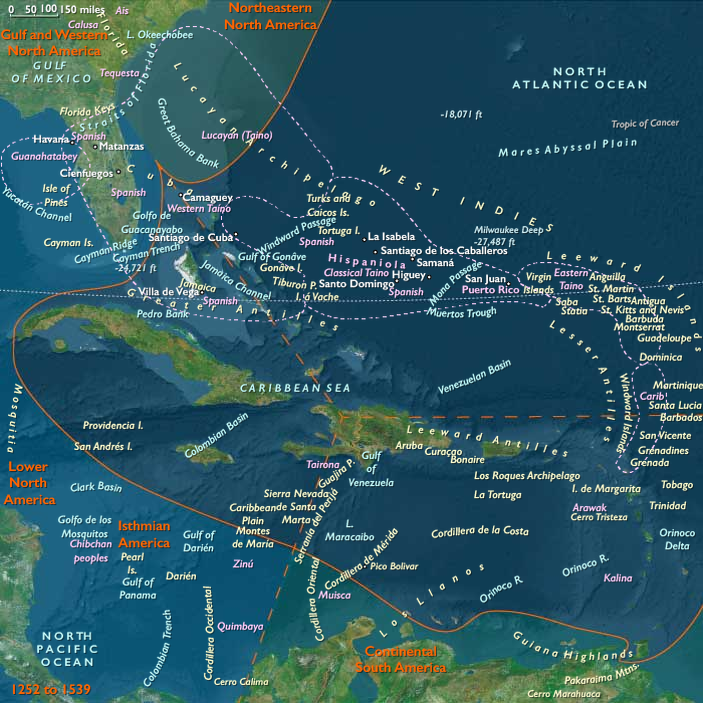
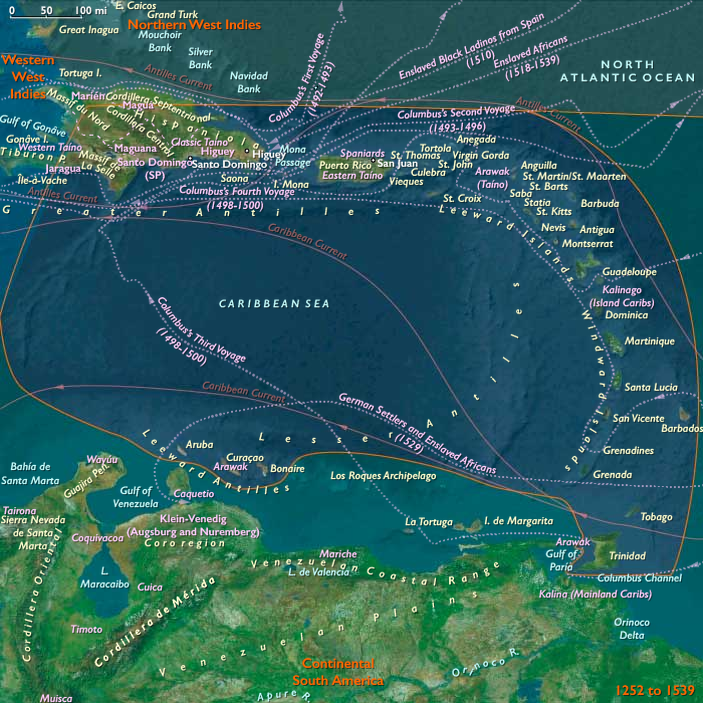
During the same journey, Ojeda constructs a …
Years: 1499 - 1499
August
During the same journey, Ojeda constructs a ship and visits the Las Aves archipelago and …
Locations
People
Groups
- Arawak peoples (Amerind tribe)
- Kalinago (Amerind tribe)
- Caquetio people
- Aragon, Crown of
- Castile, Crown of
Topics
Commodoties
Subjects
Regions
Subregions
Related Events
Filter results
Showing 10 events out of 40057 total
Dürer, on his return to Nuremberg in 1495, had opened his own workshop (being married is a requirement for this).
Over the next five years his style has increasingly integrated Italian influences into underlying Northern forms.
His best works in the first years of the workshop are his woodcut prints, mostly religious, but including secular scenes such as The Men's Bath House (about 1496).
These are larger and more finely cut than the great majority of German woodcuts hitherto, and far more complex and balanced in composition.
It is now thought unlikely that Dürer cut any of the woodblocks himself; this task would have been performed by a specialist craftsman.
However, his training in Wolgemut's studio, which made many carved and painted altarpieces and both designed and cut woodblocks for woodcut, has evidently given him great understanding of what the technique can be made to produce, and how to work with block cutters.
Dürer either draws his design directly onto the woodblock itself, or glues a paper drawing to the block.
Either way, his drawings are destroyed during the cutting of the block.
Durer’s famous series of sixteen great designs for the Apocalypse is dated 1498, as is his engraving of St. Michael Fighting the Dragon.
He made the first seven scenes of the Great Passion in the same year, and a little later, a series of eleven on the Holy Family and saints.
Apocalypse, published in 1498 in German and Latin editions, uses full-page illustrations without captions and with printed texts on the back.
The Four Horsemen of the Apocalypse, the allegorical figures of the sixth chapter of the New Testament’s Book of Revelation, riding a white, a red, a black, and a pale horse, are generally understood to symbolize power or conquest, violence or war, poverty or famine, and death; the rider on the white horse is sometimes interpreted as representing Jesus Christ.
During the same period Dürer has trained himself in the difficult art of using the burin to make engravings.
It is possible he had begun learning this skill during his early training with his father, as it was also an essential skill of the goldsmith.
In 1496 he executed the Prodigal Son, which the Italian Renaissance art historian Giorgio Vasari will single out for praise some decades later, noting its Germanic quality.
Bayezid, his objectives unfulfilled by a new peace with Hungary, turns toward Venice, his other major European enemy.
Eyeing Cyprus, he hopes also to conquer the last Venetian ports in the Morea to establish bases for complete Ottoman naval control of the eastern Mediterranean.
The young Safaviyya leader Ismail has grown up bilingual, speaking Persian and Azerbaijani.
Not only does Ismail have Kurdish ancestors, but he also has ancestors from various other ethnic groups; the majority of scholars will agree that the empire he founds is an Iranian one.
In hiding from the Ak Koyunlu, a Turkic tribal federation that has controlled most of Iran for the past six years, Ismail reappears in 1499 at twelve years of age and returns to Iranian Azerbaijan along with his followers.
Ismail's advent to power is due to Turkmen tribes of Anatolia and Azerbaijan, who form the most important part of the Qizilbash movement.
Husayn Beg Shamlu of the Shamlu tribe, one of the seven Turkmen tribes of the Qizilbash that support Ismail.
During Ismail's stay in Gilan, Husayn Beg has served as his guardian and mentor.
Safi al-Din had in 1301 assumed the leadership of the Zahediyeh, a significant Sufi order in Gilan, from his spiritual master and father-in-law Zahed Gilani.
The order was later known as the Safaviyya.
Like his father and grandfather, Ismail heads the Safaviyya Sufi order.
An invented genealogy claims that Sheikh Saf had been a lineal descendant of Ali.
Ismail also proclaims himself the Mahdi and a reincarnation of Ali.
Under Sheikh Haydar, the Safaviyya had become crystallized as a political movement with an increasingly extremist heterodox Twelver Shi'i coloring and Haydar had been viewed as a divine figure by his followers.
Shaykh Haydar was responsible for instructing his followers to adopt the scarlet headgear of twelve gores commemorating the Twelve Imams, which has led to them being designated by the Turkish term Qizilbash, "Red Head".
The ruler of Zeta until 1496 had been Stefan's older brother Đurađ Crnojević, who maintained frequent correspondence with other Christian feudal states with intention to establish an anti-Ottoman coalition.
When his brother Stefan betrayed him to the Ottomans in 1496, Đurađ had proposed to accept Ottoman suzerainty under Feriz Beg, if they accepted to recognize him as governor in Zeta.
Feriz Beg had refused the proposal and invited Đurađ to either come to Scutari to clarify his anti-Ottoman activities, or to flee Zeta.
When Feriz Beg attacked Zeta with strong forces in 1496, Đurađ decided to flee to the Republic of Venice.
Stefan had remained in Zeta hoping that the Ottomans will accept his suzerainty, but they are only using him in order to easier gain control over his domains.
Stefan is lord of Zeta only nominally, while Ottomans collect taxes from its population.
Feriz Beg had captured Grbalj in 1497 and put it under his effective military control, although it is still part of Zeta governed by Stefan Crnojević.
Feriz Beg formally annexes Zeta to the territory of his Sanjak of Scutari in 1499 after he becomes suspicious toward Stefan because of his contacts with Venice.
Feriz Beg now invites Stefan Crnojević to Scutari, where he has him imprisoned.
Stefan probably dies in prison since he is never mentioned again in historical sources.
According to some authors, after his brother had fled Zeta, Stefan was only an Ottoman spahi, who in 1499 went to Hilandar and became a monk, taking the monastic name Marko.
Josquin des Prez, born in the region of Hainaut and probably trained musically at Cambrai, had been employed as a singer at the cathedral in Milan until the end of 1472, had then passed into the service of Galeazzo Sforza, duke of Milan.
After Galeazzo's death in 1476, Josquin had joined the entourage of the duke's brother, Cardinal Ascanio Sforza, with whom he had remained probably until September 1486, when he became a papal singer in Rome.
He then began a period of traveling in Italy, France, and the Low Countries, returning to the papal chapel again in June 1489.
Nominated for several important benefices by the pope, Josquin remains in the papal choir, first under Pope Innocent VIII, and later under the Borgia pope Alexander VI, through November 1494.
Josquin's mature style had evolved during this period; as in Milan he had absorbed the influence of light Italian secular music, in Rome he had refined his techniques of sacred music.
Several of his motets have been dated to the years he spent at the papal chapel.
Josquin most likely reenters the service of the Sforza family around 1498, on the evidence of a pair of letters between the Gonzaga and Sforza families.
He probably does not stay in Milan long, for in 1499 Louis XII captures Milan in his invasion of northern Italy and imprisons Josquin's former employers.
Around this time Josquin most likely returned to France, although documented details of his career around the turn of the sixteenth century are lacking.
Prior to departing Italy he most likely wrote one of his most famous secular compositions, the frottola El grillo (the Cricket), as well as In te Domine speravi ("I have placed my hope in you, Lord"), based on Psalm 30.
The latter composition may have been a veiled reference to the religious reformer Girolamo Savonarola, who had been burned at the stake in Florence in 1498, and for whom Josquin seems to have had a special reverence; the text had been the Dominican friar's favorite psalm, a meditation on which he left incomplete in prison prior to his execution.
Amerigo Vespucci, trained for a business career, is the third son of Ser Nastagio (Anastasio), a Florentine notary, and Lisabetta Mini.
Amerigo had been educated by his uncle, Fra Giorgio Antonio Vespucci, a Dominican friar of the monastery of San Marco in Florence.
While his elder brothers had been sent to the University of Pisa to pursue scholarly careers, Amerigo Vespucci had embraced a mercantile life, and had been hired as a clerk by the Florentine commercial house of Medici, headed by Lorenzo de' Medici.
Vespucci had acquired the favor and protection of Lorenzo di Pierfrancesco de' Medici, who had become the head of the business after the elder Lorenzo's death in 1492.
In March of that year, the Medici dispatched the thirty-eight-year-old Vespucci and Donato Niccolini as confidential agents to look into the Medici branch office in Cádiz, whose managers and dealings were under suspicion.
In April 1495, by the intrigues of Bishop Juan Rodríguez de Fonseca, the Crown of Castile had broken their monopoly deal with Christopher Columbus and had begun handing out licenses to other navigators for the West Indies.
Just around this time, Vespucci, engaged as the executor of Giannotto Berardi, an Italian merchant who had recently died in Seville, had organized the fulfillment of Berardi's outstanding contract with the Castilian crown to provide twelve vessels for the Indies.
After these were delivered, Vespucci had continued as a provision contractor for Indies expeditions, and is known to have secured beef supplies for at least one (if not two) of Columbus' voyages.
A letter published in 1504 purports to be an account by Vespucci, written to Florentine statesman Piero Soderini, of a lengthy visit to the New World, leaving Spain in May 1497 and returning in October 1498.
However, modern scholars have doubted that this voyage took place, and consider this letter a forgery.
Whoever did write the letter makes several observations of native customs, including use of hammocks and sweat lodges.
The names of Amerigo Vespucci's ships were the San Antiago, Repertaga, Wegiz, and Girmand.
About 1499–1500, Vespucci joins an expedition in the service of Spain, with Alonso de Ojeda (or Hojeda) as the fleet commander.
The intention is to sail around the southern end of the African mainland into the Indian Ocean.

Cisneros accompanies the court of the Spanish Inquisition in 1499 to Granada, and here interferes with the Archbishop of Talavera's efforts to peacefully convert its Muslim inhabitants to Christianity.
Talavera favors slow conversion by explaining to the Moors, in their language, the truths of the Catholic religion, but Cisneros says that this is "giving pearls to pigs," and proceeds with forced mass conversion.
He orders the public burning of all Arabic manuscripts that can be found in Granada—five thousand is the lowest figure the contemporary sources give—except those dealing with medicine.
The indignation of the unconverted Mudéjares (i.e., Iberian Muslims living in Christian territories) over this gross violation of the Alhambra treaty swells into the open revolt known as the First Rebellion of the Alpujarras.
The revolt is violently suppressed and they are given a choice—contrary to the terms of Granada's surrender—of baptism or exile.
The majority accept baptism.
The Romani, although they are refugees from the conflicts in southeastern Europe, are often suspected by the local populations in the West as being associated with the Ottoman invasion because of their physical features seemed related to the Turks. (The German Reichstags at Landau and Freiburg in 1496-1498 had declared that the Romani were spies of the Turks).
In Western Europe, such suspicions and discrimination against a people who were a visible minority results in persecution, often violent, with efforts to achieve ethnic cleansing until the modern era.
In times of social tension, the Romani suffer as scapegoats; for instance, they are accused of bringing the plague during times of epidemics.
Spanish legislation in 1499 orders Gypsies to find a trade and master and cease traveling together, within sixty days, on pain of one hundred lashes and banishment.
The punishment for repeat offenders is amputation of ears, sixty days in chains, and banishment.
Third-time offenders are to become enslaved by those who capture them.
Donato Bramante, just before leaving for Rome in 1499, completes his second great work in Milan, the enlargement of the church of Santa Maria della Grazie, making of the interior a vast monumental version of Filippo Brunelleschi's old sacristy in the church of San Lorenzo in Florence.
The design of the apse of the church has been attributed to Bramante; however, while it was built while he was in the service of the Duchy, there is scant documentary evidence linking him to this church.
His name is inscribed in a piece of marble in the church vaults delivered in 1494.
Some document, though, mention the name Amadeo, likely Giovanni Antonio Amadeo.
Similarities to his work at Santa Maria alla Fontana make this attribution more likely.
However, there is no real evidence of the fact other than that Bramante lived in Milan at this time, and he continued the Gothic style from the first part, but mixed with Romanesque influence.
Years: 1499 - 1499
August
Locations
People
Groups
- Arawak peoples (Amerind tribe)
- Kalinago (Amerind tribe)
- Caquetio people
- Aragon, Crown of
- Castile, Crown of