
The Tran family, which had effectively controlled …
Years: 1252 - 1395
The Tran family, which had effectively controlled the Vietnamese throne for many years, had replaced the Ly dynasty in 1225 tby arranging a marriage between one of its members and the last Ly monarch, an eight-year-old princess.
Under the Tran dynasty (1225-1400), the country prospers and flourishes as the Tran rulers carry out extensive land reform, improve public administration, and encourage the study of Chinese literature.
The Tran, however, are best remembered for their defense of the country against the Mongols and the Cham.
The Mongols controlled most of northern China and Manchuria by 1225 and were eyeing southern China, Vietnam, and Champa.
In 1257, 1284, and 1287, the Mongol armies of Kublai Khan invade Vietnam, sacking the capital at Thang Long (renamed Hanoi in 1831) on each occasion, only to find that the Vietnamese had anticipated their attacks and evacuated the city beforehand.
Disease, shortage of supplies, the climate, and the Vietnamese strategy of harassment and scorched- earth tactics foil the first two invasions.
The third Mongol invasion, of three hundred thousand men and a vast fleet, is also defeated by the Vietnamese under the leadership of General Tran Hung Dao.
Borrowing a tactic used by Ngo Quyen in 938 to defeat an invading Chinese fleet, the Vietnamese drive iron-tipped stakes into the bed of the Bach Dang River (located in northern Vietnam in present- day Ha Bac, Hai Hung, and Quang Ninh provinces); then, with a small Vietnamese flotilla, lure the Mongol fleet into the river just as the tide is starting to ebb.
Trapped or impaled by the iron-tipped stakes, the entire Mongol fleet of four hundred craft is sunk, captured, or burned by Vietnamese fire arrows.
The Mongol army retreats to China, harassed en route by Tran Hung Dao's troops.
Locations
People
Groups
- Vietnamese people
- Chinese (Han) people
- Dai Viet, Kingdom of
- Mongols
- Mongol Empire
- Chinese Empire, Yüan, or Mongol, Dynasty
Topics
Commodoties
Subjects
Regions

Subregions
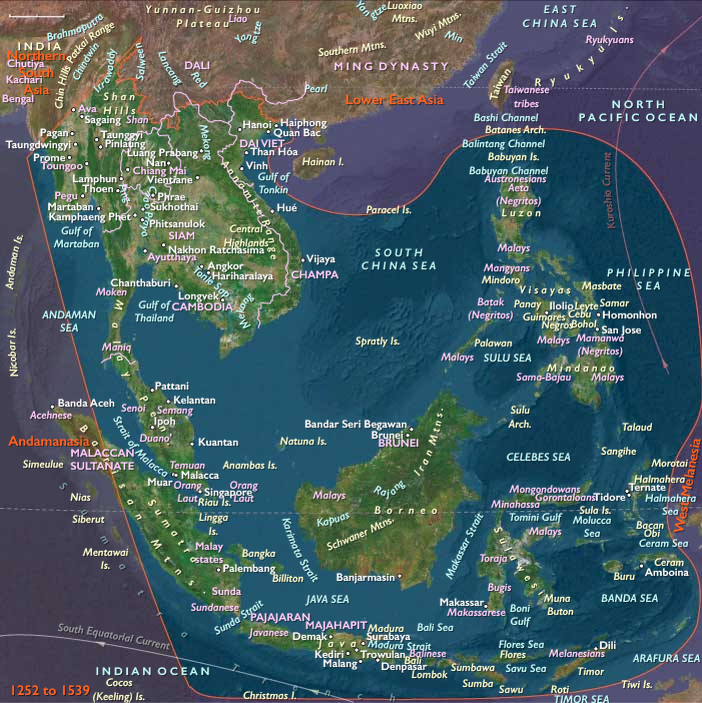
Years: 1252 - 1395
Locations
People
Groups
- Vietnamese people
- Chinese (Han) people
- Dai Viet, Kingdom of
- Mongols
- Mongol Empire
- Chinese Empire, Yüan, or Mongol, Dynasty
Topics
Commodoties
Subjects
Regions
Subregions