
Ships had typically stopped at the Commander …
Years: 1768 - 1768
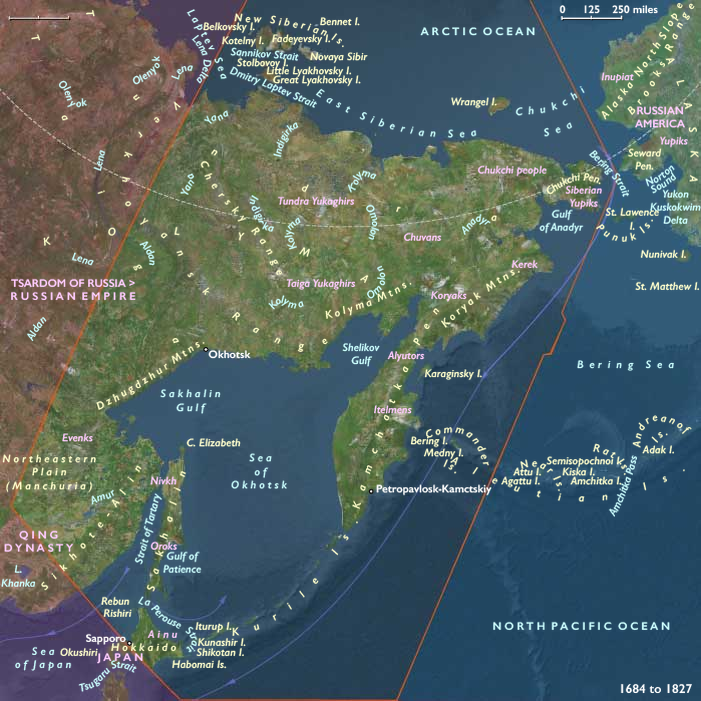
Ships had typically stopped at the Commander Islands During the early decades of the maritime fur trade in order to slaughter and preserve the meat of Steller's Sea Cows, whose range is limited to those islands.
A large sirenian mammal which grows up to seven point nine meters (twenty-five point nine feet) long and weighs up to three tons, the Steller's sea cow had been discovered in the Commander Islands in 1741 by the German naturalist Georg Wilhelm Steller, who was traveling with Vitus Bering.
A small population lived in the Arctic waters around Bering Island and nearby Copper Island.
However, prior to the arrival of Europeans they lived all along the North Pacific coast.
The population of sea cows had been small and limited in range when Steller first described them. (Steller had stated they were numerous and found in herds, but zoologist Leonhard Hess Stejneger will later estimate that at discovery there had been less than fifteen hundred remaining, and thus had been in immediate danger of extinction from overhunting by humans.)
They are quickly driven to extinction by the sailors, seal hunters, and fur traders who have followed Bering's route past the islands to Alaska, who hunt them both for food and for their skins, which are used to make boats.
They are also hunted for their valuable subcutaneous fat, which is not only used for food (usually as a butter substitute), but also for oil lamps because it produces neither smoke nor odor and can be kept for a long time in warm weather without spoiling.
Steller's sea cow is extinct by 1768, less than thirty years after its discovery.
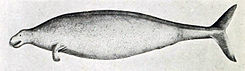
Steller's sea cow (extinct; sketch by Steller),
Locations
Groups
Topics
Commodoties
Subjects
Regions

Subregions
Related Events
Showing 10 events out of 1072 total
Years: 1768 - 1768
Steller's sea cow (extinct; sketch by Steller),
Locations
Groups
Topics
Commodoties
Subjects
Regions
Subregions