
Rembrand, seeking to emulate the baroque style …
Years: 1633 - 1633
Rembrand, seeking to emulate the baroque style of Rubens during his early years in Amsterdam (1632–1636), begins to paint dramatic biblical and mythological scenes in high contrast and of large format.
With the occasional help of assistants in Uylenburgh's workshop, he paints numerous portrait commissions both small (Jacob de Gheyn III) and large (Portrait of the Shipbuilder Jan Rijcksen and his Wife, 1633, Anatomy Lesson of Dr. Nicolaes Tulp, 1632).
In The Anatomy Lesson of Dr. Nicolaes Tulp, Dr. Nicolaes Tulp is pictured explaining the musculature of the arm to medical professionals.
The corpse is that of the criminal Aris Kindt, strangled earlier that day for armed robbery.
Some of the spectators are various doctors who paid commissions to be included in the painting.
The event can be dated to January 16, 1632: the Amsterdam Guild of Surgeons, of which Tulp is official City Anatomist, permits only one public dissection a year, and the body would have to be that of an executed criminal.
Anatomy lessons are a social event in the seventeenth century, taking place in lecture rooms that are actual theaters, with students, colleagues and the general public being permitted to attend on payment of an entrance fee.
The spectators are appropriately dressed for a solemn social occasion.
It is thought that, with the exception of the figures to the rear and left, these people were added to the picture later.
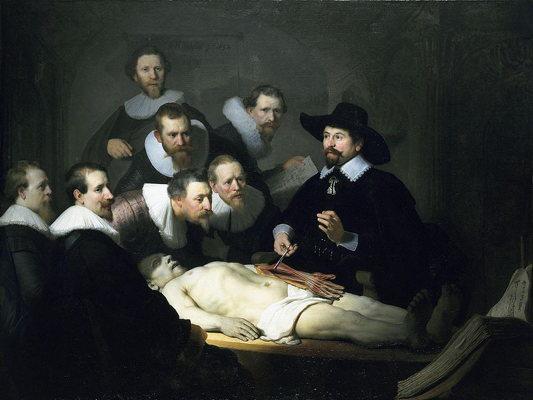
Rembrandt: The Anatomy Lesson of Dr. Nicolaes Tulp, 1632. Oil on canvas, Mauritshuis, The Hague.
Locations
People
Groups
Topics
Subjects
Regions
Subregions

Related Events
Showing 10 events out of 32511 total
Years: 1633 - 1633
Rembrandt: The Anatomy Lesson of Dr. Nicolaes Tulp, 1632. Oil on canvas, Mauritshuis, The Hague.
Locations
People
Groups
Topics
Subjects
Regions
Subregions