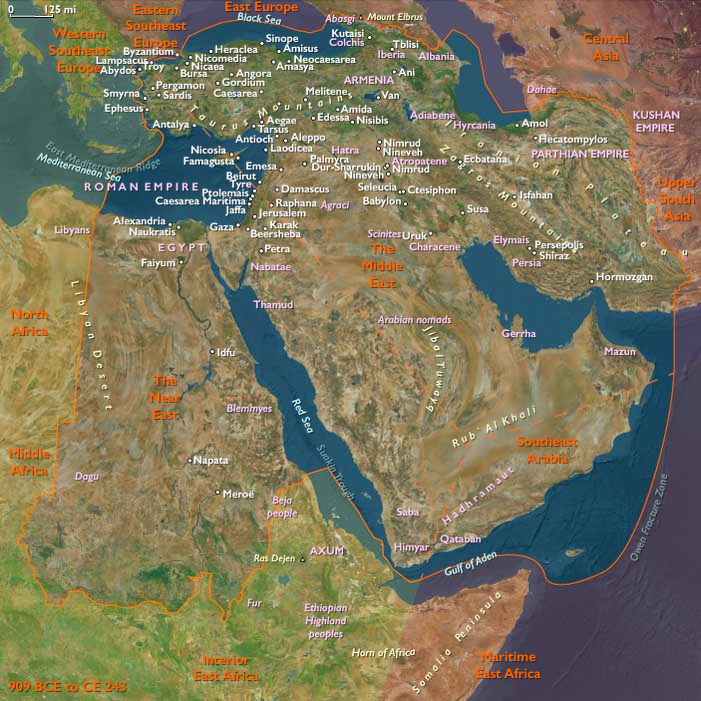
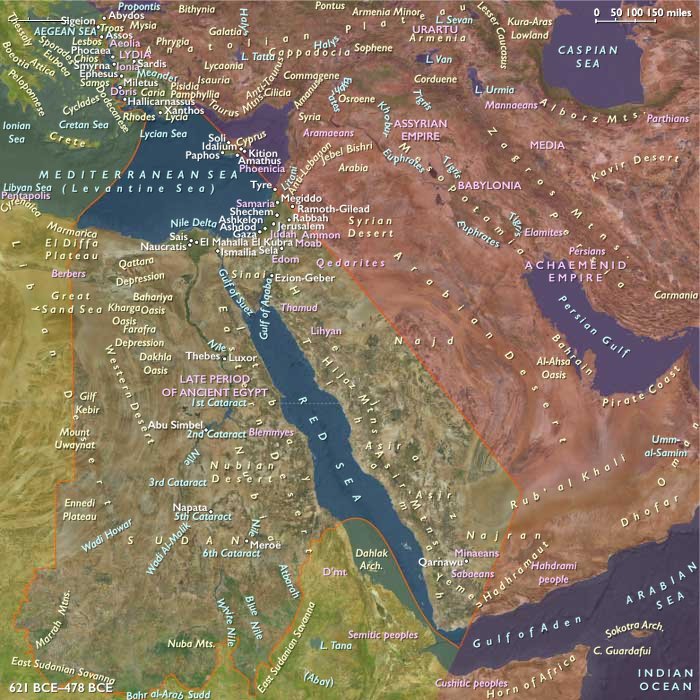
The Cypriot kings during Persian king Xerxes' …
Years: 480BCE - 480BCE
July
The Cypriot kings during Persian king Xerxes' invasion of Greece in 481-480 BCE, like the Ionian Greeks of coastal Anatolia, …
Locations
People
Groups
Topics
- Younger Subboreal Period
- Iron Age, Near and Middle East
- Iron Age Cold Epoch
- Classical antiquity
- Greco-Persian Wars, Early
- Artemisium, Battle of
- Persian Invasion of Greece, Second
- Thermopylae, Battle of
Commodoties
Subjects
Regions
Subregions
Related Events
Filter results
Showing 10 events out of 65583 total
The Ligurians called themselves Ambrones, according to Plutarch, but this does not necessarily indicate a relationship with the Ambrones of northern Europe.
Classical references and toponomastics suggest that the Ligurian sphere once extended further than the present boundary of Liguria.
Ligurian toponyms have been found in Sicily, the Rhône valley, Corsica and Sardinia.
Aeschylus represents Hercules as contending with the Ligures on the stony plains near the mouths of the Rhone, and Herodotus speaks of Ligures inhabiting the country above Massilia (modern Marseilles, founded by the Greeks).
Thucydides also speaks of the Ligures having expelled the Sicanians, an Iberian tribe, from the banks of the river Sicanus, in Iberia.
The Periplus of Pseudo-Scylax describes the Ligyes (Ligures) living along the Mediterranean coast from Antion (Antibes) as far as the mouth of the Rhone; then intermingled with the Iberians from the Rhone to Emporion in Spain.
Little is known of the Ligurian language.
Only place-names and personal names remain.
It appears to be an Indo-European branch with both Italic and particularly strong Celtic affinities.
Strabo tells us that they were of a different race from the Celts (by which he means Gauls) who inhabited the rest of the Alps, though they resembled them in their mode of life.
Lucan in his Pharsalia (around 61 CE) described Ligurian tribes as being long-haired, and their hair a shade of auburn (a reddish-brown): ...Ligurian tribes, now shorn, in ancient days First of the long-haired nations, on whose necks Once flowed the auburn locks in pride supreme.
The Ligurians are ignorant of their own origin.
In the nineteenth century, the Ligures' question got the attentions of not a few scholars.
Dominique-François-Louis Roget, Baron de Belloguet, claimed a "Gallic" origin.
Amédée Thierry, a French historian, linked them to the Iberians, while Karl Müllenhoff, professor of Germanic antiquities at the Universities of Kiel and Berlin, studying the sources of the Ora maritima by Avienus (a Latin poet who lived in the fourth century CE, but who used as source for his own work a Phoenician periplus of the sixth century BCE), held that the name Ligurians generically referred to various peoples who lived in Western Europe, including the Celts, but thought the real Ligurians were a Pre-Indo-European population.
Also favoring a Pre-Indo-European origin thesis were French historian Henri d'Arbois de Jubainville, who argued that the Ligurians, together with the Iberians, constituted the remains of the native population that had spread in Western Europe with the Cardium Pottery culture cardial ceramic, or related to the Bell Beaker folk; and Arturo Issel, a Genoese geologist and paleontologist, who considered them direct descendants of the Early European Modern Humans that lived throughout Gaul from the Mesolithic.
The Ligures seem to have been ready to engage as mercenary troops in the service of others; Ligurian auxiliaries are mentioned in the army of the Carthaginian general Hamilcar in 480 BCE.
Hamilcar, delayed by three years, leads a Carthaginian expedition to Sicily, which coincides with the expedition of Xerxes against mainland Greece in 480 BCE.
He is said to have assembled an army numbering three hundred thousand soldiers from Iberia, Sardinia, Corsica, Italy, Gaul and Africa under the command of a body of Carthaginian officers, along with war chariots, two hundred warships and three thousand transports for the venture.
Hamilcar had chosen not to sail to Selinus and then attack Akragas, although it lies on the coast closest to Carthage.
The Carthaginian fleet, escorted by sixty triremes, sails to Panormus instead.
Hamilcar has chosen this course probably because restoring Terrilus was his primary objective.
The conquest of Sicily, if this indeed is a consideration, takes second place to his duty as a guest friend of Terrilus.
The fleet is battered by storms at sea, losing the ships carrying the chariots and horses—which is to be a significant factor in the coming battle.
The Greek fleet, able to muster two hundred ships, does not contest the crossing; in fact, it will play no part in the coming battle.
Hamilcar spends three days reorganizing his forces at Panormus, and repairing his battered fleet.
The Carthaginians march along the Sicilian coast to Himera, with the fleet sailing alongside.
Situated on the western bank of the River Himera, the city sits atop a hill (three hundred to four hundred feet high) that is steep in the northern, western, and eastern sides but gradually slopes to the south.
There are hills to the west and south of the city.
The Carthaginians erect two camps, joined by siege works: the Sea camp is set to the north of Himera by the sea, surrounded by a palisade and a ditch.
The army is billeted in a separate camp to the south on a low hill west of Himera.
Theron is already present in Himera with his army, but the Greeks do not interfere with Carthaginian operations.
The Greek allies of Hamilcar (Greeks of Selinus and Anaxilas of Rhegion) are absent—and never join the battle.
It is not known if Hamilcar wished to build siege weapons at Himera or settle the issue through battle.
After the camps are erected, the Punic ships drop off provisions at the sea camp and are sent to Sardinia and Africa for more supplies.
Twenty triremes patrols the sea, the rest of the ships are beached in the sea camp.
Himera is not fully invested—the east and south sides were open.
Hamilcar leads a picked body of men on reconnaissance mission, and defeats the Greeks in a pitched battle outside Himera.
The Greeks block the west gates of Himera and their morale also falls, while the Carthaginian foragers range the territory of Himera.
Theron sends messages to Gelo, who arrives with his army and encamps across the river.
Gelon's cavalry manages to capture many of the foragers, as Hamilcar has no cavalry present to counter his moves.
The morale in Himera improves, and the bricked-up gates are cleared on Gelo's orders.
The different versions of the battle given by Herodotus and Diodorus Siculus are hard to reconcile; Diodorus provides a more detailed account.
Herodotus noted that Sicilian tradition held that this battle and the battle of Salamis were fought on the same day.
The Greek and Punic armies fight from dawn on through the day, while Hamilcar watches the battle from his camp and offers sacrifices to Baal in a huge fire.
Sometime after the battle is joined, disguised Greek horsemen kill Hamilcar while he is preparing the sacrifice, and then set fire to the beached ships, causing great confusion at the sea camp.
However, it is not known what further role the Greek cavalry played in the battle.
The Carthaginians rush to launch whatever ships they can save and some of the ships, overcrowded with soldiers, leave the site altogether.
When the news of Hamilcar's death and the burning of ships reaches the fighting armies, the Greeks press harder and rout the Carthaginians, who flee to their camp.
Gelo's army storms the Carthaginian camp and the Greeks scatter to loot the tents.
The Iberians of the Carthaginian army reform, then attack the now disordered Greeks, inflicting severe casualties.
The Greeks fight back, but they are hard pressed and the Iberians get the upper hand in the struggle.
At this critical juncture, Theron decides to join the battle.
He directs his attack on the flank and rear of the Iberian position inside the camp and also sets fire to tents near them.
The Iberians finally give way, and retreat to the ships still afloat.
Other Carthaginian survivors leave the camp and retreat to a hill inland, where they attempt to defend themselves.
The hill is waterless and they are ultimately forced to surrender.
About half of the Carthaginian army and majority of the fleet is destroyed, with numerous prisoners and rich booty falling into Greek hands.
Diodorus commented that the surviving Carthaginian ships were sunk in a storm on their return journey to Africa.
Ten thousand mass graves from the era show over two hundred thousand Greek dead, buried ten to fifteen per grave on the site).
The army had no siege engines and the Etruscans and the Elymians, allies in past struggles against Greeks, were not part of it.

…contribute infantry and naval contingents to the Achaemenid forces.
The ancient Greek city of Amphipolis was founded near the entrance of the Strymon River to the Aegean, at the site previously known as Ennea Odoi (Nine roads).
When Xerxes I of Persia crosses the river during his invasion in 480 BCE, he buries alive nine young boys and nine maidens as a sacrifice to the river god.
The huge Achaemenid army is at first successful, conquering Thessaly; …
…the Persian host then moves south into the Balkan peninsula in August, using the one and a half-mile- (two point four kilometer-) long canal dug through the isthmus of Áyion Óros (Mount Athos) on the orders of Xerxes, who thereby avoids taking his fleet around the treacherous cape.
The Persians sack and burn several sanctuaries in the northeast corner of Phocis, including the temple of the oracle of Apollo at Abae, which was one of those consulted by the Lydian king Croesus.
A force of two hundred and seventy-one ships under Themistocles awaits the Persian navy at Artemisium.
Themistocles, serving under a Spartan admiral (since Corinth and Aegina will not serve under an Athenian), conducts the main fleet to the narrow straits north of Euboea.
At sea, a detachment of two hundred Persian ships attempts to surprise the Greek fleet, but the Greeks, forewarned, engage the main Persian navy in an inconclusive battle.
Rounding Euboea, the Persian ships approach en masse down a coast with few beaches, and that night a typical north Aegean storm destroys the Persian squadron while the Greeks are safely in port, inflicting losses that probably, in the end, prove decisive.
The strategic and narrow pass of Thermopylae lies between Mount Oeta and the Gulf of Malia's southern shore on the route from Thessaly to Locris.
Its name, meaning “hot gates,” is derived from its hot sulfur springs.
The Spartans have sent their king Leonidas to Thermopylae with a force of four thousand Peloponnesians, including three hundred full Spartan citizens and perhaps a helot contingent as well.
Mycenae, now an independent Dorian city-state, dispatches a contingent to help the Spartans.
Some three thousand central Greeks, including Boeotians from Thespiae and Thebes, join the Peloponnesians.
Leonidas surely knows that the Greeks cannot hold the pass indefinitely, but he also knows that an oracle has said that Sparta will be devastated unless one of its kings is killed.
For three days, Leonidas withstands attacks by the Persians.
However, on the second night, a Greek traitor guides the best Persian troops around the pass behind the Greek army.
Leonidas then orders most of his Peloponnesian and central Greek troops to retreat to the safety of the south, and he and his three hundred Spartans, together with their helots, and eleven hundred Thespian and Theban Boeotians, fight to the last man.
Although the Persians win at Thermopylae, they suffer considerable losses in the battle.
This episode makes a deep impression on the Greek imagination and gives rise to the legend that Spartans never surrender.
Sparta's single-minded dedication to rule by a militarized oligarchy precludes any hope of a political unification of classical Greece, but it performs a great service by its heroic stand at Thermopylae and its subsequent leadership in the Greco-Persian wars.
Years: 480BCE - 480BCE
July
Locations
People
Groups
Topics
- Younger Subboreal Period
- Iron Age, Near and Middle East
- Iron Age Cold Epoch
- Classical antiquity
- Greco-Persian Wars, Early
- Artemisium, Battle of
- Persian Invasion of Greece, Second
- Thermopylae, Battle of