
Filters:
The Assassination of Louis of Orléans and …
Years: 1407 - 1407
The Assassination of Louis of Orléans and the Outbreak of the Armagnac-Burgundian Civil War (1407–1477)
On November 23, 1407, Louis, Duke of Orléans, was brutally assassinated in the streets of Paris, a murder orchestrated by his rival, John the Fearless, Duke of Burgundy. This political killing triggered a civil war between the House of Orléans (later the Armagnacs) and the House of Burgundy, a conflict that would destabilize France for decades and only conclude with the death of John’s grandson, Charles the Bold, in 1477.
I. The Rivalry Between John the Fearless and Louis of Orléans
- The power struggle between John the Fearless and Louis of Orléans escalated as both men vied for control over the French government, taking advantage of King Charles VI’s recurring bouts of insanity.
- After a series of kidnappings and recoveries of the Dauphin, John managed to have himself officially appointed as guardian of the king’s children, further straining relations with Louis.
- The two rivals soon exchanged open threats, as John’s influence over the royal court grew, particularly in Paris, where he had secured the loyalty of the University and the merchants.
II. The Assassination of Louis of Orléans (November 23, 1407)
- On the night of November 23, 1407, Louis of Orléans was attacked by fifteen men on the Rue Vieille du Temple in Paris.
- His arms were literally severed, leaving him defenseless before being killed.
- No one doubted that the order had come from John the Fearless, who boldly took responsibility for the murder.
III. Justification and Political Gain for Burgundy
- Rather than concealing his crime, John publicly justified the assassination.
- He secured the support of the Parisian population and the University of Paris, promising to reintroduce ordinances similar to the Great Ordinance of 1357, which had previously limited royal power in favor of noble and urban governance.
- John commissioned the Sorbonne theologian Jean Petit to write an elegy in praise of tyrannicide, effectively framing the assassination as a righteous act against an alleged "tyrant."
IV. The Outbreak of the Armagnac-Burgundian Civil War (1407–1435)
- The murder of Louis of Orléans plunged France into a bloody civil war between:
- The Burgundians, led by John the Fearless, supported by Parisian merchants and scholars.
- The Orléanists, later known as the Armagnacs, led by Charles, Duke of Orléans (Louis’ son) and supported by the Valois royal family and southern nobility.
- After escaping Paris and engaging in several skirmishes, John was able to reconcile with King Charles VI, but the rivalry between Burgundy and the French royal family deepened.
V. The Long-Term Consequences: Seventy Years of Division
- The Armagnac-Burgundian conflict weakened France, allowing English forces to expand their control during the Hundred Years’ War.
- The feud did not fully end until 1477, with the death of John’s grandson, Charles the Bold, Duke of Burgundy, and the absorption of most of Burgundy’s territories into the French Crown.
The assassination of Louis of Orléans in 1407 was the catalyst for a civil war that divided France for seven decades, shaping French politics and the Hundred Years' War, and ultimately leading to the downfall of the independent Duchy of Burgundy in 1477.
Locations
People
Groups
Topics
Commodoties
Subjects
Regions
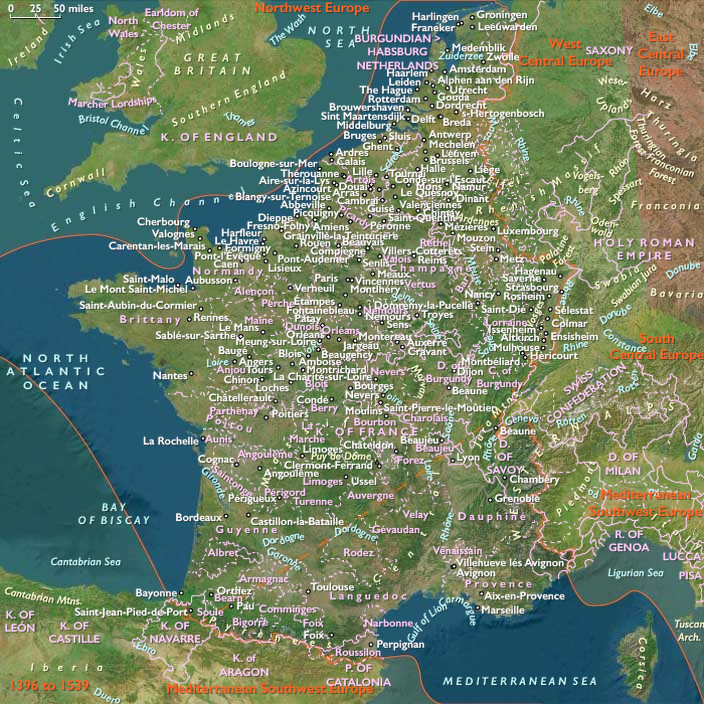
Subregions
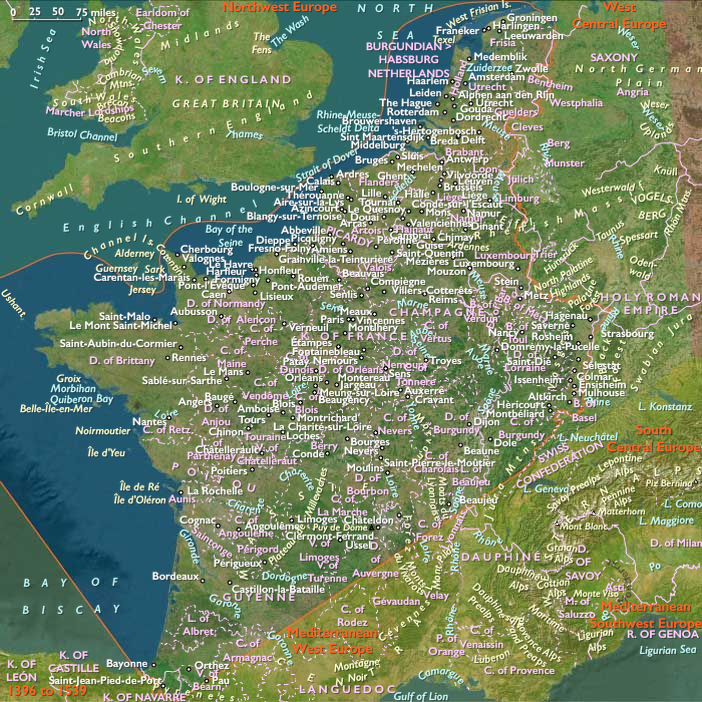
Years: 1407 - 1407
Locations
People
Groups
Topics
Commodoties
Subjects
Regions
Subregions