Duke Amadeus VIII of Savoy retires after …
Years: 1434 - 1434
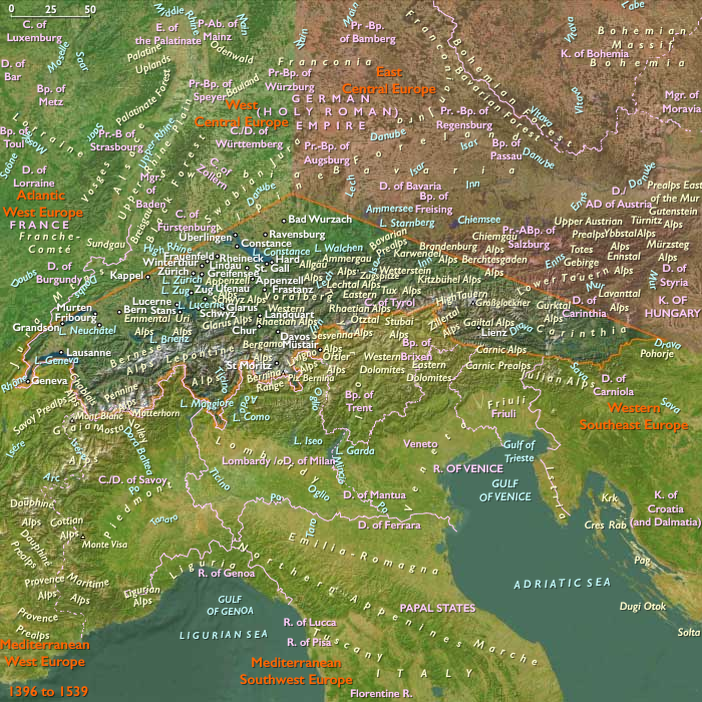
Duke Amadeus VIII of Savoy retires after forty-two years on the throne to a monastery at Ripaille, near Geneva, in 1434.
His retirement is only partial, however, and he continues to exercise power, with his son Louis (Ludovico) acting as his lieutenant.
During this period Amadeus' daughter Margherita is betrothed to Louis III of Anjou, pretender to the throne of Naples.
When Louis dies suddenly in 1434, Amadeus briefly claims Naples for Margherita but in the end abandons the kingdom to Alfonso V of Aragon.
Locations
People
Groups
Subjects
Regions
Subregions
Related Events
Filter results
Showing 10 events out of 10 total
Henry VII’s Campaign and the Siege of Boulogne (1490–1492)
By 1490, King Henry VII of England saw his diplomatic efforts to protect English interests in Brittany frustrated by the shifting political landscape, especially France’s assertive move to annex the duchy and Spain’s secret diplomatic rapprochement with the French crown. Faced with diminishing options and the failure of diplomatic channels, Henry turned to military force in an attempt to pressure France into concessions, launching an invasion of northern France.
Background: Diplomatic Frustration and Breton Crisis
Henry VII’s primary objective was to prevent French domination of Brittany, maintaining it as an independent buffer against French expansion across the Channel. However, his strategy had unraveled following the Treaty of Laval (1491), in which the Breton duchess, Anne, succumbed to French pressure and married King Charles VIII, thus bringing Brittany directly under French control. Henry’s diplomatic isolation was compounded when Ferdinand II of Aragon, previously an ally against France, entered into secret negotiations with Charles VIII.
English Military Intervention: Siege of Boulogne (1491–1492)
In response to this diplomatic setback, Henry mobilized a substantial English expeditionary force in late 1490, personally sailing across the Channel to invade French territory. By 1491, Henry had laid siege to Boulogne, a fortified and strategically significant port city, intending to apply military pressure on Charles VIII and secure a stronger bargaining position.
The siege was part of a larger, calculated strategy: Henry hoped that direct military pressure would force Charles VIII into concessions, thereby reasserting English influence on the continent. However, the siege was plagued by logistical challenges, insufficient supplies, and limited support from Henry’s continental allies, especially after Spain’s diplomatic realignment.
Diplomatic Resolution: Treaty of Étaples (1492)
The English siege of Boulogne, despite demonstrating England’s willingness to employ military force, did not yield immediate strategic gains. Ultimately, facing domestic pressures, military expenses, and the impending winter, Henry negotiated a settlement. The resulting Treaty of Étaples (November 1492) ended hostilities, with Charles VIII agreeing to pay a substantial financial compensation—known as the "French pension"—in exchange for Henry’s withdrawal from France.
While the treaty did not restore Brittany’s independence, it provided Henry VII with financial security and diplomatic recognition, satisfying immediate political and fiscal objectives. This compromise underscored the pragmatic nature of Henry’s foreign policy.
Long-Term Historical Significance
The Siege of Boulogne (1491–1492) and subsequent Treaty of Étaples highlighted both the limitations and adaptability of English diplomacy under Henry VII. Although Henry failed to preserve Brittany’s independence, his actions secured a financially advantageous peace, which supported his broader goal of stabilizing the Tudor regime and consolidating royal authority domestically.
Furthermore, the episode clarified the shifting nature of European alliances, with Spain’s secret diplomacy marking a new era of competitive statecraft. It also foreshadowed England’s future continental engagements, which oscillated between ambitious intervention and cautious diplomacy over the ensuing centuries.
In essence, Henry VII’s campaign at Boulogne represented a critical moment in late medieval geopolitics in Atlantic West Europe, illustrating the challenges of balancing military ambition, diplomatic reality, and economic prudence at a pivotal moment in the early history of Tudor England.

Henry had meanwhile ordered Suffolk to attack Boulogne, crossing on July 14 to Calais and moving to join him.
The Siege of Boulogne begins on July 19—despite the protests of the Emperor, who insists that Henry should advance towards Paris.
Henry, meanwhile, is personally directing the besiegers at Boulogne; the town falls in early September, and a breach is made into the castle on September 11.
The defenders finally surrender a few days later.
Charles, short on funds and needing to deal with increasing religious unrest in Germany, asks Henry to continue his invasion or to allow him to make a separate peace.
By the time Henry has received the Emperor's letter, however, Charles has already concluded a treaty with Francis—...
Henry himself returns to England at the end of September 1544, ordering Norfolk and Suffolk to defend Boulogne.
...the Dauphin, left unopposed, concentrates his efforts on besieging Boulogne.
Francis now embarks on a more dramatic attempt to force Henry's hand—an attack on England itself.
For this venture, an army of more than thirty thousand men is assembled in Normandy, and a fleet of some four hundred vessels prepares at Le Havre, all under the command of Claude d'Annebault.
A French expeditionary force had landed in Scotland on May 31, 1545.
The English under John Dudley, Viscount Lisle, had mounted an attack on the French fleet in early July, t, but had little success due to poor weather; nevertheless, the French had suffered from a string of accidents: d'Annebault's first flagship had burned, and his second had run aground.
Finally leaving Le Havre on July 16, the massive French fleet had entered the Solent on July 19 and briefly engaged the English fleet, to no apparent effect; the major casualty of the skirmish, the Mary Rose, sank accidentally.
The French had landed on the Isle of Wight on July 21, and again at Seaford on July 25, but these operations were abortive, and the French fleet had soon returned to blockading Boulogne.
D'Annebault makes a final sortie near Beachy Head on August 15, but retires to port after a brief skirmish.
The war is a virtual stalemate by September 1545; both sides, running low on funds and troops, unsuccessfully seek help from the German Protestants.
Henry, Francis, and Charles attempt extensive diplomatic maneuvering to break the deadlock; but none of the three trusts the others, and this has little practical effect.
Henry II, anxious to regain control of Boulogne from England despite the treaty of 1546, had declared war in 1549 after a series of military and naval maneuvers in the Boulogne area calculated to harass the English.
In a combination of actions on sea and land, including the bribing of England’s German mercenaries, the French have encircled the city, but prove unable to reduce it.
France instead buys it back in early 1550 from a war-weary England, whose last two wars with France have driven the royal exchequer into debt.
Napoleon had set up a camp at Boulogne-sur-Mer to prepare for an invasion of Britain after Great Britain broke the Peace of Amiens and declared war on France in May 1803.
By 1805, Britain has convinced Austria and Russia to join a Third Coalition against France.
Napoleon has assembled an invasion force, called the Armée d'Angleterre (Army of England) around six camps at Boulogne.He intends to use this invasion force to strike at England, and is so confident of success that he has commemorative medals struck to celebrate the conquest of the English.
Napoleon knows the French fleet cannot defeat the Royal Navy in a head-to-head battle and plans to lure it away from the English Channel.
The French Navy would escape from the British blockades of Toulon and Brest and threaten to attack the West Indies, thus drawing off the British defense of the Western Approaches, in the hope a Franco-Spanish fleet could take control of the channel long enough for French armies to cross from Boulogne and invade England.
However, after defeat at the naval Battle of Cape Finisterre in July 1805 and Admiral Villeneuve's retreat to Cadiz, invasion will never again be a realistic option for Napoleon.Although they never invade, Napoleon's troops receive careful and invaluable training for any possible military operation.
Boredom among the troops occasionally set in, but Napoleon pays many visits and conducted lavish parades in order to boost morale.
He also orders his soldiers to be vaccinated.
The men at Boulogne formed the core for what Napoleon will later call La Grande Armée.
At the start, this French army has about two hundred thousand men organized into seven corps, which are large field units that contain thirty-six to forty cannon each and are capable of independent action until other corps can come to the rescue.
A single corps (properly situated in a strong defensive position) can survive at least a day without support, giving the Grande Armée countless strategic and tactical options on every campaign.
In addition to these forces, Napoleon has created a cavalry reserve of twenty-two thousand organized into two cuirassier divisions, four mounted dragoon divisions, one division of dismounted dragoons and one of light cavalry, all supported by twenty-four artillery pieces.
By 1805, the Grande Armée has grown to a force of three hundred and fifty thousand men, who sre well equipped, well trained, and led by competent officers.
The Allied leaders will attend Peace Celebrations in England before progressing to the Congress of Vienna (between September 1814 and June 1815), which will be held to redraw the map of Europe.