
Duilius meets Hannibal Gisco off northern Mylae …
Years: 260BCE - 260BCE
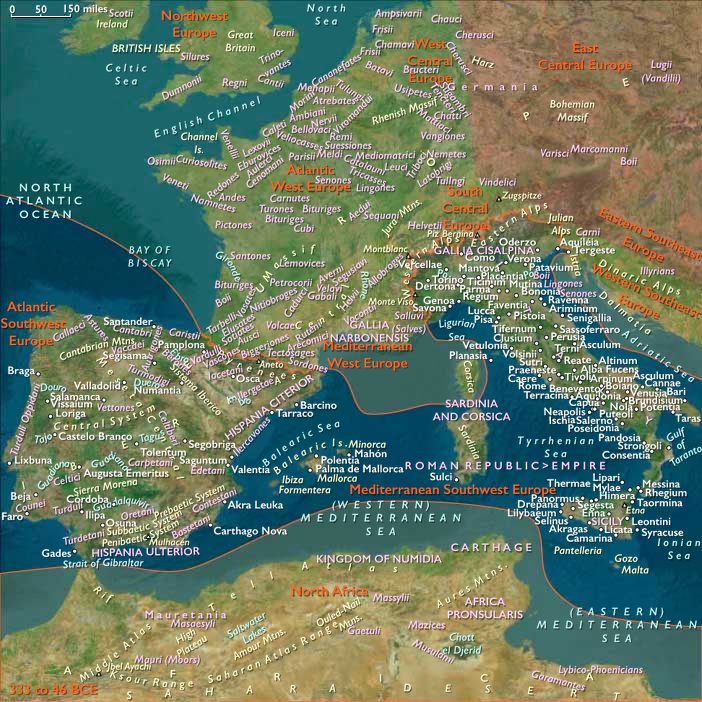
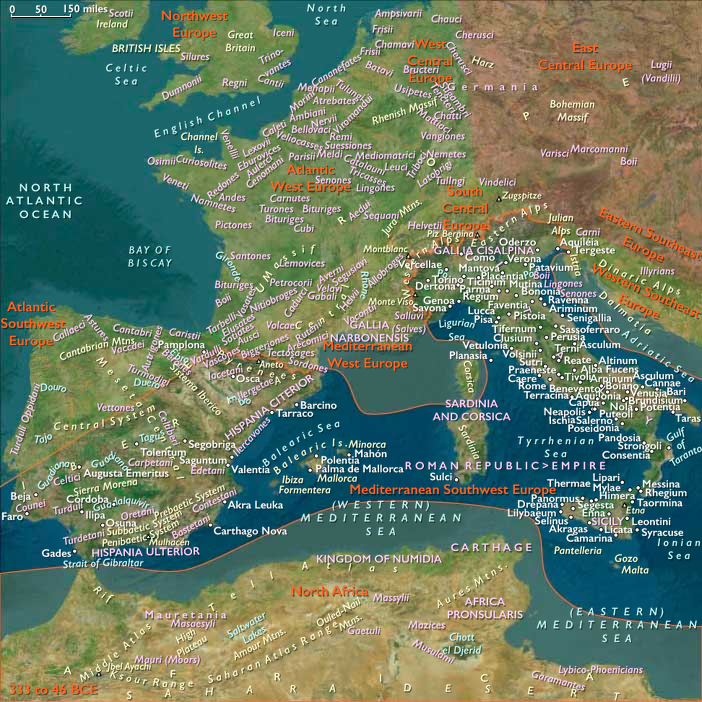
Duilius meets Hannibal Gisco off northern Mylae in 260.
Confident in Carthage's superiority at sea, Gisco deploys his ships for the Battle of Mylae in the traditional long line arrangement.
Polybius states that the Carthaginians had one hundred and thirty ships, but does not give an exact figure for the Romans.
The loss of seventeen ships at the Lipari Islands from a starting total of one hundred and twenty ships suggests that Rome had one hundred and three remaining.
However, it is possible that this number was larger than one hundred and three, thanks to captured ships and the assistance of Roman allies.
The Carthaginians anticipate victory, especially because of their superior experience at sea.
The corvus tactics are very successful, and help the Romans seize the first thirty Carthaginian ships that get close enough.
In order to avoid the corvus, the Carthaginians are forced to navigate around them and approach the Romans from behind, or from the side.
The corvus is usually still able to pivot and grapple most oncoming ships.
Once an additional twenty of the Carthaginian ships have been hooked and lost to the Romans, Hannibal retreats with his surviving ships, leaving Duilius with a clear victory.
The new weapon, having proved its worth in the Battle of Mylae, the first Roman naval victory, will continue to do so in the following years, especially in the huge Battle of Cape Ecnomus.
The addition of the corvus forces Carthage to review its military tactics, and since the city has difficulty in doing so, Rome has the naval advantage, mainly due to the innovative use of land tactics in naval warfare.
Instead of following the remaining Carthaginians at sea, …
Locations
People
Groups
- Sicily, classical
- Carthage, Kingdom of
- Segesta, (Elymian-Ionian Greek) city-state of
- Syracuse, Corinthian city-state of
- Camerina (Dorian Greek) city-state of
- Akragas (Dorian Greek) city-state of
- Roman Republic
Topics
Commodoties
Subjects
Regions
Subregions
Years: 260BCE - 260BCE
Locations
People
Groups
- Sicily, classical
- Carthage, Kingdom of
- Segesta, (Elymian-Ionian Greek) city-state of
- Syracuse, Corinthian city-state of
- Camerina (Dorian Greek) city-state of
- Akragas (Dorian Greek) city-state of
- Roman Republic
Topics
Commodoties
Subjects
Regions
Subregions