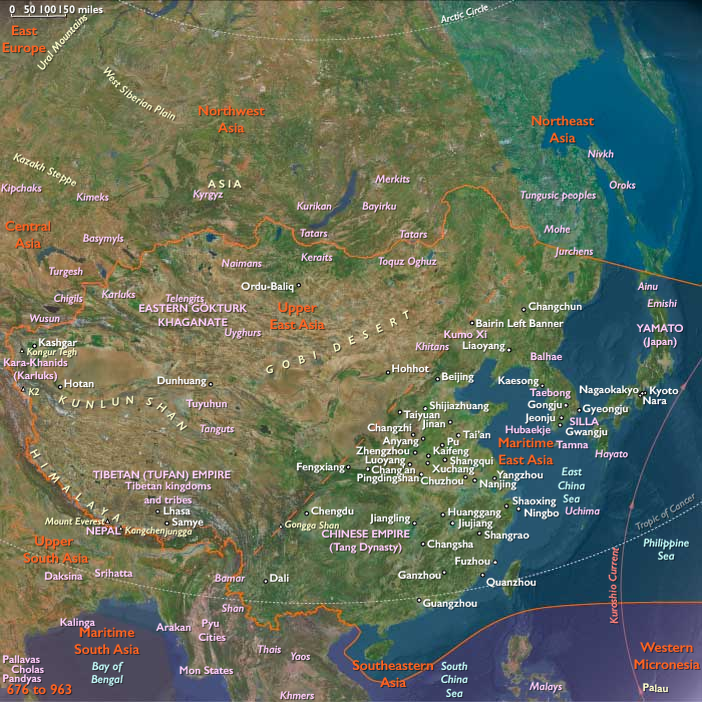
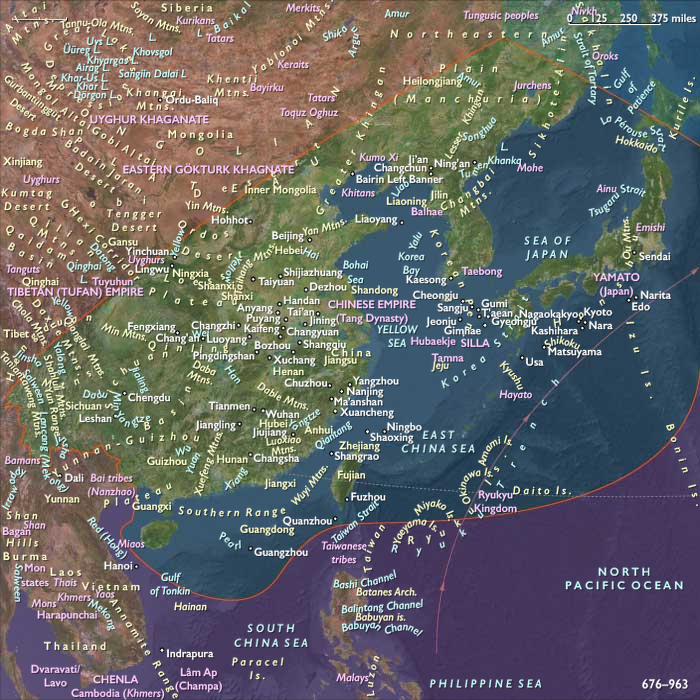
Duan Chengshi is best known outside of …
Years: 863 - 863
Duan Chengshi is best known outside of China for being the author of an early version of Cinderella, called Ye Xian.
The story had first appeared 853 in Miscellaneous Morsels from Youyang, which was published shortly after he returned to Chang'an after his term of acting Governor of Jizhou (now known as Ji'an in Jiangsu).
It is believed that it was a folktale told by peasants before it was recorded on paper.
Some people even believe that the French author Charles Perrault copied Duan's version, renaming it and slightly altering it.
Duan is also known for describing in his written work of 863 the slave trade, ivory trade, and ambergris trade of Bobali, which is now Berbera in Somalia, East Africa.
Locations
People
Groups
Commodoties
Subjects
Regions
Subregions
Related Events
Filter results
Showing 10 events out of 54025 total
Michael (presumably through the Patriarch) sends a group of clerics, headed by Constantine and Methodius, who had learned the South Slav dialects spoken in their native region, to Moravia in 863, where they teach and celebrate the liturgy in the Slavic vernacular, now known as Old Church Slavonic.
Negotiations have taken place between Bulgarian khan Boris and Photios on the status of the Bulgarian diocese but have not lead to the result expected by the Bulgarians.
The Greeks demand that the Bulgarian church organization should be entirely subjected to Constantinople.
A dissatisfied Boris renews his diplomatic contacts with the West.
Photios had soon come into conflict with Pope Nicholas, who continues to refuse to recognize Photios as patriarch of Constantinople because his predecessor had been illegally deposed.
Nicholas, eager both to extend the growing power of the papacy over the empire and interested in the jurisdiction over the Bulgarians, who Photios has converted, in 863 orders the reinstatement of Ignatios.
The conflict, purely administrative at the beginning, acquires doctrinal undertones when Frankish missionaries in Bulgaria, acting as the pope's emissaries, begin to introduce an interpolated text of the Nicene Creed.
In the original text, the Holy Spirit was said to have proceeded "from the Father," whereas in Carolingian Europe (but not yet in Rome) the text has been revised to say "from the Father and the Son" (“filioque”).
Because Michael refuses to depose Photios, a schism with Rome results.
When Nicholas anathematizes and deposes Photios, the latter replies with a counter-excommunication.
Charles of Provence has never ruled his realm in anything more but name.
It is Gerard, rather than he, who in 858 arranged that should Charles die without children, Provence would revert to Charles' brother Lothair II.
When Charles dies in 863, however, his other brother Emperor Louis II also claims Provence, and the realm is divided between the two: Lothair receives the bishoprics of Lyon, Vienne and Grenoble, to be governed by Gerard; Louis II receives Arles, Aix and Embrun.
The Destruction of Dorestad (863): The End of a Major Frankish Trade Hub
By 863, the once-prosperous Carolingian trading hub of Dorestad, located in present-day the Netherlands, meets its final destruction. The city's downfall is the result of Viking control, economic decline, and political instability, culminating in an uprising by its merchants against the Viking ruler Rorik.
Dorestad’s Decline and Viking Domination
- Dorestad had been one of the most important trading centers in Northwestern Europe, linking the North Sea trade routes to the Rhine and the Frankish interior.
- The city had already suffered multiple Viking raids since the 830s, leading to its gradual economic deterioration.
- In 850, Emperor Lothair I granted Dorestad to Rorik, a Danish Viking leader, in an attempt to stabilize the region by integrating the Norse rulers into the Frankish political framework.
The Merchant Revolt and the Final Destruction (863)
- By 863, the merchants of Dorestad, weary of Viking rule, refuse to submit to Rorik, likely rejecting his demands for tribute or resisting Viking domination over trade.
- In response, Rorik and his forces destroy the city, ensuring that it is never rebuilt.
- The final destruction of Dorestad signals the complete collapse of its commercial power.
Consequences of Dorestad’s Fall
- Trade Shifts Elsewhere → With Dorestad in ruins, commercial activity moves to other Frankish river ports, particularly Quentovic, Ghent, and Tiel.
- Frankish Vulnerability to Viking Expansion → The inability to defend Dorestad highlights Carolingian weakness in the Low Countries, further encouraging Norse settlements and attacks.
- Permanent Viking Presence in Frisia → Rorik remains in control of Frisian territories, consolidating Viking rule in the region.
The destruction of Dorestad in 863 marks the definitive end of one of the Carolingian Empire’s greatest trading centers, a victim of both Viking aggression and shifting economic patterns. With its fall, the political and economic landscape of the Low Countries is permanently altered, paving the way for new trade centers and increased Norse influence in the region.
Umar strikes again in the summer of 863, joining forces with the Abbasid general Ja'far ibn Dinar al-Khayyat (probably the governor of Tarsus) for a successful raid into Cappadocia.
The Arabs cross he Cilician Gates into imperial territory, plundering as they go, until they reach a place near Tyana.
Here, the Tarsian army returns home, but Umar obtains Ja'far's leave to press on into Asia Minor.
Umar's forces represen the bulk of his emirate's strength, but their size is unknown: the contemporary Muslim historian Ya'qubi claims that Umar had eight thousand men at his disposal, while the Byzantine historians Genesius and Theophanes Continuatus inflate the numbers of the Arab army to forty thousand men.
The Byzantinist John Haldon considers the former number to be closer to reality, and estimates the size of the combined Arab force at fifteen to twenty thousand men.
It is likely that a Paulician contingent under Karbeas was present as well.
Emperor Michael III had assembled an imperial army to counter the Arab raid, and meets them at a battle in an area called Marj al-Usquf ("Bishop's Meadow") by Arab sources, a highland near Malakopeia, north of Nazianzus.
The battle is bloody with many casualties on both sides; according to the Persian historian al-Tabari, only a thousand of Umar's army survived.
Nevertheless, ...
…the Arabs manage to escape the imperial forces and continue their raid north into the Armeniac Theme, eventually reaching the Black Sea and capturing and sacking the port city of Amisos.
The Byzantine historians report that Umar, enraged at the sea blocking his advance, ordered it to be lashed, but this is most likely inspired by the similar account of Xerxes during the Persian Wars.
Umar plunders the regions of Paphlagonia and Galatia, then withdraws his forces toward the Anti-Taurus Mountains.
Michael, immediately upon learning of the fall of Amisos, had ordered a huge force to be assembled (al-Tabari gives its size at fifty thousand men) under his uncle Petronas, the Domestic of the Schools, and Nasar, the stratēgos of the Bucellarian Theme.
Al-Tabari records that the Emperor himself assumed command of these forces, but this is not supported by Byzantine sources.
Given the bias against Michael by the historians writing during the Macedonian dynasty, this may be a deliberate omission.
The forces assembled come from all over the Empire.
Three separate armies are formed and converge on the Arabs: a northern force composed of the forces from the Black Sea themes of the Armeniacs, Bucellarians, Koloneia and Paphlagonia; a southern force, probably the one that had already fought at the Bishop's Meadow and had kept shadowing the Arab army, composed from the Anatolic, Opsician and Cappadocian themes, as well as the kleisourai (frontier districts) of Seleukeia and Charsianon; and the western force, under Petronas himself, comprising the men of the Macedonian, Thracian and Thracesian themes and of the imperial tagmata from the capital.
The coordination of all these forces is not easy, but the imperial armies, marching from three directions, are able to converge on the same day (September 2) and surround Umar's smaller army at a location called Poson or Porson near the Lalakaon River.
The exact location of the river and the battle site have not been identified, but most scholars agree that they lay near the river Halys, some one hundred and thirty kilometers (eighty-one miles) southeast of Amisos.
With the approach of the imperial armies, the only open escape route left to the Emir and his men is dominated by a strategically located hill.
During the night, both Arabs and Greeks endeavor to occupy it, but the imperial forces emerge victorious from the ensuing fight.
On the next day, September 3, Umar decides to throw his entire force towards the west, where Petronas is located, attempting to achieve a breakthrough.
The imperial troop stand firm, though, giving the other two imperial wings time to close in and attack the Arab army's exposed rear and flanks.
The rout is complete, as the larger part of the Arab army falls on the field, including Umar himself.
Casualties possibly included the Paulician leader Karbeas: although the latter's participation in the battle is uncertain, it is recorded that he died in that year.
Only the Emir's son, at the head of a small force, manages to escape the battlefield, fleeing south towards the border area of Charsianon.
He is, however, pursued by Machairas, the kleisourarchēs of Charsianon, and is defeated and captured with many of his men.

The importance of Constantinople’s victories of 863 does not go unnoticed at the time: the Empire’s citizens hail them as revenge for the sack of Amorium twenty-five years earlier, the victorious generals are granted a triumphal entry into Constantinople, and special celebrations and services ware held.
Petronas is awarded the high court title of magistros, and the kleisoura of Charsianon is raised to a full theme.