
Du Fu departs for Chengdu, where he …
Years: 759 - 759
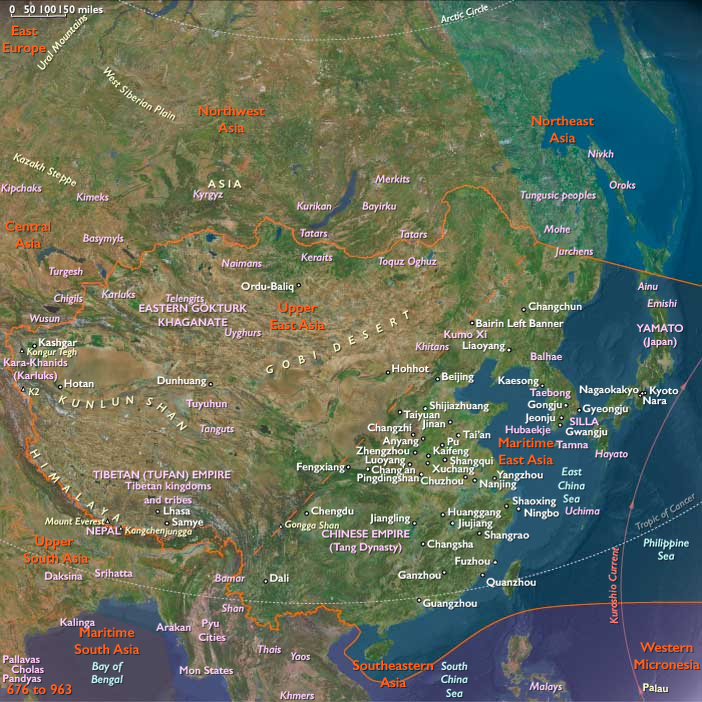
Du Fu departs for Chengdu, where he is hosted by fellow poet Pei Di.
Locations
People
Groups
Topics
Commodoties
Subjects
Regions
Subregions

Related Events
Filter results
Showing 10 events out of 55185 total
The Ōtomo clan are warriors and bureaucrats in the Yamato Court, and Otomo no Yakamochi serves as a provincial governor in several provinces.
Like his grandfather and father before him, Yakamochi is a well-known politician.
He had met Udoneri in 738, and in 740 at the behest of Emperor Shōmu had gone to Kyushu Daisaifu to suppress the rebellion of Fujiwara no Hirotsugu.
He had became a jogoika in 745.
In July of the following year, he became governor of Etchu Province, a post he lasted in until 751.
By this time he was already the author of 220 waka.
Promoted to shonagon in 751, he had returned to the capital.
He had had been appointed military commander in 755, and the following year had concerned himself with the garrison at Namba, a time that is described in the Sakimori Songs Collection in the Man'yoshu, the first Japanese poetry anthology, Yakamochi is one of the compilers of Man'yoshu, for which he has not only written several poems but also transcribed, rewrote, and refashioned an unknown number of ancient poems and folklore.
He is the most prolific and prominent writer of his time, and has a great influence on the Shika Wakashu as well.
Constantine V invades Bulgaria again in 759, but this time his enormous army is ambushed in the mountain passes of the Stara Planina (battle of the Rishki Pass) and completely defeated.
The Byzantine historian Theophanes the Confessor wrote that the Bulgarians killed the strategos of Thrace, Leo the commander of Drama, and many soldiers.
Khan Vinekh does not take the favorable opportunity to advance on enemy territory and sues for peace.
This act is very unpopular among the nobles and the Khan will be murdered in 762.
Khurshid was born in 734/735, the son of Dadhburzmihr or Dadmihr (died 740) and grandson of Farrukhan the Great (died around 728), the first ruler (ispahbadh) of the Dabuyid dynasty from whose reign coins are known.
According to the traditional account, the Dabuyids had established themselves as the quasi-independent rulers of Tabaristan in the 640s, during the tumults of the Muslim conquest of Persia and the collapse of the Sassanid Empire.
They owed only the payment tribute and nominal vassalage to the Arab Caliphate, and managed, despite repeated Muslim attempts at invasion, to maintain their autonomy by exploiting the inaccessible terrain of their country.
A more recent interpretation of the sources by P. Pourshariati, however, supports that Farrukhan was the one who actually established the family's rule over Tabaristan, sometime in the 670s.
Khurshid of Tabaristan had succeeded his father at the age of only six, and for eight years the regency had been exercised by his uncle Farrukhan-i Kuchak ("Farrukhan the Little").
When Khurshid came of age, Farrukhan's own sons had refused to recognize his claim and tried to usurp the throne.
Their plot was allegedly betrayed to Khurshid by an enslaved girl, Varmja Haraviya.
With the help of the sons of his cousin Jushnas, Khurshid had managed to defeat and imprison Farrukhan's sons and later took Varmja Haraviya as his wife, while the sons of Jushnas were given high positions in the state.
The historian Ibn Isfandiyar gives a vivid description of the prosperity of Tabaristan at this time, which is a major center for textile production (including silk), and which trades with the Turks of Central Asia, probably via the Caspian Sea.
Khurshid is said to have contributed to this prosperity by building numerous bazaars and caravanserais.
Khurshid has also tried to consolidate and even extend his royal power, and had used the turmoil within the Umayyad Caliphate during the Third Islamic Civil War to this effect, rebelling against Caliph Marwan II (r. 744–750), and even sending an embassy to the Tang court in 746, which recognized him ("king Hu-lu-ban") as a vassal prince.
During the Abbasid Revolution, however, he had been forced to submit to the Abbasid armies under Abu Muslim.
As one of Abu Muslim's vassals, he had supported the latter in his quarrel with the Caliph al-Mansur.
After the Caliph had Abu Muslim murdered in 755, Khurshid had supported the anti-Abbasid rebellion of Sunbadh, who had entrusted part of Abu Muslim's treasure to Khurshid's keeping.
When Sunbadh's revolt was defeated, Sunbadh had fled to Tabaristan, but had been killed there by one of Khurshid's cousins, ostensibly because he had failed to show the man proper respect.
It is possible, however, that the murder was instigated by Khurshid, in the hope of acquiring the remainder of Abu Muslim's treasure.
Al-Mansur sends his son and heir, al-Mahdi, to recover the treasure of Abu Muslim.
Khurshid denies having it, and al-Mansur tries to unseat Khurshid by crowning one of his cousins as ispahbadh.
This did not have the desired effect of challenging the loyalty of Khurshid's subjects, but Khurshid had eventually been forced to accommodate the Abbasids by accepting an increase in the annual tribute, which brought it to the level paid to the Sassanids.
Soon after, nevertheless, Khurshid takes advantage of the rebellion of Abd al-Jabar ibn Abd al-Rahman, the governor of Khurasan, to once again throw off allegiance to the Caliphate.
Al-Mansur sends an army into Tabaristan, with the intention of completely subduing the country and making it a province.
Khurshid flees to the fortress of al-Tak in the mountains, where he is besieged in 759–760.
Although Khurshid himself escapes to nearby Daylam, the fortress eventually falls, and with it his family falls into the hands of the Abbasids and brought to Kufa.
The Frankish king and the Septimanian counts had gone on to invest Narbonne, the main Umayyad stronghold in Septimania, but do not manage to capture it from Iberian Muslims until seven years later in 759, only after Pepin promised the defenders of the city to uphold the Gothic law, and the county is granted to Miló, the Gothic count in Muslim times, thus earning the loyalty of Septimania's Goths against Waifer of Aquitaine.
Al-Andalus is sealed off at the Pyrenees.
Charters dating from the first two years of Offa's reign show the Hwiccan kings as reguli, or kinglets, under his authority; and it is likely that he was also quick to gain control over the Magonsæte, for whom there is no record after 740 of an independent rule.
Offa was probably able to exert control over the kingdom of Lindsey at an early date, as it appears that the independent dynasty of Lindsey had disappeared by this time.
These efforts had stopped short of making Buddhism the state religion, but Nara Buddhism has heightened the status of the imperial family.
Buddhist influence at court increased under the two reigns of Shomu's daughter.
As Empress Koken from 749 to 758, she brings many Buddhist priests into court.
Koken abdicates in 758 on the advice of her cousin, Fujiwara Nakamaro.
When the retired empress comes to favor a Buddhist faith healer named Dokyo, Nakamaro rises up in arms in 764 but is quickly crushed.
Koken charges the ruling emperor with colluding with Nakamaro, and has him deposed and reascends the throne as Empress Shotoku from 764 to 770.
It is at this point that she commissions the printing of one million prayer charms, many examples of which survive, and which are known as the earliest printing in the world until an earlier example dating 751 will be discovered in Korea in 1966.
Shotoku has the charms printed to placate the Buddhist clergy.
She may even have wanted to make Dokyo emperor, but she dies before she can act.
Her actions shock Nara society and lead to the exclusion of women from imperial succession and the removal of Buddhist priests from positions of political authority.
The An Lushan rebellion spans the reigns of three Tang emperors before it is quashed, and involves a wide range of regional powers; besides the Tang dynasty loyalists, others involved are anti-Tang families, especially in An Lushan's base area in Hebei, and Arab, Gökturk, and Sogdian forces or influences, among others.
The rebellion and subsequent disorder result in a huge loss of life and large-scale destruction.
It significantly weakens the Tang dynasty, and leads to the loss of the Western Regions.
An Lushan’s rebellion ends on February 17, 763, when Yan falls (although the effects last past this).
This event is also known (especially in Chinese historiography) as the An–Shi Rebellion or An–Shi Disturbances, as it had continued after An Lushan's death under his son An Qingxu and his deputy and successor Shi Siming, or as the Tianbao Rebellion, as it began in the fourteenth year of that era.
East Central Europe (760–771 CE): Bavarian and Saxon Dominance, Emerging Slavic States, and the Eve of Carolingian Influence
Between 760 and 771 CE, East Central Europe—encompassing Poland, Czechia, Slovakia, Hungary, and those portions of Germany and Austria lying east of 10°E and north of a line stretching from roughly 48.2°N at 10°E southeastward to the Austro-Slovenian border near 46.7°N, 15.4°E—experienced further consolidation of Bavarian and Saxon influence, continued political and economic stabilization among Slavic communities, and sustained internal coherence within the Avar Khaganate. Thuringia remained effectively independent of diminishing Merovingian power, setting the regional stage for the transformative emergence of Carolingian power to the west.
Political and Military Developments
Bavarian Consolidation over Carantania
-
The Duchy of Bavaria solidified its protectorate over the Slavic principality of Carantania, further embedding the region within Bavarian political and cultural influence and reinforcing the strategic divide between southern Slavs and their northern and eastern kin.
Sustained Saxon Power
-
Saxon dominance remained firmly established east of the Elbe River, maintaining influential control over eastern Germany and extending political, economic, and cultural influence into western Poland and northern Czechia.
Early Slavic State Formation
-
Principalities in Bohemia and Moravia matured significantly, further clarifying territorial boundaries, administrative structures, and defensive systems, laying foundational structures for medieval statehood.
Continued Autonomy in Thuringia
-
Thuringian dukes preserved their political autonomy, reinforcing the ongoing decentralization and decline of Merovingian royal authority.
Diplomatic Stability of the Avar Khaganate
-
The Avars retained internal political stability and carefully managed diplomatic relations with neighboring Bavarian, Saxon, and Slavic territories, maintaining regional equilibrium.
Economic and Technological Developments
Flourishing Regional Economy
-
Prosperous trade networks continued connecting Bavarian, Saxon, Slavic, Thuringian, Avar, and Frankish territories, exchanging agricultural produce, metals, textiles, luxury items, and crafts.
Expansion of Fortifications and Infrastructure
-
Saxon, Slavic, Bavarian, and Avar communities expanded and refined their fortified settlements, reflecting stable governance, economic prosperity, population growth, and advanced technological capabilities.
Cultural and Artistic Developments
Germanic Cultural Expansion
-
Bavarian and Saxon cultural traditions further permeated Slavic regions, significantly shaping artistic styles, pottery, metalwork, burial practices, and jewelry throughout the area.
Continued Development of Slavic Regional Identities
-
Bohemian, Moravian, and Carantanian Slavic groups deepened their distinct regional identities, archaeologically visible in differentiated ceramics, settlement patterns, and material culture.
Avar Artistic Continuity
-
Avar cultural and artistic traditions remained influential, particularly evident in sophisticated metalworking techniques, jewelry designs, and equestrian accessories.
Settlement and Urban Development
Saxon and Bavarian Territorial Integration
-
Saxon and Bavarian territories expanded settlement networks, developing fortified urban centers and economically productive rural communities, solidifying regional stability.
Slavic Urban and Administrative Growth
-
Bohemian, Moravian, and Carantanian urban centers grew increasingly prominent, reflecting stable political leadership, economic prosperity, and demographic growth.
Continued Stability in Thuringia
-
Thuringian communities maintained their economic vitality and regional political stability, benefiting from sustained peaceful trade and minimal external pressures.
Social and Religious Developments
Solidified Germanic Leadership Structures
-
Bavarian and Saxon societies reinforced hierarchical structures under powerful warrior aristocracies, ensuring cohesive regional governance and military effectiveness.
Centralization of Slavic Authority
-
Slavic communities in Bohemia, Moravia, and Carantania continued centralizing political authority, enhancing governance, defense, and regional integration.
Continued Stability of Avar Society
-
Avar societal organization remained cohesive, effectively managed by a stable hierarchy and strong leadership, maintaining internal stability and diplomatic effectiveness.
Long-Term Consequences and Historical Significance
The era 760–771 CE further entrenched key political and cultural structures that would shape East Central Europe's medieval future. Bavarian and Saxon dominance, Slavic state formation, persistent Thuringian independence, and ongoing Avar stability created the conditions for the transformative developments soon to emerge with the rise of the Carolingian Empire. These dynamics fundamentally influenced the region's long-term historical trajectory.
Eastern Southeast Europe (760–771 CE): Emergence of the Serbian Principality
Settlement and Migration Patterns
Establishment of the Serbian Principality
Around 768 CE, the Serbs established a principality in the northeastern region of modern Serbia, within Eastern Southeast Europe. This political formation marked the beginning of Serbia's increasing influence and strategic significance in regional politics, laying foundational elements for its subsequent historical role.
Stability Amid Bulgarian Turmoil
Between 760 and 771 CE, Eastern Southeast Europe maintained demographic stability despite political disruptions within the neighboring Bulgarian state. Regional populations, including previously relocated communities, continued consolidating their presence and reinforcing territorial security.
Political and Military Developments
Serbian Political Consolidation
The newly established Serbian principality gradually gained regional prominence, becoming an important political and military actor that would play a critical role in later regional dynamics, particularly in interactions with the Byzantine and Bulgarian empires.
Bulgarian Political Instability
Bulgarian power significantly faltered during this era, characterized by the assassination of one khan, swiftly followed by another, and the rapid, successive elections of two more khans. This political instability within Bulgaria led directly to a period of peace lasting five years between Bulgaria and the Byzantine Empire.
Imperial Advantage
The turmoil in Bulgaria provided the Byzantine Empire an opportunity to consolidate its territorial and military gains without immediate threats from the north. This period of peace enabled further strengthening of defensive and administrative systems within the empire.
Economic and Technological Developments
Economic Consolidation
Economic conditions continued to benefit from prolonged peace and stability, fostering growth in trade and agricultural productivity. The absence of Bulgarian military threats further secured economic routes and resource allocations.
Continued Defensive Enhancements
Defensive infrastructure and fortifications, particularly along critical frontier regions, were maintained and improved. These strategic preparations reinforced regional security during this peaceful interval.
Cultural and Artistic Developments
Sustained Cultural Flourishing
Cultural and artistic activities thrived due to the stability afforded by the temporary cessation of northern military threats. This allowed further investments in religious and cultural institutions, enhancing regional identity and artistic expression.
Intellectual Resilience
Educational and scholarly institutions continued to preserve classical and theological knowledge, ensuring cultural and intellectual continuity. This period of relative peace enabled scholarly communities to expand their activities further.
Social and Religious Developments
Strengthening of Eastern Orthodox Identity
Eastern Orthodoxy's role within society remained robust, continuously shaping communal cohesion and cultural identity. Religious institutions continued to support societal stability, especially during this brief respite from external pressures.
Persistent Iconoclast Debate
The ongoing Iconoclast controversy continued to shape social and religious discourse. Despite political and military stability, theological tensions persisted, influencing interactions within religious communities and the broader society.
Long-Term Consequences and Historical Significance
The period from 760 to 771 CE was marked by significant political instability within Bulgaria, providing a valuable strategic respite for the Byzantine Empire and witnessing the establishment of the Serbian principality. These developments significantly influenced regional political dynamics, laying important foundations for future historical trajectories in Eastern Southeast Europe.
Bulgarian power falters as first one khan is assassinated, then another, followed by the successive elections of two more khans, resulting in a five-year peace with Constantinople.
Years: 759 - 759
Locations
People
Groups
Topics
Commodoties
Subjects
Regions
Subregions