Du Fu, a precocious child and the …
Years: 744 - 744
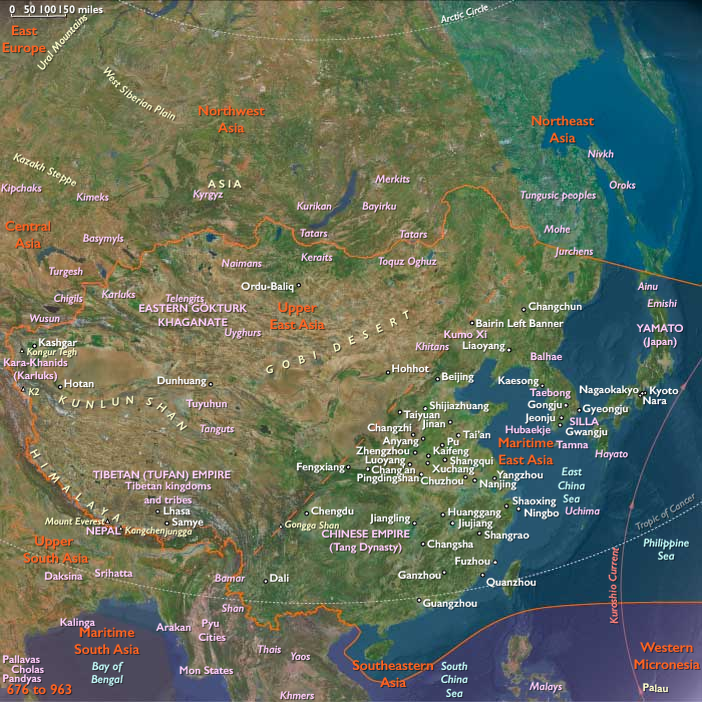
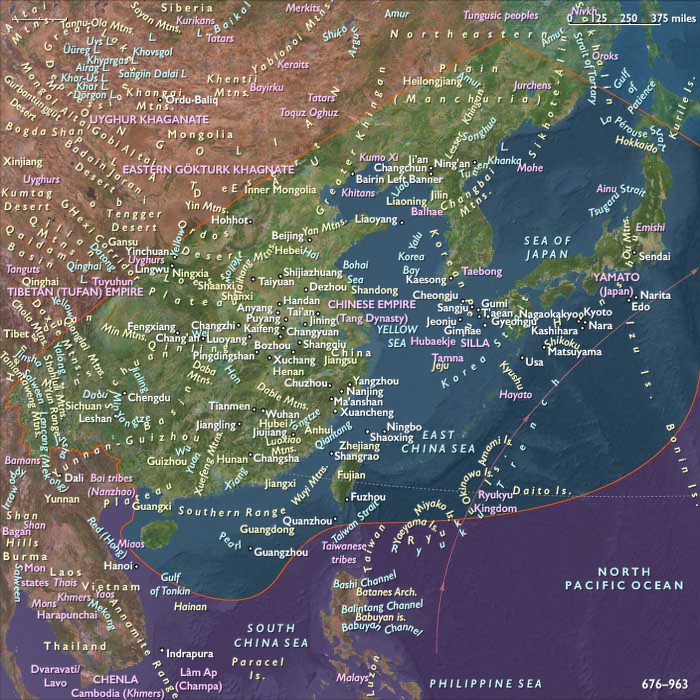
Du Fu, a precocious child and the son of a scholar-official who traces his ancestry back to the third-century Confucian scholar Du Yu (Tu Yu), had failed his government examinations in 736, but, following a second unsuccessful attempt to secure a career as a scholar-official, had been able to secure a minor post in the Tang government.
An aspiring poet, Du Fu meets Li Bai in 744 and is deeply influenced by the older poet.
Locations
People
Groups
Subjects
Regions
Subregions
Related Events
Filter results
Showing 10 events out of 55369 total
The nomadic Uyghurs—speakers of a southeast Turkic variety of the Ural-Altaic language family; light-skinned, relatively tall people with brown hair, brown or lighter eye-color, and aquiline noses, who originated on the Mongol steppes during the sixth century CE.
When Kul Bilge Qaghan of the Uyghurs allied himself with the Karluks and Basmyls, the power of the Göktürks had been very much on the wane.
Kutluk seizes Ötükän in 744 and beheads the last Göktürk khagan Ozmysh Qaghan, whose head is sent to the Tang Dynasty Chinese court.
The Uyghurs in a space of a few years have gained mastery of Inner Asia and established the Uyghur Khaganate to become the absolute rulers of Mongolia.
The death of the Umayyad Caliph Hishām in 743 provokes a rebellion in the east after he is succeeded by Al-Walid II, the son of Yazid II.
Al-Walid is reported to have been more interested in earthly pleasures than in religion, a reputation that may be confirmed by the decoration of the so-called "desert palaces" (including Qusayr Amra and Khirbat al-Mafjar, aka Hisham's Palace) that have been attributed to him.
Walid, jealous of Sulayman's popularity, had had him flogged and imprisoned, an act which has aroused considerable opposition and cost Walid much of the initial good will that he had enjoyed at his accession.
He had quickly attracted the enmity of many, both by executing a number of those who had opposed his accession, and by persecuting the Qadariyya, a theological movement in early Islam which holds that man was endowed by God with free will.
Qadariyya resists the Umayyad Caliphs' claims to be ordained rulers of all Muslims by God himself.
Yazid has spoken out against the "immorality" of his cousin, Caliph al-Walid, which includes discrimination on behalf of the Banu Qays Arabs against Yemenis and non-Arab Muslims.
Yazid receives further support from the Qadariya and Murji'iya (believers in human free will).
Yazid slips into Damascus and deposes Walid in a coup in spring 744, following this up with a disbursement of funds from the treasury.
His army tracks down and kills al-Walid II.
The Arabs of the region around Homs, still loyal to Walid, rise up and march on Damascus with the intention of installing as caliph a descendant of the Sufyanid branch of the Umayyad clan, Abu Muhammad al-Sufyani, but Sulayman is released from prison and defeats them.
Yazid III has received a certain reputation for piety, and may have been sympathetic to the Qadariyya.
After a mere six months into his reign, he falls ill of a brain tumor and dies on October 3 or 4, 744.
Yazid had named his brother Ibrahim as his successor.
The powerful and ambitious governor of northern Mesopotamia (Jazira), Marwan ibn Muhammad, the grandson of Marwan I, had decided to oppose Yazid III, and even though he had later given allegiance to Yazid, on the early death of that caliph, Marwan had continued his own ambitions.
Ibrahim only rules for a short time in 744 before he abdicates, and goes into hiding out of fear of his political opponents.
Initially, Marwan does not claim the caliphate for himself, but proclaims his intention to restore the throne to the two imprisoned sons of Walid II.
Marwan's advance is met south of Baalbek by Sulayman with the Dhakwāniyya, his personal army, 5,000 or more strong, maintained from his own funds and estates but recruited mostly from the mawālī (non-Arab Muslims).
In the ensuing battle, Marwan is victorious.
Sulayman retreats to Damascus, where he orders the execution of Walid II's sons, and then flees, together with Ibrahim, to Palmyra.
Marwan, supported mostly by the Qasi of the Jazira and northern Syria, leads an army from the northern frontier and enters Damascus in December 744, where he is proclaimed caliph.
Soon, Ibrahim and Sulayman come before Marwan and surrender themselves.
Ibrahim, having requested and been granted Marwan's assurance of personal safety, travels with Marwan to former Caliph Hisham's residence at Rusafah in Syria.
Marwan immediately moves the capital north to …

…Harran, in present-day Turkey.
The Syrian junds are allocated a third of the tax revenues collected in their regions, and given responsibilities of tax-collection and military service to the Andalusian governor.
The arrival of the Syrian junds is to have tremendous implications for subsequent Spanish history.
They increase substantially the Arab element on the Iberian peninsula, and, as such, are instrumental in deepening the Muslim hold on the south, what will become the heart of al-Andalus, but they also bring trouble.
Unwilling to be governed, the Syrian junds will carry on an existence of autonomous feudal anarchy, severely destabilizing the power of the governor of al-Andalus.
Lombard law and administration in the mid-eighth century reflects both Roman and Germanic influences.
Many of the Lombards have converted from Arianism to Roman Catholicism during Liutprand's reign.
By the time of King Liutprand’s death in 744, the Lombards have accepted, in addition to orthodox Christianity, many elements of Roman culture, including the Latin language.
Hildeprand, a son or a grandson of Liutprand, begins his reign in his own right in January 744, but is deposed by a great council after a few months for his incompetence.
He is dead by August.
Ratchis, Duke of Friuli, whose father was Duke Pemmo and whose Roman wife is Tassia, becomes king.
His brother Aistulf succeeds him in Friuli.
The rebel Berber alliance had dissolved in the aftermath of the defeat near al-Kairouan.
Even before this denouement, the Barghawatas, as founders of the revolt, had grown resentful of the attempt by later adherents, notably the Zenata chieftains, in alliance with the increasingly authoritarian Sufri commissars, to take control of the leadership of the rebellion.
As their primary objective—the liberation of their people from Umayyad rule—had already been achieved, and there is little prospect of it ever being re-imposed, the Barghwata saw little point in continued military campaigns.
In CE 742 or 743, the Barghwata had removed themselves from the rebel alliance, and retreated to the Tamesna region, on the Atlantic coast of Morocco, where they establish their new independent state and abandon their Sufri Kharijitism.
The Synod of Soissons (744): Boniface Strengthens Church Authority
The Synod of Soissons, convened at the instigation of Pepin the Short, marks a significant step in the reformation of the Frankish Church. Presided over by Boniface, the Pope’s chief missionary to pagan Germany, the council seeks to enforce ecclesiastical discipline and eliminate teachings considered heretical or unorthodox.
At the synod, Boniface secures the condemnation of Frankish bishop Adalbert and Irish missionary Clement, both of whom had been spreading teachings deemed incompatible with orthodox Christian doctrine. Their condemnation aligns with Boniface’s broader efforts to standardize Christian practice in the Frankish world, reinforcing the authority of the Roman Church and eliminating religious movements that threaten ecclesiastical unity.
This synod is part of Boniface’s larger mission, supported by Pepin and Pope Zachary, to bring the Frankish Church under tighter control, ensuring it remains aligned with papal directives rather than fragmented by regional variations and competing influences.
Hunald of Aquitaine and the Frankish Campaigns (736–742)
Hunald, Duke of Aquitaine, had long resisted Frankish supremacy, refusing to recognize the high authority of Charles Martel. In response, Charles marched south of the Loire, seizing Bordeaux and Blaye in a show of force. However, rather than fully annexing Aquitaine, Charles ultimately allowed Hunald to retain his duchy, on the condition that he pledge fealty to the Frankish ruler.
From 736 to 741, relations between Charles and Hunald remained relatively amicable, with Aquitaine functioning as a vassal duchy under Frankish suzerainty.
The Revolt of Hunald After Charles’s Death (741)
Following Charles Martel’s death in 741, Hunald saw an opportunity to reassert Aquitanian independence. Breaking his oath of fealty, he declared war on the Franks, forming an alliance with the Basques, traditional enemies of Frankish expansion in the southwest.
In response, Charles’s successors, Pepin the Short and Carloman, led a punitive expedition across the Loire, determined to bring Aquitaine back under Frankish control. Their forces:
- Ransacked Berry and laid waste to the outskirts of Bourges, ...
...
- Destroyed the castle of Loches, a key defensive stronghold, and
- Took all its inhabitants prisoner, further demonstrating their military dominance.
Despite these efforts, the Aquitanian conflict would persist, requiring continued Frankish intervention over the next decade. The struggle between Aquitaine and the Franks remains a significant challenge to Carolingian consolidation, highlighting the ongoing resistance of regional powers against centralized rule.