
Dresden's Baroque Frauenkirche has been built between …
Years: 1743 - 1743
Dresden's Baroque Frauenkirche has been built between 1726 and 1743, designed by Dresden's city architect, George Bähr, who had not lived to see the completion of his greatest work.
Bähr's distinctive design for the church has captured the new spirit of the Protestant liturgy by placing the altar, pulpit, and baptismal font directly centered in view of the entire congregation.
Famed organ maker Gottfried Silbermann in 1736 had built a three-pedal, forty-three-stop instrument for the church.
The organ was dedicated on November 25 and Johann Sebastian Bach had given a recital on the instrument on 1 December.
The church's most distinctive feature is its unconventional ninety-six meter-high dome, called die Steinerne Glocke or "Stone Bell".
An engineering feat comparable to Michelangelo's dome for St. Peter's Basilica in Rome, the Frauenkirche's twelve thousand-ton sandstone dome stands high, resting on eight slender supports.
Dresden’s first Kirche zu unser liuben Vrouwen had been built in the eleventh century in romanesque style, outside the city walls and surrounded by a grave yard.
The Frauenkirche had been the seat of an archbishop in the Meißen Diocese until the Reformation, when it had become a Protestant church.
This first Frauenkirche had been torn down in 1727 and replaced by a new church due to the need for increased capacity.
The modern Frauenkirche is built by the citizenry as a Lutheran (Protestant) parish church.
Even though Saxony's Prince-elector, Frederick August I, had reconverted to Roman Catholicism to become King of Poland, he had supported the construction so that the Dresden townscape would feature an impressive cupola.
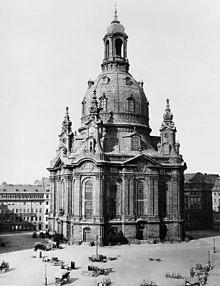
Frauenkirche (Church of Our Lady), 1880
Locations
People
Groups
Topics
Subjects
Regions
Subregions
Years: 1743 - 1743
Frauenkirche (Church of Our Lady), 1880
Locations
People
Groups
Topics
Subjects
Regions
Subregions